Bagarius vegrandis
Last revised 2026Edit this page
On this page7 sections
Quick factsEdit
Difficulty1 of 8 measures
Not enough data to rate
- Space
- large tank
- Water
- unknown
- Temp
- unknown
- Diet
- unknown
- Temperament
- unknown
- Social
- unknown
- Compatibility
- unknown
Other demands
Each of these can raise the rating on its own, whatever the measures above say.
- Hardiness
- unknown
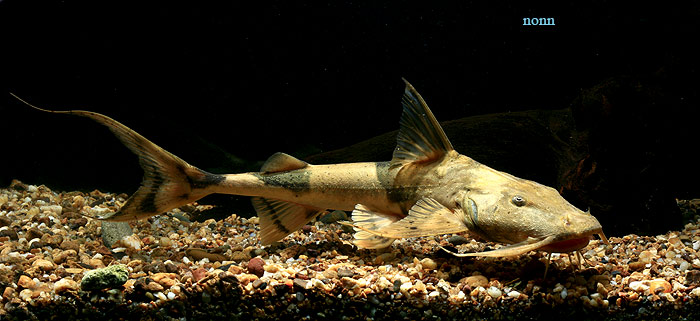
Bagarius vegrandis is a small sisorid catfish from the Chao Phraya and Mekong drainages in Thailand, Laos and Cambodia. Described by Ng & Kottelat in 2021, it grows to about 22 cm SL, much smaller than any other Bagarius. Most records of B. bagarius from Indochina refer to it. It lives in rapids and rocky pools of large and medium-sized rivers.
Etymology
EditBagarius: from 'Vaghari', a local name in Calcutta (Kolkata).
vegrandis: from the Latin vegrandis, meaning 'little' or 'diminutive', in reference to its small size compared with other Bagarius.
Distribution
EditHabitat
Write a noteEditAdults live in rapids and rocky pools of large and medium-sized rivers (FishBase).
Diet
Write a noteEditIn the wild it preys on smaller fishes. In the aquarium it takes cockles, mussels, whole prawns, dead fish and earthworms (ScotCat).
Behaviour and compatibility
Write a noteEditBest kept alone, because it eats any tankmate small enough to fit in its mouth (ScotCat).
Notes
EditNg & Kottelat (2021) described it in the same paper that restricted B. bagarius to the Indian subcontinent. FishBase treats earlier records of B. bagarius from Indochina as this species.
It differs from the other Bagarius in its much smaller maximum size, about 22 cm SL against 52 to 140 cm SL, and in having the adipose-fin origin well behind the anal-fin origin (Ng & Kottelat, 2021).
The large Bagarius of the same rivers is B. lica, and B. suchus also occurs in the Chao Phraya and Mekong.
It is fished for food, but its meat spoils quickly and can cause illness (FishBase).
The genus Bagarius is distinguished from all other genera in the family Sisoridae by having markedly heterodont teeth in the lower jaw. Teeth are present in two or three outer rows of relatively numerous, close-set conical teeth, and one or two inner rows of less numerous, widely separated, and much larger conical teeth (vs. dentition of the lower jaw consisting of only small conical teeth, or a roughened bony plate).
Species images · 2
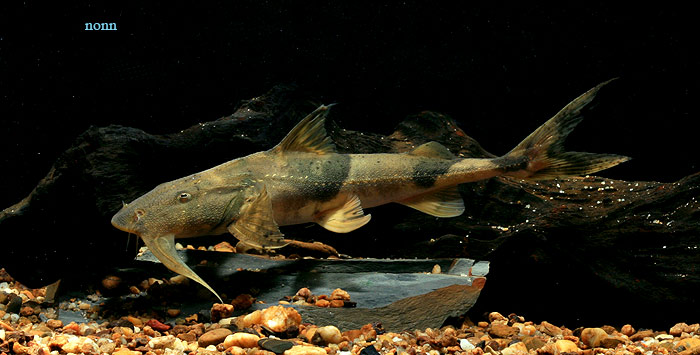
These photographs are used with each photographer's permission.
Send a photographDistribution
Profile completeness11 of 24
Contributors
Written by a contributor
Community
Questions about Bagarius vegrandis?
Ask on Discord