Benthochromis tricoti
Formerly Haplotaxodon tricoti Poll, 1948
Last revised 2012Edit this page
On this page13 sections
Quick factsEdit
Difficulty6 of 8 measures
- Space
- very large tank
- Water
- flexible
- Temp
- needs a steady temperature
- Diet
- unknown
- Temperament
- peaceful
- Social
- needs to be in a group
- Compatibility
- choose tankmates carefully
Other demands
Each of these can raise the rating on its own, whatever the measures above say.
- Hardiness
- unknown
- Needs a very large tank
Before you buy
Needs a tight-fitting lid as this species is known to jump
Keep the tank well-covered, as it's a powerful swimmer that can jump when excited.
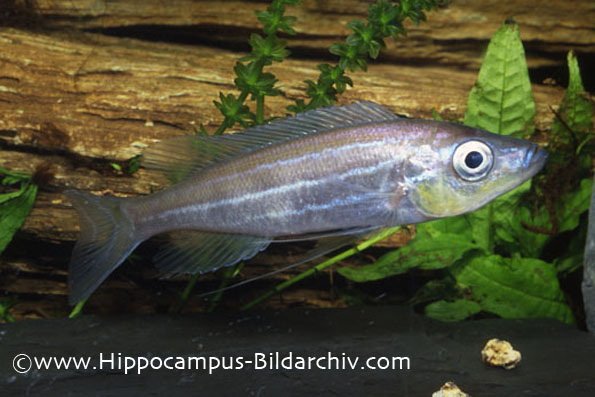
Benthochromis tricoti is a deep-water cichlid endemic to Lake Tanganyika, where it lives in open water and feeds on zooplankton. The species is seldom seen in the hobby as it is difficult to collect and ship, and the similar B. horii, described in 2008, had been confused with it and traded under its name. It needs a long tank with the upper two thirds left clear for swimming, and calm tankmates.
Etymology
EditBenthochromis: from the Greek benthos, meaning 'depth', and chromis, a name the ancient Greeks used for a fish.
tricoti: in honour of M. Tricot, director of the Great Lakes Railroad Company at Albertville (now Kalemie), for his help to the Belgian Hydrobiological Mission to Lake Tanganyika of 1946-1947. The mission collected the type.[6]
Distribution
EditHabitat
Write a noteEditA fish of open water over the deeper parts of the lake, away from the rocky shoreline. The type specimens were trawled at 100-125 m, and most museum specimens with a recorded depth were caught at 40-85 m.
Little else has been published on its habitat, and we have no reliable data on where in the water column it spawns.[1]
Aquarium size
Write a noteEditA tank measuring 150 ∗ 60 ∗ 60 cm60 ∗ 24 ∗ 24 in (~540 litres~143 US gal) is the minimum for a group of this species.
Maintenance
Write a noteEditIt swims in open water, mostly in the upper half of the tank, and doesn't use rocks or caves the way many Tanganyikan cichlids do. Leave at least the upper two thirds of the tank clear, as the fish need the swimming space and can injure their large eyes on sharp rockwork if startled.
A few low piles of rock along the bottom are fine for looks, or for tankmates that need them. Use fine sand as the substrate and keep the lighting subdued, since this is a fish of deep, dim water. Some water movement is also recommended.
Keep the tank well-covered, as it's a powerful swimmer that can jump when excited.
Water conditions
EditTemperature: 24 – 27 °C75 – 81 °F
pH: 7.5 – 9.0
Hardness: 10 – 25 dGH
These recommendations come from this profile’s own figures. They contain affiliate links, so we may earn a commission.
Diet
Write a noteEditIn the lake it feeds on zooplankton, mainly small crustaceans (Konings, 1988).
It has a small mouth, so small live and frozen foods such as Artemia, Mysis and Cyclops should form the staple diet. Supplement these with a good-quality dried food that includes some vegetable matter, such as a Spirulina flake, and feed small amounts several times a day so it gets its share.[3]
Behaviour and compatibility
Write a noteEditPeaceful, and easily stressed by boisterous tankmates such as Tropheus or the Malawian mbuna. Those fish also need a different diet.
It's best kept in a species tank, but it has been kept with other calm Tanganyikan cichlids such as Enantiopus, Xenotilapia, Cyprichromis, Paracyprichromis, Altolamprologus and Gnathochromis species. Smaller Tanganyikan catfishes such as Synodontis petricola are also suitable, but larger species are best avoided.
It lives in schools in the lake and should be kept in a group of at least 5 or 6, with several females to each male if possible.
Sexual dimorphism
Write a noteEditAdult males are larger and far more colourful than females. Females are mostly plain.
Reproduction
Write a noteEditA maternal mouthbrooder (Takahashi, 2008). The female takes the eggs into her mouth as soon as they are laid.
Spawnings have been reported in aquaria, but broods are small and few fry have been raised to adulthood. Captive-bred fry are released weak and underdeveloped, with a large head and a small body, and are difficult to feed. Newly hatched Artemia nauplii of the finest grade are the usual first food.
B. horii has been traded under this name (Takahashi, 2008), so some aquarium breeding reports may refer to that species. We have no reliable figures for brood size or incubation time in B. tricoti.[2]
Notes
EditDescribed as Haplotaxodon tricoti by Poll in 1948, and made the type species of Benthochromis when Poll erected the genus in 1986.
The genus has three species: B. tricoti, B. melanoides (Poll, 1984) and B. horii Takahashi, 2008. B. horii was described from off Mtondwe Island in the Zambian part of the lake, and had been confused with B. tricoti and traded as an aquarium fish under that name.
Takahashi (2008) separates the two by eye size and dorsal-fin rays. In B. horii the eye is usually shorter than the snout and the dorsal fin has 30 or 31 spines and rays in total, while in B. tricoti the eye is as long as or longer than the snout and the dorsal fin usually has 28 or 29. Large males of B. horii also differ in colour pattern and have long pelvic fins.
It's seldom seen in the hobby, as it's difficult to collect and ship, and it's one of the more expensive Tanganyikan cichlids when it does appear.[2]
References
- Poll, M. (1948). Descriptions de Cichlidae nouveaux recueillis par la mission hydrobiologique belge au Lac Tanganika (1946-1947) Bulletin du Musée Royal d'Histoire Naturelle de Belgique 24(26), 1-31
- Takahashi, T. (2008). Description of a new cichlid fish species of the genus Benthochromis (Perciformes: Cichlidae) from Lake Tanganyika Journal of Fish Biology 72(3), 603-613doi.org/10.1111/j.1095-8649.2007.01727.x
- Konings, A. (1988). Tanganyika cichlids Verduijn Cichlids and Lake Fish Movies, Zevenhuizen, 1-272
- Maréchal, C.; Poll, M. (1991). Benthochromis. In: Daget, J., J.-P. Gosse, G. G. Teugels and D. F. E. Thys van den Audenaerde (eds), Check-list of the freshwater fishes of Africa (CLOFFA) vol. 4 ISNB, Brussels; MRAC, Tervuren; ORSTOM, Paris, 25-26
- Mushagalusa, D. (2025). Benthochromis tricoti. The IUCN Red List of Threatened Species 2025: e.T60474A47191804 IUCN Red List of Threatened Speciesdoi.org/10.2305/iucn.uk.2025-2.rlts.t60474a47191804.en
- Benthochromis tricoti summary page FishBasefishbase.se/summary/Benthochromis-tricoti.html
- Eschmeyer's Catalog of Fishes: Benthochromis California Academy of Sciencesresearcharchive.calacademy.org/research/ichthyology/catalog/fishcatget.asp?tbl=species&genus=Benthochromis
Species images · 1
These photographs are used with each photographer's permission.
Send a photographDistribution
Profile completeness23 of 24
Community
Questions about Benthochromis tricoti?
Ask on Discord