Cyprinodon veronicae
Charco Palma Pupfish
On this page8 sections
Quick facts
Difficulty3 of 8 measures
More bars, more demanding.
- Space
- modest tank
- Water
- unknown
- Temp
- unknown
- Diet
- unknown
- Temperament
- unknown
- Social
- shoal
- Compatibility
- not a community fish
Other demands
Each of these can raise the rating on its own, whatever the measures above say.
- Hardiness
- unknown
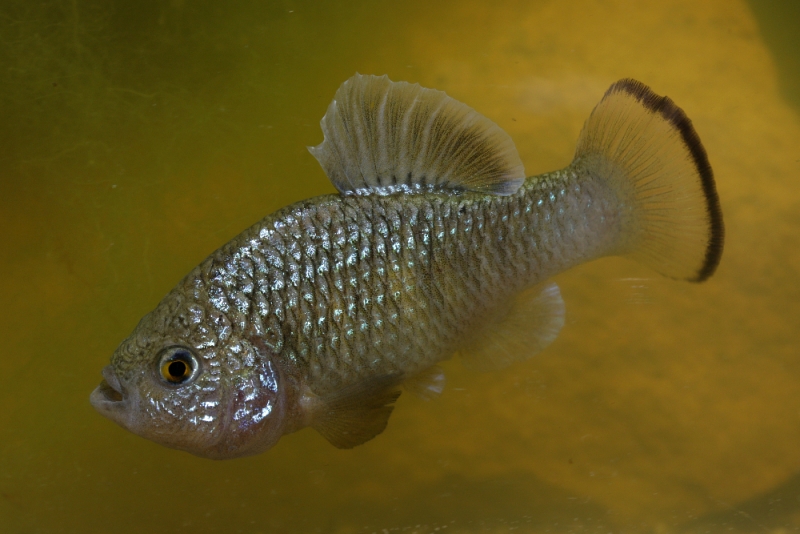
The Charco Palma pupfish, Cyprinodon veronicae, is a pupfish known only from the spring Ojo de Agua Charco Azul in Nuevo León, Mexico. The Bolsón de Sandia spring system has been dry since the late 1990s because of water extraction by local communities, and all four Cyprinodon species described from it are now considered extinct in the wild. Nuptial males are violaceous blue.
Etymology
Cyprinodon: from the Ancient Greek κυπρῖνος (kuprinos), meaning 'carp', and ὀδούς (odous), meaning 'tooth'.
veronicae: named for Verónica Contreras Arquieta.
Distribution
Type locality is 'Ojo de Agua Charco Azul (= Barreno), 24°09.8'N, 100°03.7'W, Aramberri, Nuevo León, Mexico', and to date this species has not been recorded elsewhere.
Habitat
Ojo de Agua Charco Azul was a freshwater spring system located at around 1600 AMSL within the Bolsón de Sandia (pluvial Lake Sandia) fossil lake system.
Aquatic vegetation included Ceratophyllum, Potamogeton, Typha, Eleocharis, Lemna, Utricularia, Scirpus, and Chara species and the water was crystal clear with a temperature around 19 – 20 °C66 – 68 °F.
The surrounding area is semi-arid and the Bolsón de Sandia was once a pristine oasis with a number of springs, abundant vegetation and diverse wildlife but has been dry since the late 1990s due to indiscriminate water extraction by local communities.
Four endemic Cyprinodon species, namely C. veronicae, C. inmemoriam, C. longidorsalis and C. ceciliae, have been described from separate springs within the system but all are now considered extinct in the wild.
Aquarium size
An aquarium with base dimensions of 60 ∗ 30 cm24 ∗ 12 in or equivalent is just about acceptable for a single pair but like most members of the family Cyprinodontidae this species does best when maintained as a group in a larger tank or container.
Maintenance
Need not be too complicated so long as there are plenty of broken lines-of-sight.
Provide plenty of cover in the form of aquatic plants, wool mops, etc., and if using filtration air-powered, sponge-type units are best as these will not harm eggs or fry.
Lighting is unimportant but can be used if you wish, and growth of filamentous algae should be encouraged if possible.
Notes
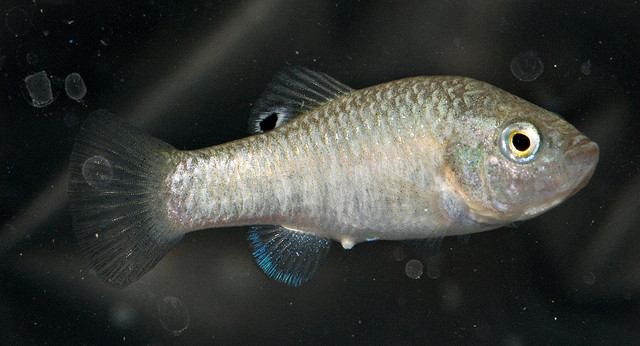
This species differs from congeners in the following combination of characters: maxilla short 0.70-0.77 times in anal-fin base; head large 2.7-2.9 times in SL; male with 6-7 diffused dark bars along sides, covering only upper half of body; female with an irregular ocellus on dorsal-fin, its black spot half-moon shaped, smaller than a pupil; eye 1-1.2 times in anal fin base; postdorsal-postanal 0.9-1.1 times in caudal peduncle length; anal-fin usually smaller than its congeners, 3-3.9 times in head length; teeth absent on 4th ceratobranchial; dorsal fin inserted behind pelvic origin; nuptial males violaceous blue.
References
- Lozano-Vilano, M. de L. and S. Contreras-Balderas (1993). Four new species of Cyprinodon from southern Nuevo León, Mexico, with a key to the C. eximius complex (Teleostei: Cyprinodontidae). Ichthyological Exploration of Freshwaters 4(4), 295-308
Species images · 3
Used with the photographer’s permission. Not licensed for reuse.
Distribution
Profile completeness16 of 24
67% complete
Also missing: water condition notes, diet, behaviour and compatibility, sexual dimorphism, reproduction.
Community
Questions about Cyprinodon veronicae?
Ask on Discord