Distichodus sexfasciatus
Six-banded Distichodus
On this page11 sections
Quick facts
Difficulty4 of 8 measures
More bars, more demanding.
- Space
- very large tank
- Water
- tap water
- Temp
- steady heat
- Diet
- unknown
- Temperament
- peaceful
- Social
- unknown
- Compatibility
- unknown
Other demands
Each of these can raise the rating on its own, whatever the measures above say.
- Hardiness
- unknown
- Needs a very large tank
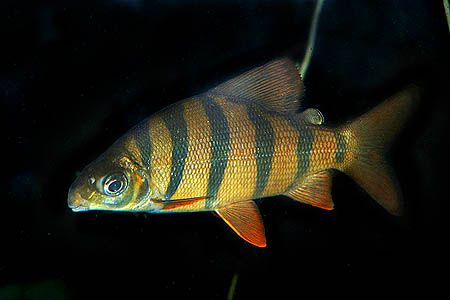
The six-banded distichodus, Distichodus sexfasciatus, is a large citharinid from Cameroon, the Democratic Republic of Congo and Tanzania. The most common Distichodus in the hobby, it is often sold for the general community tank, which its temperament and size do not suit: it reaches 75 cm, though rarely more than 40 cm in aquaria. Juveniles are orange and black striped with red fins, but much of this colour fades as the fish grows.
Distribution
Habitat
A predominantly benthic species inhabiting lakes and rivers.
Aquarium size
A tank of 240 ∗ 90 ∗ 60 cm96 ∗ 36 ∗ 24 in - ~1296 litres~342 US gal should be considered a bare minimum to house one of these. A much larger tank would be needed to house it as part of a community or species group.
Maintenance
Not a good choice for the planted setup, as it will munch most greenery. Furnish the tank with smooth rocks and driftwood branches instead. Sand or gravel can be used as substrate. If you want to try some plants, use species such as Anubias or Bolbitis, as most fish leave these alone. A little water flow is appreciated. It's an excellent jumper, so the tank must have a tightly-fitting, heavy cover.
Water conditions
Temperature: 22 – 26 °C72 – 79 °F
pH: 6.0-7.5
Hardness: 10-20°H
These recommendations come from this profile’s own figures. They contain affiliate links, so we may earn a commission.
Diet
Omnivorous and will accept most foods offered. It should be fed a decent proportion of vegetable matter to keep it in the best of health. A diet of live and frozen foods such as earthworms, prawn and mussel, along with frozen peas (remove the shells), Spirulina flake and blanched spinach would provide the desired balance.
Behaviour and compatibility
Somewhat unpredictable. While some specimens remain peaceful with similarly-sized species, others can become very spiteful as they mature. Certainly don't attempt to keep one of these with much smaller or shy species. Tankmates in a big tank could include bichirs, large characins, cyprinids, catfish and Loricariids.
Similarly, while juvenile specimens will shoal together peacefully, they become increasingly aggressive towards one another as they grow. An enormous tank would be needed in order to keep a group of adults.
Sexual dimorphism
Unknown.
Reproduction
Not known to have been bred in captivity.
Notes
This is the most common of the few Distichodus species regularly seen in the hobby, and sadly, it is often sold as being suitable for the general community tank. This is clearly not the case in terms of both its temperament and potential size. Do not buy one unless you have the facilities to house it for life. It is usually seen for sale at a couple of inches long, and at this size is a very attractive orange and black striped fish with bright red finnage. Unfortunately, much of this colour and patterning fades as it grows. It is depressing to think where most specimens end up, as adults are rarely seen on sale.
Species images · 4
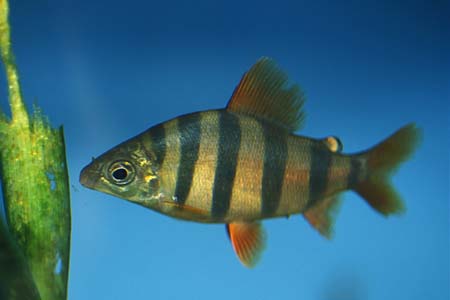
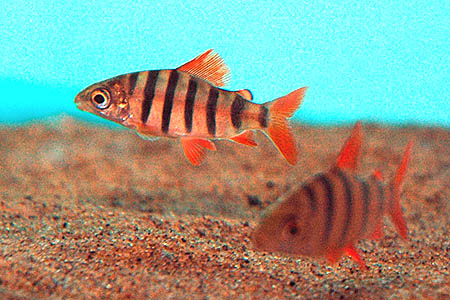
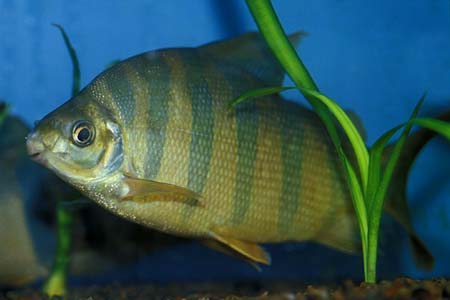
Used with the photographer’s permission. Not licensed for reuse.
Profile completeness18 of 24
75% complete
Also missing: a recorded distribution, taxonomic authority, etymology.
Contributors
Improved by
- Birch28
- baldinus1
Figures show the number of accepted contributions across Seriously Fish.
Community
Questions about Distichodus sexfasciatus?
Ask on Discord