Country · Africa
Malawi
Only species with a profile on Seriously Fish are counted, whether native or introduced.
- Species
- 18
- Families
- 2
- Genera
- 6
- Found only here
- 10
- Photographed
- 17 of 18
Shares its fishes withspecies recorded in both
Found only here10
10 of the species on this page are recorded in Malawi and in no other country. This is not the same as being endemic.

Aristochromis christyi
Cichlidae · Trewavas, 1935
Aristochromis christyi is a predatory cichlid endemic to Lake Malawi, found throughout the lake but most commonly in intermediate zones. Growing to 300 mm SL, it is not particularly common in the lake or the hobby. Its beak-like mouthparts are adapted for hunting small fish in crevices between rocks, and it also ambushes prey, sometimes rolling onto its side as it approaches then taking it with a fast sideways motion.

Aulonocara baenschiNew Yellow Regal Peacock
Cichlidae · Meyer & Riehl, 1985
The new yellow regal peacock, Aulonocara baenschi, is a cichlid endemic to Lake Malawi, known from five sites along the lake's western shoreline. It inhabits intermediate zones where rocky shores give way to sand with scattered rocks, usually at 4 to 6 metres. Also sold as the 'yellow regal cichlid', 'Baensch's peacock', 'sunshine peacock' and 'Nkhomo-Benga peacock', it is most easily told from similar congeners by its steeper, more curved snout.

Aulonocara ethelwynnaeNorthern Aulonocara
Cichlidae · Meyer, Riehl & Zetzsche, 1987
The northern aulonocara, Aulonocara ethelwynnae, is a cichlid endemic to Lake Malawi, known only from Chitande Island and the nearby northwest shore. Quite rarely seen in the hobby, it is most easily distinguished by the chocolate-brown striping of mature males. In intermediate zones, females and immature males form loose schools at around 3 metres while mature males hold territories deeper, at 6 to 7 metres.

Aulonocara hansbaenschiRed Shoulder Peacock
Cichlidae · Meyer, Riehl & Zetzsche, 1987
The red shoulder peacock, Aulonocara hansbaenschi, is a cichlid endemic to Lake Malawi, known from four localities on its southeastern shore. Some authors regard it as a geographical variant of the highly variable A. stuartgranti. It is also sold as the 'firebird cichlid' and 'red peacock'. At Masinje it shows a distinct preference for rocky caves and crevices in 3 to 6 metres of water, where most of the genus forage over sand.

Aulonocara jacobfreibergiMalawi Butterfly
Cichlidae · Johnson, 1974
The Malawi butterfly, Aulonocara jacobfreibergi, is a cichlid endemic to Lake Malawi, living where rocky shores give way to sand. One of the larger members of the genus, with males reaching 150 to 170 mm, it was among the first Aulonocara species in the hobby and is also sold as 'Freiberg's peacock' and 'fairy cichlid'. Males react aggressively to fish with a similar colour pattern, so tankmates need choosing with care.

Aulonocara maylandiSulphurhead Peacock
Cichlidae · Trewavas, 1984
The sulphurhead peacock, Aulonocara maylandi, is a cichlid endemic to Lake Malawi, where it occurs in two principal colour forms. Males from West Reef and Eccles Reef, in the southeast of the lake, carry a bright yellow band from the snout along the back and dorsal-fin margin. At Kande Island, off the central-western shore, the stripe is whitish and both sexes have an enlarged lower pharyngeal bone. That population was described as A. maylandi kandeensis, a name still widely used in the hobby.

Aulonocara sp. 'stuartgranti maleri'Sunshine Peacock
Cichlidae · authority not recorded
The sunshine peacock, Aulonocara sp. 'stuartgranti maleri', is a cichlid endemic to the south-west of Lake Malawi around the Maleri Islands. Whether it represents an undescribed species remains unclear, and the vernacular name is confusing because it is based on that of a described taxon: it is often called A. stuartgranti 'Maleri', and the Maleri Islands fish are traded as 'yellow regal peacock'. It resembles A. baenschi but has a straighter head and snout profile and relatively smaller eyes.

Aulonocara stuartgrantiGrant's Peacock
Cichlidae · Meyer & Riehl, 1985
Grant's peacock, Aulonocara stuartgranti, is a cichlid endemic to Lake Malawi, widely distributed along both the east and west coastlines. Males vary in colour by locality, with blue forms found mostly in the north of the lake and yellow in the south, and many populations are traded under their own names. That variation has caused taxonomic problems: A. baenschi, A. korneliae and A. hueseri were all once considered forms of it. It inhabits the intermediate zones where rocky shores give way to sand.

Champsochromis caeruleusMalawi Trout
Cichlidae · authority not recorded
The Malawi trout, Champsochromis caeruleus, is a large predatory cichlid endemic to Lake Malawi, where it roams from rocky shores to open water. Also known as the trout cichlid, it is only occasionally offered for sale because its solitary lifestyle makes it difficult to collect. It is told apart from C. spilorhynchus by its more elongate shape, and at up to 32.5 cm this active, pelagic species needs a tank of at least 180 x 60 x 60 cm.

Champsochromis spilorhynchus
Cichlidae · authority not recorded
Champsochromis spilorhynchus is a large predatory cichlid known from Lake Malawi, Lake Malombe and the upper Shire River. It is only occasionally offered for sale because its solitary lifestyle makes it difficult to collect, and it is much sought after by enthusiasts. A deeper body and distinctive black markings on the snout separate it from C. caeruleus. At up to 35 cm, this active, pelagic species needs a very large tank with plenty of swimming space.

Copadichromis azureus
Cichlidae · authority not recorded
Copadichromis azureus is an Utaka cichlid endemic to Lake Malawi, found in the southern part of the lake around the Maleri and Mbenji Islands. It shoals in open water around rocky shores and reefs at 20-30 metres. Dozens of colour forms exist, usually sold with the collection locality attached, and it is sometimes seen under the invalid name Haplochromis chrysonotus, which causes confusion with C. chrysonotus. Peaceful even by Copadichromis standards, it should not be kept with Mbuna.

Copadichromis borleyi
Cichlidae · authority not recorded
Copadichromis borleyi is an Utaka cichlid endemic to Lake Malawi, where it shoals over rocky areas and isolated boulders at 5-20 metres. One of the species most commonly encountered in the hobby, it is available in several colour morphs, often divided into yellow and red finned forms and sold with the collection locality attached, such as 'Kadango'. It is also sold under invalid names such as Haplochromis 'red Kadango'. Other Copadichromis should be left out, as they can hybridise.
Copadichromis chrysonotus
Cichlidae · authority not recorded
Copadichromis chrysonotus is an Utaka cichlid endemic to Lake Malawi, collected between Karonga and Monkey Bay in deep, open water. Among Copadichromis it is the best-known open-water spawner. It is not seen often in the hobby, and most fish imported under the name turn out to be C. azureus sold as 'Haplochromis chrysonotus'. Males are paler on the dorsal surface than the uniformly blue C. azureus, while the females are virtually indistinguishable.

Copadichromis ilesi
Cichlidae · authority not recorded
Copadichromis ilesi is an Utaka cichlid endemic to Lake Malawi, collected at Gome, Nkata Bay and Monkey Bay around rocky shores and reefs. Described in 1999, it was previously sold as Copadichromis 'virginalis kajose' and is a close relative of C. virginalis, with which it shoals at Gome Rock. Its females are sandy brown, and males grow larger than C. virginalis and lack the red stripe in the dorsal fin.

Copadichromis virginalis
Cichlidae · authority not recorded
Copadichromis virginalis is an Utaka cichlid endemic to the northern end of Lake Malawi, shoaling in open water around rocky shores and reefs. Numerous colour forms exist and are usually sold with the collection locality attached, such as 'Gold Nkanda'. It shoals alongside the similar C. ilesi at some locations, but males have a red stripe along the dorsal fin and the females are silver. Peaceful even by Copadichromis standards, it should not be combined with Mbuna.

Nimbochromis livingstonii
Cichlidae · (Günther, 1894)
Nimbochromis livingstonii is a predatory cichlid endemic to Lake Malawi, where it is fairly widespread. An ambush predator, it lies motionless on the substrate and its mottled pattern makes it appear dead to the smaller fish that come to investigate. This 'playing dead' behaviour gave it the local name 'Kaligono', loosely 'sleeper'. It is not a fish for the general Malawi cichlid community.

Nimbochromis venustusVenustus
Cichlidae · (Boulenger, 1908)
The venustus, Nimbochromis venustus, is a predatory cichlid endemic to Lake Malawi, where it is fairly widespread. Also sold as 'giraffe hap' or 'giraffe cichlid' after its pattern of irregular dark markings, it is an ambush predator that lies motionless on the substrate to take smaller fish. It is not a fish for the general Malawi cichlid community.
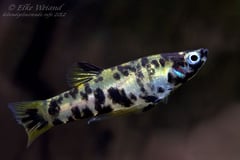
Phalloceros caudimaculatusDusky Millions Fish
Poeciliidae · Hensel, 1868
The dusky millions fish, Phalloceros caudimaculatus, is a small livebearer native to Brazil, Paraguay, Uruguay and Argentina. Feral populations in Australia, New Zealand, Ethiopia and Malawi were purportedly introduced for mosquito control and are now considered invasive. Highly variable in colour pattern, it is known in the hobby in spotted and golden ornamental forms. P. caudimaculatus is the type species of a genus that was monotypic until 21 new species were described in 2008.