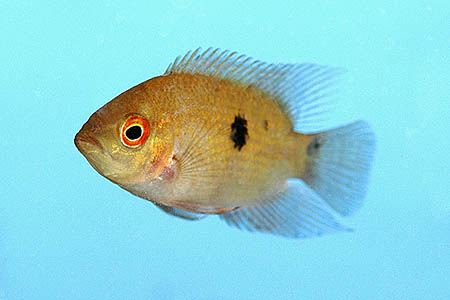
Hypselecara temporalis
Chocolate Cichlid
On this page8 sections
Quick facts
Difficulty4 of 8 measures
More bars, more demanding. Hardiness is not averaged with the rest.
- Space
- large tank
- Water
- tap water
- Temp
- unfussy
- Diet
- unknown
- Temperament
- peaceful
- Social
- unknown
- Compatibility
- unknown
Hardiness on its own can raise the rating, whatever the measures above say.
- Hardiness
- unknown
Widely distributed in parts of Peru, Colombia, Venezuela and Brazil, where it inhabits silt-laden, slow-flowing rivers. Despite its size it is a placid species, and it can be kept with other large fish in a suitably-sized tank.
Distribution
Habitat
It most often inhabits silt-laden, slow-flowing rivers.
Aquarium size
48" x 18' x 18" (120cm x 45cm x 45cm) litres for a single adult male or mated pair.
Maintenance
A sand substrate is preferable, with large pieces of bogwood and smooth boulders as additional decor. Plants can be used if you wish, as it doesn't usually dig. If you want to breed the fish place some pieces of slate vertically up the sides of the tank, to act as potential spawning sites.
Water conditions
Temperature: Prefers warmer water, from 77 - 86°F (25 - 30°C).
pH: 5.0-7.0
Hardness: 0-12°H
These recommendations come from this profile’s own figures. They contain affiliate links, so we may earn a commission.
Diet
It's omnivorous, feeding on a variety of invertebrates, algae and other plant matter in the wild. Happily it proves similarly unfussy in aquaria. Offer a varied diet including live, frozen and dried foods.
Behaviour and compatibility
Despite its large size this is actually quite a placid species and can be kept in a community of large fish in a suitably-sized tank. Possible tankmates include large cyprinids, characins, catfish, Loricariids and in a very big tank, other South American cichlids.
Species images · 1
Used with the photographer’s permission. Not licensed for reuse.
Profile completeness15 of 24
63% complete
Also missing: a recorded distribution, taxonomic authority, sexual dimorphism, reproduction, notes, etymology.
Community
Questions about Hypselecara temporalis?
Ask on Discord