Megalancistrus sp.
L234 · Dragon Hi Fin Pleco
Last revised 2026Edit this page
On this page9 sections
Quick factsEdit
Difficulty5 of 8 measures
Rated difficult because it needs a tank at least 2 m long.
- Space
- very large tank
- Water
- flexible
- Temp
- flexible
- Diet
- unknown
- Temperament
- unknown
- Social
- fine alone
- Compatibility
- choose tankmates carefully
Other demands
Each of these can raise the rating on its own, whatever the measures above say.
- Hardiness
- unknown
- Needs a tank at least 2 m long
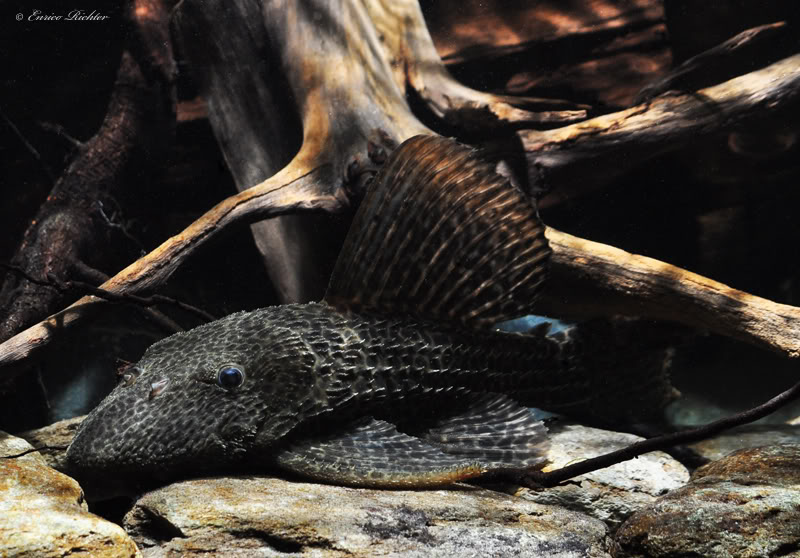
L234, the dragon hi fin pleco, is a large Megalancistrus catfish known only from the rio São Francisco system in eastern Brazil. The L-number was previously applied to Megalancistrus parananus, but that species is native to the Paraná, Paraguay and Uruguay drainages, so L234 appears to be an unidentified species. It grows to 500 to 600 mm and can behave very aggressively in confined surroundings.
Etymology
EditMegalancistrus: from the Greek μέγας (mégas), meaning 'big, large, great', and the generic name Ancistrus.
Distribution
EditKnown only from the rio São Francisco system in eastern Brazil.
Aquarium size
Write a noteEditSuitable only for public installations or the very largest private aquaria.
Water conditions
EditDiet
Write a noteEditWild specimens are likely to feed primarily on aquatic invertebrates alongside smaller quantities of wood as in the congener M. parananus, although it's unclear whether the latter is an essential part of the diet or ingested unintentionally while the fish are foraging.
In the aquarium it does best when offered a varied diet comprising sinking dried foods, frozen Daphnia, mosquito larvae, chironomid larvae (bloodworm), and prawn/shrimp, for, example, plus fresh fruit, parboiled potato, etc.
Home-made foods using a mixture of natural ingredients bound with gelatin are very useful since they can be tailored to contain fresh vegetables, Spirulina and meatier ingredients.
These recommendations come from this profile’s own figures. They contain affiliate links, so we may earn a commission.
Behaviour and compatibility
Write a noteEditCan behave very aggressively in confined surroundings and should only be maintained alongside similarly-sized, robust fishes in suitably-sized aquaria (see 'Aquarium Size').
Notes
EditL234 was previously applied to M. parananus, which has also has the L-number L113 assigned to it.
However M. parananus is native to the Paraná, Paraguay and Uruguay drainages, whereas L234 is collected in the rio São Francisco so appears to represent an unidentified species.
M. barrae and M. sp. 'LDA097' are also exported from the São Francisco system.
References
- Stawikowski, R., A. Werner and I. Seidel (2004). DATZ Special: L-Numbers. DATZ, 1-132
Species images · 1
These photographs are used with each photographer's permission.
Send a photographDistribution
Profile completeness16 of 24
67% complete
Also missing: aquarium size, taxonomic authority, habitat, maintenance, water condition notes, sexual dimorphism, reproduction.
Community
Questions about Megalancistrus sp.?
Ask on Discord