Mesoheros festae
Red Terror
Formerly Cichlasoma festae
Last revised 2026Edit this page
On this page11 sections
Quick factsEdit
Difficulty4 of 8 measures
Rated difficult because it needs a tank at least 2 m long.
- Space
- very large tank
- Water
- flexible
- Temp
- needs a steady temperature
- Diet
- unknown
- Temperament
- territorial
- Social
- unknown
- Compatibility
- unknown
Other demands
Each of these can raise the rating on its own, whatever the measures above say.
- Hardiness
- unknown
- Needs a tank at least 2 m long
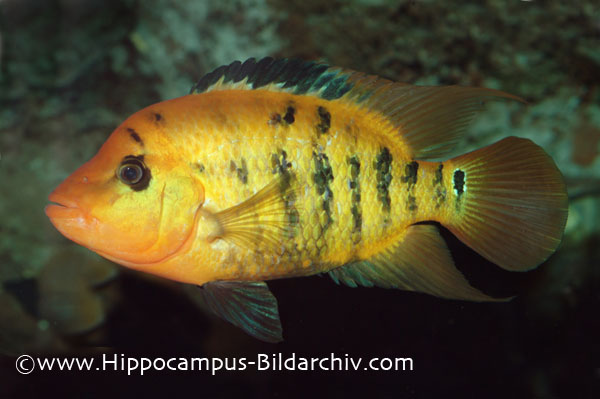
The red terror, Mesoheros festae, is a large, territorial cichlid from the Rio Esmeraldas in Ecuador and the Rio Tumbes in Peru. Males reach around 20 inches and females 12, and anything the fish can fit in its large mouth will be seen as food. Pairing is troublesome, since the weaker fish of an incompatible pair is likely to be killed, so a pair is best grown on from six juveniles. An introduced population also exists in Singapore.
Distribution
EditHabitat
Write a noteEditA seemingly adaptable species existing in various types of habitat, usually in rivers and their tributaries.
Aquarium size
Write a noteEdit210 ∗ 60 ∗ 60 cm84 ∗ 24 ∗ 24 in - ~756 litres~200 US gal
Maintenance
Write a noteEditMake sure there is a lot of swimming area for Mesoheros festae, but also provide cover in the form of stable rocks and bits of wood. The Red Terror is a digger so plants won't last long, and because of its size potted plants likely won't either. Floating plants are an option, as are plants rooted to bits of wood or rock.
Water conditions
EditTemperature: 25 – 29 °C77 – 84 °F
pH: 6.0 to 8.0
Hardness: 4 to 18°dH
These recommendations come from this profile’s own figures. They contain affiliate links, so we may earn a commission.
Diet
Write a noteEditAvailable scientific data suggests the species feeds mainly on benthic aquatic crustaceans and other invertebrates. It also probably consumes on the fry of other fish as well as various fruits and seeds. Omnivorous. Will eat most things offered but a large (physical size), high quality, meaty cichlid pellet is ideal as staple food. The dry foods specifically for large carnivorous cichlids are ideal. Make sure large live and frozen foods are offered regularly, earth and mealworms are ideal.
Behaviour and compatibility
Write a noteEditVery territorial and can sometimes be downright aggressive. Only house with similarly sized, similarly aggressive, robust fish. Anything which the red terror can fit in its large mouth will be seen as food - at full size, this can mean 6" fish.
Sexual dimorphism
Write a noteEditFemales keep their juvenile colours of vivid red with black bands. Males are larger.
Reproduction
Write a noteEditThe Red Terror is a cave brooder and will lay their eggs in caves or in sheltered areas. Rockwork is usually the best bet, especially with Festae over 12". A number of spawning pits will be dug in the substrate, then the female will lay upto 3000 large eggs in a sheltered place or cave. Fry will hatch in 3 or 4 days, and will then be moved to the aforementioned spawning pits. Around 5 or 6 days later the fry will be free swimming, but parents will still guard them very carefully.
Notes
EditThe Red Terror can be troublesome to breed due to pairing problems - if a pair of fish are incompatible and are housed together for any length of time, it is likely that the weaker fish will be killed. The best way of getting a true pair is to grow 6 juveniles up until a noticeably strong pair has formed. Also, its size means finding an aquarium and suitable breeding surfaces can be difficult. As previously mentioned, rocks (siliconed if necessary) and bits of slate used to create man-made caves are ideal.
Mesoheros festae is not a fish to be messed with. Its large size and ferocious attitude can lead to some serious issues in an aquarium. Make sure you have a large enough aquarium to begin with, as very few shops (or hobbyists) will take a 12"+ Red Terror off your hands when it grows too large for your tank.
A stunning fish and a challenge to breed, the Red Terror can make an amazing centre piece for any large, predatory south American cichlid setup.
Species images · 1
These photographs are used with each photographer's permission.
Send a photographHow the name has changed
Moved from Cichlasoma festae to Mesoheros festae.
Distribution
Profile completeness20 of 24
83% complete
Also missing: etymology.
Community
Questions about Mesoheros festae?
Ask on Discord