Country · Asia
Singapore
Only species with a profile on Seriously Fish are counted, whether native or introduced.
- Species
- 32
- Families
- 15
- Genera
- 26
- Found only here
- 0
- Photographed
- 30 of 32
Shares its fishes withspecies recorded in both
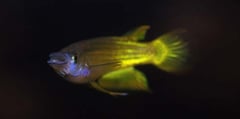
Aplocheilus lineatusStriped Panchax
Aplocheilidae · (Valenciennes, 1846)
The striped panchax, Aplocheilus lineatus, is a predatory killifish from peninsular India and northern Sri Lanka, growing to 10 cm TL. It lives in permanent water from mountain streams and lakes to swamps and rice paddies, and is not an annual species. The golden wonder panchax sold in the trade is a golden form selectively bred in the hobby that does not occur in the wild.
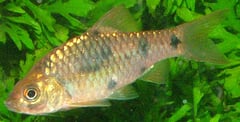
Barbodes banksi
Cyprinidae · Herre, 1940
Barbodes banksi is a cyprinid from Peninsular Malaysia, Singapore and western Borneo, plus the Anambas and Natuna islands of Indonesia. It is tentatively considered distinct from the closely related B. binotatus, differing in a dark, wedge-shaped marking below the dorsal fin in place of a midlateral spot, though the two may be colour forms of a single species. Occasionally exported as bycatch, it lives in habitats from fast hill streams to canals and floodplain ponds.
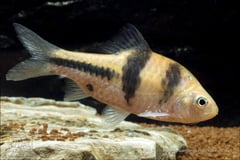
Barbodes lateristrigaSpanner Barb
Cyprinidae · Valenciennes, 1842
The spanner barb or 'T-barb', Barbodes lateristriga, is a cyprinid from peninsular Thailand, Peninsular Malaysia, Singapore, Sumatra and Java. Its colour pattern varies with locality, and the form most commonly seen in the trade corresponds most closely to fish from Johor. The species may prove to be a complex of closely-related taxa. Quite boisterous, it can intimidate more timid species with its size and activity, especially at feeding times.

Barbonymus gonionotus
Cyprinidae · Bleeker, 1849
Barbonymus gonionotus is a large cyprinid with an enormous distribution across Southeast Asia, from the Mekong to Java and Sumatra. It inhabits larger, slow-moving rivers and their floodplains, moving into flooded forest to feed and spawn, and is increasingly found in man-made canals and lakes. Plain grey caudal and dorsal fins and pale yellow pelvic and anal fins separate it from congeners. Populations in Peninsular Malaysia appear to be introduced.

Barbonymus schwanefeldiiTinfoil barb
Cyprinidae · Bleeker, 1854
The tinfoil barb, Barbonymus schwanefeldii, is a large cyprinid found across much of Southeast Asia, from the Mekong to Borneo and Sumatra. Usually sold at 50 to 75 mm, it grows to 355 mm SL, and tinfoil barbs are among the species most often returned to shops having outgrown their aquarium. Selectively-bred 'golden' and 'blushing' strains exist, and the species has also been subjected to artificial dyeing.

Belontia hasseltiJava Combtail
Osphronemidae · Cuvier, 1831
The Java combtail, Belontia hasselti, is a labyrinth fish from peninsular Thailand, Peninsular Malaysia, Singapore, Sumatra, Borneo and Java. Also known as the 'Malay combtail', it mostly inhabits acidic forest peat swamps with little water movement. It differs from its only congener, B. signata, in its brownish grey body and the mosaic pattern in its unpaired fins. Growing to 200 mm SL, it will eat very small fishes and is not recommended for the average community aquarium.

Betta pugnax
Osphronemidae · Cantor, 1849
Betta pugnax is a paternal mouthbrooding labyrinth fish from much of Peninsular Malaysia and Singapore, described from Penang. It lends its name to the B. pugnax complex. Populations inhabit shallow, flowing clear-water hill streams as well as stiller forest swamps. It is not among the more aggressive members of the genus and can be maintained in a pair or group.
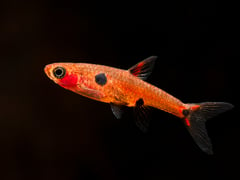
Boraras maculatusDwarf Rasbora
Cyprinidae · Duncker, 1904
The dwarf rasbora, Boraras maculatus, is a miniature cyprinid from Peninsular Malaysia, southern Thailand, eastern Sumatra, Singapore and Bintan. It inhabits blackwater streams and rivers associated with forest peat swamps, where the water is very soft and acidic. Colour pattern varies between populations, some forms showing more intense red than others. It is most similar to B. naevus, in which the red body colouration does not extend into the head.

Butis butisCrazy Fish
Butidae · Hamilton, 1822
The crazy fish, Butis butis, is a flathead gudgeon of coastal and brackish waters across the Indo-Pacific, from eastern Africa to Fiji. The most commonly traded member of the genus, it has many other names, including crocodile fish, duckbill sleeper and upside-down sleeper. A nocturnal ambush predator, it often swims upside-down, and it is territorial and not sociable with conspecifics, so is best kept singly.

Channa gachuaDwarf Snakehead
Channidae · Hamilton, 1822
The dwarf snakehead, Channa gachua, is a snakehead recorded across an enormous range from Iran to Taiwan and Bali. There is significant evidence that C. gachua as currently understood is a complex of similar-looking species in need of taxonomic review. A mouthbrooder bred regularly in captivity, it can share a well-chosen community with peaceful fishes too large to be prey, but populations should not be mixed as some may hybridise.

Cichlasoma festaeRed Terror
Cichlidae · authority not recorded
The red terror, Cichlasoma festae, is a large, territorial cichlid from the Rio Esmeraldas in Ecuador and the Rio Tumbes in Peru. Males reach around 20 inches and females 12, and anything the fish can fit in its large mouth will be seen as food. Pairing is troublesome, since the weaker fish of an incompatible pair is likely to be killed, so a pair is best grown on from six juveniles. An introduced population also exists in Singapore.
Cichlasoma trimaculatumThree Spot Cichlid
Cichlidae · authority not recorded
The three spot cichlid or trimac, Cichlasoma trimaculatum, is a large cichlid from western Mexico, Guatemala and El Salvador. It lives mainly in sluggish waters of the Pacific coastal plains, among roots, branches and vegetation over mud and sand. A fairly aggressive fish that grows to around 40 cm, it is believed to be one of the species used to create the flowerhorn hybrid, and both parents guard the eggs and fry.

Cichlasoma urophthalmusMayan Cichlid
Cichlidae · authority not recorded
The Mayan cichlid, Cichlasoma urophthalmus, is a large cichlid native to eastern parts of Mexico, Belize, Guatemala, Honduras and Nicaragua. Also known as the Mexican mojarra, it lives in swamps, marshes and coastal lagoons, can tolerate and even breed in full marine conditions, and is often seen spawning around mangroves. Territorial and fairly aggressive, it is regarded as a potential pest fish in the USA, where introduced populations exist.

Datnioides polotaSilver Tiger Perch
Datnioididae · Hamilton, 1822
The silver tiger perch, Datnioides polota, is a tiger perch widely distributed in southeastern Asia, from India and Bangladesh east to Indonesia. Mostly found in brackish habitats such as estuaries, mangroves and coastal lagoons, it has a highly variable colour pattern with up to 7 dark bars. The name D. quadrifasciatus is sometimes applied to it, but that name is a junior homonym and polota takes precedence.
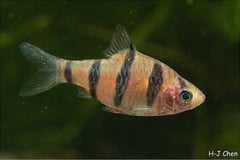
Desmopuntius hexazona'Pentazona' Barb
Cyprinidae · Weber & de Beaufort, 1912
Normally traded as the 'pentazona' barb, Desmopuntius hexazona is a cyprinid from southern Borneo, eastern Sumatra, Singapore and the Malay Peninsula. It is almost identical to D. pentazona, which has a small dark marking at the rear of the dorsal-fin base that D. hexazona lacks. Older literature may label it 'Puntius johorensis'. In Singapore it is considered highly endangered and is restricted to the Central Catchment nature reserve.
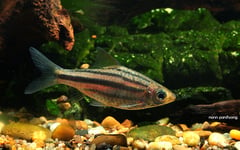
Desmopuntius johorensisStriped Barb
Cyprinidae · Duncker, 1904
The striped barb, Desmopuntius johorensis, is a cyprinid from southern Thailand, Peninsular Malaysia, Singapore, Sumatra and Borneo. Juveniles have 4 dark vertical bars and develop 5 or 6 broad lateral stripes as they grow, a pattern change shared with D. gemellus and D. trifasciatus. Before Kottelat (1992) it was referred to as Puntius eugrammus, while the name 'Puntius johorensis' was misapplied to D. hexazona. It lives mainly in peat swamps and black water streams.

Esomus metallicusStriped Flying Barb
Cyprinidae · Ahl, 1923
The striped flying barb, Esomus metallicus, is a cyprinid found from the Salween basin in Myanmar east across Thailand to Laos and Cambodia. It is abundant over most of this range and moves into rice paddies and other flooded ground at the onset of the wet season, returning to permanent water when the flooding recedes. Its lateral stripe grows more intense towards the tail and ends at the caudal-fin base.
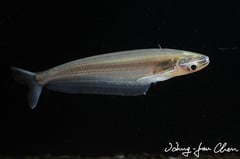
Kryptopterus cryptopterusBlue Sheatfish
Siluridae · Bleeker, 1851
The blue sheatfish, Kryptopterus cryptopterus, is a silurid catfish from the Malay Peninsula, Singapore, Sumatra, Borneo and Java. It inhabits flowing rivers and larger streams with turbid water, and is sometimes traded as 'smokey glass catfish'. Populations from Thailand, Cambodia, Laos and Vietnam once considered conspecific are now referred to K. geminus, its closest relative, from which it differs in having a wider head and a shorter snout and anal fin.
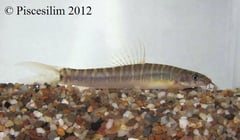
Nemacheilus selangoricus
Nemacheilidae · Duncker, 1904
Nemacheilus selangoricus is a nemacheilid loach ranging from southern Thailand through Peninsular Malaysia and Singapore to western Borneo and Sumatra. It is most common in shallow, flowing forest streams over sand, gravel and detritus. It belongs to the N. selangoricus group and is most similar to N. spiniferus, from which it differs in its 8-12 very regular dark bars on the flanks.
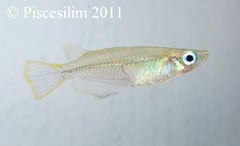
Oryzias javanicusJavanese Ricefish
Adrianichthyidae · Bleeker, 1854
The Javanese ricefish, Oryzias javanicus, ranges through Peninsular Thailand, Malaysia, Singapore and Indonesia as far east as Lombok and Sulawesi. Typically found in coastal, normally brackish, streams, pools and mangrove swamps, it tolerates a wide salinity range and has also been recorded in fresh water. It is exported on occasion and sometimes referred to as the 'blue-eyed ricefish'.
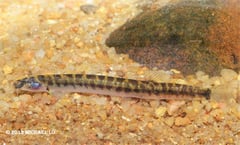
Pangio shelfordii
Cobitidae · Popta, 1903
Pangio shelfordii is a variably patterned kuhli loach from Peninsular Malaysia, Singapore, Sumatra and Borneo. Its patterning varies within and between populations, and as currently understood the species represents an assemblage containing a number of unidentified taxa. Some Sumatran and Bornean populations resemble P. piperata, which often occurs alongside it. It is exported occasionally, often as bycatch among shipments of congeners.
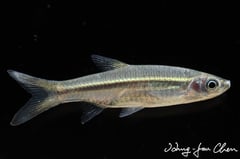
Rasbora argyrotaeniaSilver Rasbora
Cyprinidae · (Bleeker, 1849)
The silver rasbora, Rasbora argyrotaenia, is a cyprinid from Peninsular Malaysia, Singapore, Sumatra, Java, Borneo and the Palawan islands. One of the larger rasboras at up to 140 mm TL, it is a plain, silvery fish with a faint dark stripe, and fish pictured under this name with a bold black stripe are probably a regional variant of R. daniconius. A DNA barcode study found two mitochondrial lineages under the name, and the species as currently recognised is likely to be split.
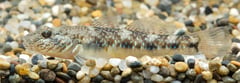
Rhinogobius giurinus
Gobiidae · Rutter, 1897
Rhinogobius giurinus is a goby found through much of China, plus Taiwan, the Korean Peninsula, Japan and the Red and Pha river basins in Vietnam. It appears to exist in a number of forms that differ in colour pattern, morphology or both, and it is unclear whether all of them are conspecific. Newly-imported wild fish tend to be aggressive towards conspecifics, so unlike most Rhinogobius it is best kept in sexed pairs.

Trichopsis vittataCroaking gourami
Osphronemidae · Cuvier, in Cuvier & Valenciennes, 1831
The croaking gourami, Trichopsis vittata, is a labyrinth fish found through much of Indochina, Peninsular Malaysia and Singapore. The largest of its genus, it produces audible sounds with a specialised pectoral mechanism unique within the Osphronemidae. Wild populations vary in colour pattern, and records from Borneo, Sumatra and Java might refer to a distinct species.
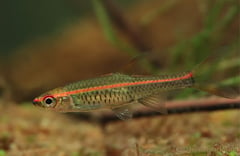
Trigonopoma pauciperforatumGlowlight Rasbora
Cyprinidae · Weber & de Beaufort, 1916
The glowlight rasbora, Trigonopoma pauciperforatum, is a small cyprinid from Peninsular Malaysia, Singapore, Borneo and Sumatra. Also sold as the 'redline' rasbora, its lateral stripe varies from deep orange to golden with locality, diet, condition and mood. It inhabits blackwater streams associated with peat swamps, where the pH can drop as low as 3.0 or 4.0, and the name R. agilis is a junior synonym of it.
Xiphophorus helleriiGreen Swordtail
Poeciliidae · Heckel, 1848
The green swordtail, Xiphophorus hellerii, is a livebearer native to southeastern Mexico, Guatemala, Belize and Honduras. Among the world's most recognisable aquarium fishes, it is ubiquitous in the trade, where selective breeding and hybridisation with X. maculatus and X. variatus have produced a bewildering array of ornamental forms. The name is often misspelled X. helleri.

Anabas testudineusClimbing Perch
Anabantidae · Bloch, 1792
The climbing perch, Anabas testudineus, is a labyrinth fish found from Pakistan and Sri Lanka east to southern China, Indonesia and Singapore. It lives in almost every kind of lowland water from rice paddies to main river channels, and can cross several hundred metres of land provided it stays moist. Its taxonomy is confused, and additional taxa probably exist. Its size and predatory nature make it unsuitable for the general community.
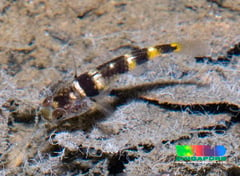
Brachygobius kabiliensisKabili bumblebee goby
Gobiidae · Inger, 1958
The Kabili bumblebee goby, Brachygobius kabiliensis, is a tiny goby described from the Kabili River in Sabah, northeastern Borneo. Its reported range is disjunct, with records from Brunei, Singapore and the lower Mekong in Vietnam and Cambodia. The name is often misapplied to B. doriae-type fishes in the trade. It lives in fresh and brackish lowland coastal habitats and prefers harder water than some congeners. It grows to just 15 to 18 mm.

Channa micropeltesGiant Snakehead
Channidae · Cuvier, 1831
The giant snakehead, Channa micropeltes, is a predatory fish from Southeast Asia that grows to well over a metre. Juveniles are sold as 'red' or 'redline' snakehead, but it is suitable only for public installations or the very largest private aquaria. Unlike most Channa species it is pelagic and needs plenty of room to swim, and adults become aggressive at sexual maturity.

Cichla ocellarisPeacock Bass
Cichlidae · authority not recorded
The peacock bass, Cichla ocellaris, is a large predatory cichlid native to Colombia, Venezuela, Guyana, Suriname, French Guiana and Brazil. Introduced populations exist in several countries, including Singapore and the USA. Often sold as small juveniles, it grows to around 75 cm and needs a tank of at least 10 x 3 x 4 feet as an adult, and it will eat any tankmate small enough to be considered food.

Ctenopharyngodon idellaGrass Carp
Cyprinidae · Valenciennes, 1844
The grass carp, Ctenopharyngodon idella, is a large cyprinid native to the Amur River system in eastern Russia and northeastern China. Adults typically reach 800 to 1200 mm, making it a wholly unsuitable aquarium subject, though an albino form is traded. Widely introduced for aquaculture and weed control, it has caused serious damage to natural waters, and unwanted fish should never be released.

Scleropages formosusAsian Arowana
Osteoglossidae · Müller & Schlegel, 1840
The Asian arowana, Scleropages formosus, is an osteoglossid from the Mekong system, eastern Thailand, Peninsular Malaysia, Sumatra and Borneo. Highly valued in the aquarium trade since the 1970s and listed on Appendix I of CITES since 1975, it is now extirpated across much of its range. It occurs in several colour forms, such as the 'super red' of the upper Kapuas, and three were described as species in 2003, though the majority view treats all of them as S. formosus pending review.