River
Maroni
Only species with a profile on Seriously Fish are counted.
- Species
- 6
- Families
- 3
- Photographed
- 6 of 6
- Difficulty rated
- 6 of 6
Basin
Shares fishes withspecies recorded from both
Runs through

Cleithracara maroniiKeyhole Cichlid
Cichlidae · Steindachner, 1881
The keyhole cichlid, Cleithracara maronii, is a small cichlid from French Guiana, Guyana, Suriname, the Orinoco delta in Venezuela and Trinidad. It is told apart from relatives by the keyhole-shaped marking on each side of the body, and is one of few fishes whose generic name derives from its aquarium common name. It inhabits slow-moving blackwater streams, is naturally shy and sensitive to deteriorating water quality, and most fish on sale are commercially farmed.
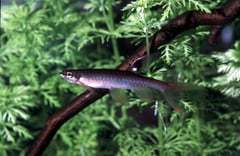
Copella carsevennensis
Lebiasinidae · Regan, 1912
Copella carsevennensis is a small lebiasinid from coastal river systems in Guyana, Suriname, French Guiana and Amapá state, Brazil. It appears in the trade from time to time among wild-caught fishes from the Guianas. Zarske (2011) separated it from C. arnoldi, partly because it lays its eggs among submerged vegetation and not out of the water, though Mol (2012) considers the two synonymous.

Hyphessobrycon roseusYellow Phantom Tetra
Characidae · Géry, 1960
The yellow phantom tetra, Hyphessobrycon roseus, is a small characid from Suriname, French Guiana and the Brazilian bank of the Oyapock/Oiapoque. Although popular in the hobby, its identity is somewhat confused, and two colour forms have been traded. It inhabits forest tributaries and igarapés with acidic, brownish water, sandy substrates and leaf litter.

Hyphessobrycon simulatusFalse X-ray Tetra
Characidae · Géry, 1960
The false x-ray tetra, Hyphessobrycon simulatus, is a characid endemic to French Guiana, from the Maroni to the Oyapock/Oiapoque river basins. Uncommon in the trade, it was originally described in the genus Pseudopristella. It is told from Pristella maxillaris by a larger humeral spot and black in the anal fin limited to the first ray.
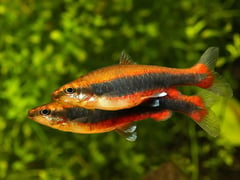
Nannostomus beckfordiGolden Pencilfish
Lebiasinidae · Günther, 1872
The golden pencilfish, Nannostomus beckfordi, is a lebiasinid widely distributed across Guyana, Suriname, French Guiana, Brazil and Venezuela. The type species of the genus and fairly ubiquitous in the trade, it is less demanding than most congeners and a good choice for a newcomer. Many fish on sale are farmed, and wild populations vary in colour pattern, several having been described as species now considered synonyms of N. beckfordi.

Hyphessobrycon borealis
Characidae · Zarske, Le Bail & Géry, 2006
Hyphessobrycon borealis is a small characid from French Guiana, recorded from the Oyapock/Oiapoque to the Maroni river systems. It inhabits shallow marginal zones with little current, where it forms large schools. The largest recorded specimen measured 27.8 mm, and the species lacks a humeral spot but has an oval spot on the caudal peduncle.