Neolamprologus kungweensis
Ocellated Shell-dweller
Formerly Lamprologus kungweensis
Last revised 2026Edit this page
On this page12 sections
Quick factsEdit
Difficulty4 of 8 measures
- Space
- medium tank
- Water
- needs alkaline water, kept steady
- Temp
- needs a steady temperature
- Diet
- unknown
- Temperament
- territorial
- Social
- unknown
- Compatibility
- unknown
Other demands
Each of these can raise the rating on its own, whatever the measures above say.
- Hardiness
- unknown
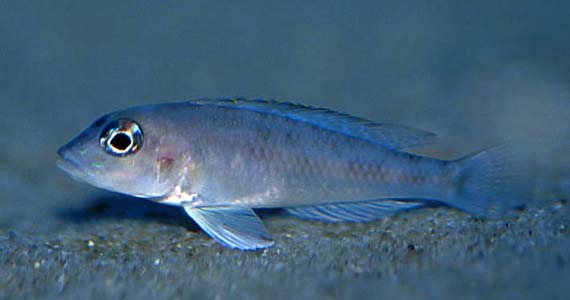
Neolamprologus kungweensis is a territorial cichlid endemic to Lake Tanganyika, where it lives over open mud flats at 10 to 50 m and digs tunnels in the firm mud. It can be recognised by the gold on top of the eye and a black spot towards the back of the dorsal fin. It uses snail shells only occasionally in the wild. In the aquarium it breeds in them, and it needs a deep soft substrate to dig in and more empty snail shells than there are fish. It is not often seen in the hobby.
Distribution
EditEndemic to Lake Tanganyika. It was described from Kungwe Bay in Tanzania and has been recorded north to Bujumbura in Burundi and south to Kalemie in the Democratic Republic of the Congo.
Habitat
Write a noteEditIt is found in areas of open mud flats at depths between 10 and 50 m.
Aquarium size
Write a noteEdit75 ∗ 30 ∗ 30 cm30 ∗ 12 ∗ 12 in - ~68 litres~18 US gal is suitable for a small group.
Maintenance
Write a noteEditThe aquarium should have large open areas of sandy substrate, to which should be added a good number of empty snail shells (see breeding section below). More shells should be provided than there are individual fish. The substrate should be at least 2" deep as this species likes to dig. The water must be hard and alkaline.
Water conditions
EditTemperature: 23 – 27 °C73 – 81 °F
pH: 7.5-9.0
Hardness: 10-25°H
These recommendations come from this profile’s own figures. They contain affiliate links, so we may earn a commission.
Diet
Write a noteEditLive and frozen varieties should form the bulk of the diet. Dried foods are sometimes refused.
Behaviour and compatibility
Write a noteEditA territorial species that will defend its shell and the small territory around it vigorously. It can be combined with other species that inhabit other areas of the aquarium. Good tankmate choices include small rockdwellers such as Neolamprologus brichardi or smaller species of Julidochromis and open water species such as Cyprichromis. If a number of fish are kept, it will form a colony. If keeping it in a colony situation, make sure there are enough shells and try to keep more females than there are males.
Sexual dimorphism
Write a noteEditTricky to sex accurately. Males grow slightly larger than females and may show a little more colour.
Reproduction
Write a noteEditEasy. Shell brooder. It may breed in the community aquarium but if you want to raise a full brood of these fish, a separate aquarium should be used. Set up the aquarium as suggested above. Provide a good number of snail shells in which the females will lay their eggs. Escargot shells are a good choice and can be obtained from most decent delicatessens. Water should be hard and alkaline with a pH of around 8.0-8.5 and a temperature of 25 – 26.5 °C77 – 80 °F. The fish can be bred in a colony within which spawning pairs will form weak bonds, until their broods are large enough to fend for themselves. The bond is not monogamous, however, and both fish may go on to spawn with other individuals. We recommend keeping several females per male, as this helps to reduce aggression between males. Condition the fish well on a good diet of live and frozen foods.
When inbreeding condition, both sexes undergo a colour change in which the dark patches on the flanks of the fish become larger and more intense. The male also develops a pattern of black spotting on his face. Females will attempt to catch the attention of males by displaying at the entrance of their chosen shells. When a male is sufficiently interested, the female swims into the shell where she deposits her eggs. She then leaves the shell and the male enters, where he fertilises the eggs. The fry can be seen around the entrance of the shell after 7-10 days and the female cares for the brood, picking up wandering fry in her mouth and carrying them back to the shell. The male guards the area around the shell. The fry are large enough to accept brine shrimp nauplii or microworm once they become free swimming. It is probably better to remove the fry to a separate rearing tank at this stage to ensure the best survival rate, although the parents do not usually harm them.
If you are having trouble spawning this species then a water change along with a slight increase in temperature may help.
Notes
EditN. kungweensis can be recognised by the gold on the top of the eye and a distinctive black spot towards the back of the dorsal fin.
It is not often seen in the hobby.
References
- Ad Konings (1998). Tanganyika Cichlids in their natural habitat Cichlid Press, 381
- Ad Konings (2019). Tanganyika Cichlids in their natural habitat, 4th edition Cichlid Press, 144-150
Species images · 1
These photographs are used with each photographer’s permission.
Send a photographHow the name has changed
Moved from Lamprologus kungweensis to Neolamprologus kungweensis.
2015Tanganyika Cichlids in their natural habitat, 3rd edition
Distribution
Profile completeness21 of 24
Contributors
Improved by
- CowPuppet55
The number beside each name is how many contributions that person has had accepted on Seriously Fish.
Community
Questions about Neolamprologus kungweensis?
Ask on Discord