Nothobranchius guentheri
Gunther's Nothobranch · Redtail Notho
Formerly Fundulus guentheri Pfeffer, 1893 · Adiniops guentheri Pfeffer, 1893 · Aphyosemion guentheri Pfeffer, 1893
On this page13 sections
Quick facts
Difficulty6 of 8 measures
More bars, more demanding. Hardiness is not averaged with the rest.
- Space
- modest tank
- Water
- tap water
- Temp
- steady heat
- Diet
- unknown
- Temperament
- fights its own
- Social
- in a pair
- Compatibility
- not a community fish
Hardiness on its own can raise the rating, whatever the measures above say.
- Hardiness
- unknown
Before you buy
Needs a tight-fitting lid as this species is known to jump
This species is an accomplished jumper so the cover must be very tight fitting.
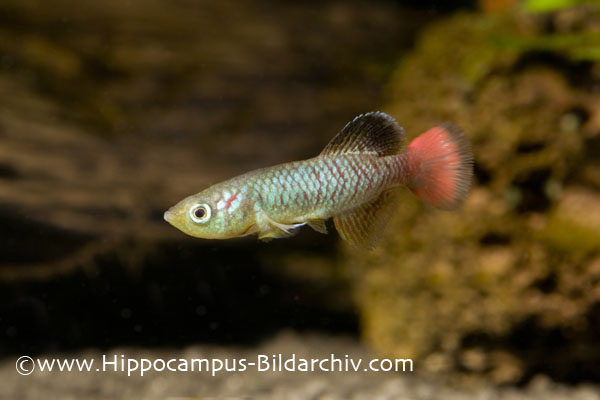
An annual killifish found only on Unguja, the main island of Zanzibar, where it lives in seasonal pools that dry out every year. Males grow to about 41 mm SL and are blue-green with a red tail edged in black. The IUCN lists it as Endangered because the pools are being drained for farming and rice fields.
Etymology
Nothobranchius: from the Greek nothos, meaning 'false', and branchia, meaning 'gill'. Peters named the genus for what he took to be free pseudobranchs. Wildekamp (2004) identified them as sensory neuromasts in an open groove on the gill cover. The groove looks like a second gill opening.
guentheri: named for the zoologist Albert Günther (1830–1914) of the British Museum, who reported this fish in 1867 under the name Fundulus orthonotus.[2][4][5]
Distribution
Habitat
Lives in seasonal pools and marshes in the coastal lowlands of Unguja, at 30–63 m above sea level. The pools fill in the rainy season and dry out completely, and the species survives the dry season only as eggs buried in the mud.
Water measured in these pools was 25 – 29 °C77 – 84 °F, pH 7.2–7.7 and 140–980 μS/cm, and usually turbid. Several known sites are in farmland, where pools are drained or turned into rice fields.
Aquarium size
A male with two or three females needs a tank with base dimensions of at least 45 ∗ 30 cm18 ∗ 12 in.
Maintenance
Use a dark, soft substrate and give it dense planting, floating plants and some wood for cover, with subdued lighting. Needs a tight-fitting lid as it jumps well. Filtration should be gentle, and an air-driven sponge filter is enough.
Water conditions
Temperature: 22 – 25 °C72 – 77 °F
pH: 6.5 – 8.0
Conductivity: 140 – 980 μS/cm, as measured in wild pools[1]
These recommendations come from this profile’s own figures. They contain affiliate links, so we may earn a commission.
Diet
A micropredator. Base the diet on small live and frozen foods such as Daphnia, Artemia and bloodworm. Most take dried food only occasionally.
Behaviour and compatibility
Best kept in a species tank. Males fight each other, so keep one male unless the tank is large enough for each to hold a territory. Keep two or three females with each male, as a male harasses a single female hard.
Sexual dimorphism
Reproduction
An annual killifish. In the wild the adults die when the pools dry out, and the eggs wait in the mud until the rains return.
In the aquarium it spawns into a layer of peat moss. Condition the sexes apart on live and frozen food, then put one male with two females in a small tank with a peat layer, an air-driven sponge filter and water of about pH 7.0–7.5 at 23 – 25 °C73 – 77 °F. They spawn daily for up to three weeks, but return them to the conditioning tanks after about a week, as daily spawning wears the females down.
Take out the peat, let it dry until it is damp but not wet, and store it in a sealed bag at 21 – 24 °C70 – 75 °F. Label each bag with the species and the date. Hobby accounts give 8 to 14 weeks of storage before the eggs are ready. Hatch them by putting the peat in shallow water in the rearing tank. Wetting the eggs too early gives weak fry. If few hatch, dry the peat again and rewet it a few weeks later, as some eggs develop more slowly.
The fry are tiny. Start them on infusoria, then brine shrimp nauplii or microworm after about two days, and larger and frozen foods after about two weeks. Keep the water shallow at first and raise it as they grow. Change a little water every two or three days, as the fry are prone to velvet disease.
Notes
It is one of the easier Nothobranchius to keep and breed, and often recommended for a first attempt at an annual killifish. Adults live for a short time, so a line is kept going by storing eggs.
Costa (2017) redescribed N. guentheri and N. melanospilus, the two Nothobranchius found on Zanzibar. The two had been confused in the past, and museum collections still held misidentified specimens. Costa separates N. guentheri by a combination of characters, including the red caudal fin with a black rear edge in males, the unspotted flanks and fins of females, and scale and fin-ray counts.
The IUCN lists it as Endangered (assessed 2018 by Nagy and Watters) because it is known from a small area of Unguja and its pools are being lost to farming.[3]
References
- Riehl, R. and H.A. Baensch (1991). Aquarium Atlas. Volume 1. Melle: Mergus, Verlag für Natur-und Heimtierkunde, Germany, 1-992
- Pfeffer, G. J. (1893). Ostafrikanische Fische gesammelt von Herrn Dr. F. Stuhlmann im Jahre 1888 und 1889 Jahrbuch der Hamburgischen Wissenschaftlichen Anstalten 10, 131-177
- Costa, Wilson J. E. M. (2017). Taxonomic revision of the seasonal killifish genusNothobranchiusfrom Zanzibar, East Africa (Cyprinodontoidei: Aplocheilidae) Journal of Natural History 51(27-28), 1609-1624doi.org/10.1080/00222933.2017.1330976
- Wildekamp, R. H. (2004). A World of Killies: Atlas of the Oviparous Cyprinodontiform Fishes of the World. Volume 4 American Killifish Association, Mishawaka, Indiana, 1-398
- The ETYFish Project: Cyprinodontiformes, part 1etyfish.org/cyprinodontiformes1
Species images · 2
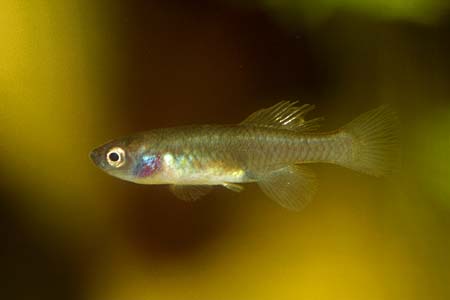
Used with the photographer’s permission. Not licensed for reuse.
Distribution
Profile completeness23 of 24
Community
Questions about Nothobranchius guentheri?
Ask on Discord