Hobbyist group · Cyprinodontiformes
Aplocheiloid Toothcarps
Aplocheiloid Toothcarps spans 3 families.
- Species
- 45
- Families
- 3
- Genera
- 7
- Photographed
- 43 of 45
- Difficulty rated
- 36 of 45
Families
Where they come fromnative records only
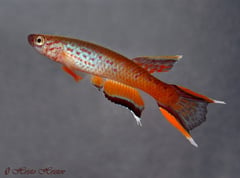
Aphyosemion australeGolden Lyretail
Nothobranchiidae · Rachow, 1921
Aphyosemion australe, the golden or Cape Lopez lyretail, is a killifish from lowland coastal areas of Gabon and Congo. It lives in swamps and small streams and is not an annual species. Among the first killifishes to be widely kept, it is easy to spawn and can live over three years, and wild forms are kept labelled by collection locality to preserve bloodlines.
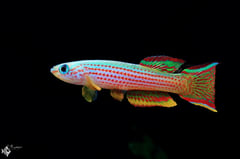
Aphyosemion striatumRed-Striped Lyretail
Nothobranchiidae · Boulenger, 1911
The red-striped lyretail, Aphyosemion striatum, is a killifish from coastal Equatorial Guinea and Gabon, as far south as the lower Ogooué basin. It inhabits perennial lowland rainforest streams, pools and freshwater swamps. Easy to breed and relatively long-lived, since it is not an annual species, it is a good beginner's killifish, though a shy one easily out-competed by more vigorous fishes.
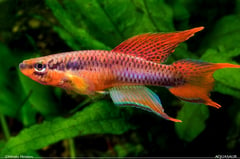
Aphyosemion bitaeniatumTwo-Striped Lyretail
Nothobranchiidae · Ahl, 1924
The two-striped lyretail, Aphyosemion bitaeniatum, is a killifish from lowland coastal regions of Togo, Benin and Nigeria. Its range reaches the Cross River delta and some inland localities along the lower Niger River. Populations in Cameroon, Equatorial Guinea and Gabon are now considered to represent other species.
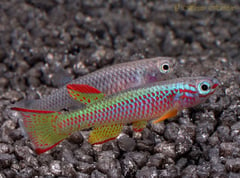
Aphyosemion gabunenseGabon Lyretail
Nothobranchiidae · Radda, 1975
The Gabon lyretail, Aphyosemion gabunense, is a killifish thought endemic to the lower Ogooué river basin in western Gabon. Found in swamps, small streams and pools, it is not an annual species and makes a good beginner's killifish. A very peaceful, shy fish, it is easily outcompeted by more vigorous tankmates and needs a tight-fitting cover, being an accomplished jumper.
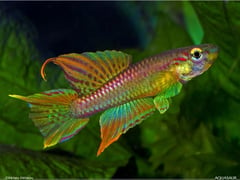
Aphyosemion splendopleureSplendid Lyretail
Nothobranchiidae · Brüning, 1929
The splendid lyretail, Aphyosemion splendopleure, is a killifish from the coastal lowlands of Nigeria, Cameroon, Equatorial Guinea and Gabon. It lives in slow-moving areas of small streams. Several colour forms exist depending on collection locality, and these should not be kept together, to prevent hybridisation. Very shy, it does not compete well with other species and is not recommended for the community aquarium.
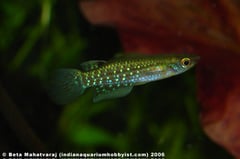
Aplocheilus blockiiGreen Panchax
Aplocheilidae · Arnold, 1911
The green panchax, Aplocheilus blockii, is a small killifish from Sri Lanka and southern India, growing to around 45 mm SL. Euryhaline, it mostly inhabits lowland, often coastal, still or slow-moving brackish or fresh water with surface vegetation or overhanging cover, and is commonly found in mangrove swamps and rice paddies.
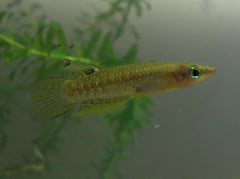
Aplocheilus parvusDwarf Panchax
Aplocheilidae · Sundara Raj, 1916
The dwarf panchax, Aplocheilus parvus, is a small killifish from Sri Lanka and Tamil Nadu state, southeastern India, growing to around 40 mm SL. Euryhaline, it mostly inhabits lowland, often coastal, still or slow-moving brackish or fresh water, and is commonly found in mangrove swamps and rice paddies.
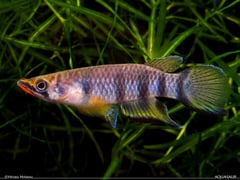
Epiplatys dagetiRed-chinned Panchax
Nothobranchiidae · Poll, 1953
The red-chinned panchax, Epiplatys dageti, is a killifish from coastal savanna in southwestern Ghana, southern Côte d'Ivoire and southern Liberia. An aquarium stalwart since the red-throated form was first exported from Monrovia in 1908, it is relatively hardy and easy to breed, and a good choice for those new to killifishes. The Monrovia fish is often labelled E. dageti monroviae in aquarium literature.
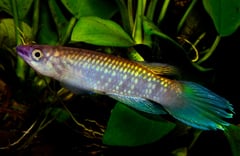
Epiplatys fasciolatusBanded Epiplatys
Nothobranchiidae · Günther, 1866
The banded epiplatys, Epiplatys fasciolatus, is a killifish from coastal Guinea-Bissau, Guinea and Sierra Leone to western Liberia. It mostly inhabits freshwater swamps and minor tributary streams, in grassy savannah at some localities and rainforest at others. Males carry metallic blue or green pigmentation on the body and fins, with a red submarginal band on the anal and lower caudal fins.
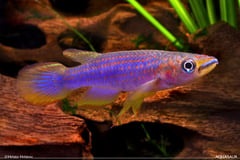
Epiplatys lamotteiRed-spotted Panchax
Nothobranchiidae · Daget, 1954
The red-spotted panchax, Epiplatys lamottei, is a killifish with a restricted range in southeastern Guinea and northern Liberia. Known from the upper Niger, Lofa, Saint Paul and Saint John drainages, it inhabits small streams and minor tributaries, and is threatened by deforestation and mining across some of its range. The flanks carry large dark bars and longitudinal bands made up of small red spots.
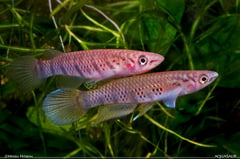
Epiplatys sexfasciatusSix-barred Panchax
Nothobranchiidae · Gill, 1862
The six-barred panchax, Epiplatys sexfasciatus, is a killifish from coastal regions between Gabon and Ghana. Well established in the hobby in several forms, it has a confusing taxonomy, and some authors restrict it to northwestern Gabon and Equatorial Guinea and treat other populations as subspecies. It mostly inhabits freshwater swamps and minor tributary streams, and is relatively easy to breed.
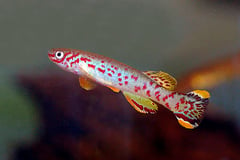
Fundulopanchax scheeli
Nothobranchiidae · (Radda, 1970)
Fundulopanchax scheeli is a killifish from Cameroon and Nigeria, living in small streams and ponds in a few areas of coastal rainforest. It occurs only in permanent water and is not an annual species. Very peaceful and shy, it is easily outcompeted by more vigorous fish and needs carefully chosen tankmates.
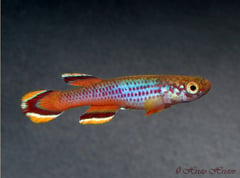
Aphyosemion celiaeCelia's Lyretail
Nothobranchiidae · Scheel, 1971
Celia's lyretail, Aphyosemion celiae, is a killifish from western Cameroon, where it appears restricted to parts of the central Mungo River basin. It was described from a small stream in Mambanda, near Kumba.
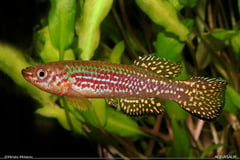
Fundulopanchax gresensi
Nothobranchiidae · Berkenkamp, 2003
Fundulopanchax gresensi is a killifish known only from a small area in the upper Cross River basin, western Cameroon. It has been collected from shallow, swampy sections of forested streams, some of which may dry out in the dry season. The commonest hobby strain is known as 'Takwai'. It jumps well, so the aquarium needs a good cover.
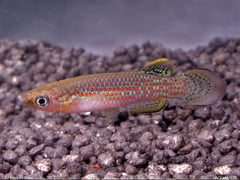
Pachypanchax playfairiiPlayfair's Panchax
Aplocheilidae · Günther, 1866
Playfair's panchax, Pachypanchax playfairii, is a killifish from forest streams in the granitic Seychelles, and has been translocated to Zanzibar. The only purely freshwater fish native to the Seychelles, it is known there from Mahé, Praslin, Silhouette and La Digue. Raised scales on the back of most adult males and a black ocellus in the dorsal-fin of females tell it apart from all congeners.
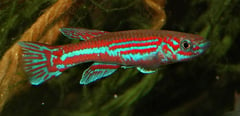
Aphyosemion ogoenseBroken-Line Lyretail
Nothobranchiidae · Pellegrin, 1930
The broken-line lyretail, Aphyosemion ogoense, is a killifish from the upper Ogooué basin in southeastern Gabon and the Republic of the Congo. Found in small streams under forest cover, it is not an annual species. More than 20 forms are known from different localities, a handful with subspecific names such as A. o. ottogartneri and A. o. pyrophore, and they must never be kept together as they may hybridise.
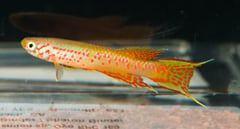
Aphyosemion sp. 'Oyo' RPC 91/8
Nothobranchiidae · authority not recorded
Aphyosemion sp. 'Oyo' RPC 91/8 is a killifish collected for the aquarium hobby in 1991 near the town of Oyo, Republic of the Congo. Oyo lies on the Alima River, a right bank tributary of the middle Congo system. This fish may be synonymous with the congener A. castaneum, and it is best maintained alone with the emphasis on captive breeding.
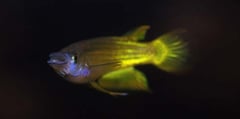
Aplocheilus lineatusStriped Panchax
Aplocheilidae · (Valenciennes, 1846)
The striped panchax, Aplocheilus lineatus, is a predatory killifish from peninsular India and northern Sri Lanka, growing to 10 cm TL. It lives in permanent water from mountain streams and lakes to swamps and rice paddies, and is not an annual species. The golden wonder panchax sold in the trade is a golden form selectively bred in the hobby that does not occur in the wild.
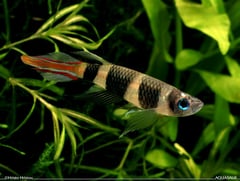
Epiplatys annulatusClown Killifish
Nothobranchiidae · Boulenger, 1915
The clown killifish, Epiplatys annulatus, is a small killifish from coastal lowlands of southern Guinea, Sierra Leone and northwestern Liberia. Also traded as 'rocket killifish' and 'banded panchax', it has four very broad dark bars alternating with yellowish ones. Fin colour varies between populations, which aquarists keep labelled by locality, and it is relatively easy to breed.
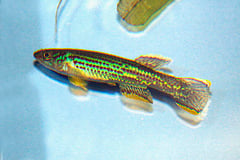
Fundulopanchax marmoratusMarbled Lyretail
Nothobranchiidae · authority not recorded
The marbled lyretail, Fundulopanchax marmoratus, is a rare killifish endemic to Cameroon, found in a single area of coastal rainforest. It inhabits small streams and ponds and occurs only in permanent water, so it is not an annual species. It needs cooler temperatures than most killifishes and is best kept in a species tank.
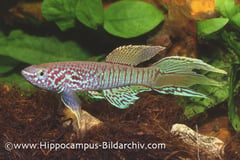
Fundulopanchax sjoestedtiGolden Pheasant
Nothobranchiidae · authority not recorded
The golden pheasant, Fundulopanchax sjoestedti, is a large killifish from Nigeria and Cameroon, reaching 12 cm, found in swampy coastal rainforest. Adult males are admired for their colouration. It was formerly classified as Aphyosemion sjoestedti, and much of the literature still uses that name. Several colour forms exist, including a smaller variety known as 'Dwarf Red'. Males are aggressive towards one another.
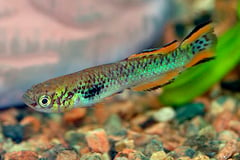
Fundulopanchax walkeri
Nothobranchiidae · authority not recorded
Fundulopanchax walkeri is a predatory killifish from the Ivory Coast and Ghana. It lives in small streams, swamps and ponds in coastal rainforest and forested savanna, and occurs as both an annual and a non-annual fish, so it can breed in permanent and temporary water. It needs cooler water than many killifishes, and will eat any fish that fits in its mouth. Some wild populations are threatened or extinct through rapid human development.
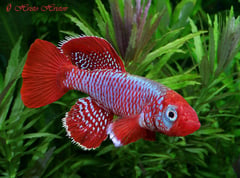
Nothobranchius eggersi
Nothobranchiidae · Seegers, 1982
Nothobranchius eggersi is an annual killifish apparently endemic to the lower Rufiji in eastern Tanzania, including freshwater parts of the delta. It inhabits ephemeral pools and swamps on lowland floodplains that dry out for several months each year, and survives as eggs in the substrate. Many wild populations are in the hobby, labelled with collection codes to limit hybridisation, alongside aquarium strains labelled 'red' or 'blue'.
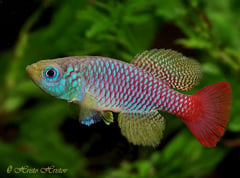
Nothobranchius foerschi
Nothobranchiidae · Wildekamp & Berkenkamp, 1979
Nothobranchius foerschi is an annual killifish from eastern Tanzania that may be restricted to a small area of the Ruvu River catchment. All confirmed records come from the Ruvu and its delta, between Soga and the coast at Bagamoyo. It inhabits ephemeral pools and swamps on lowland floodplains, mostly heavily overgrown with terrestrial vegetation, and an aquarium strain appears more yellowish than the wild form.
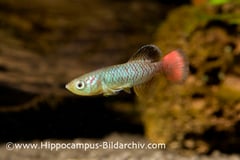
Nothobranchius guentheriGunther's Nothobranch
Nothobranchiidae · (Pfeffer, 1893)
Gunther's nothobranch, Nothobranchius guentheri, is an annual killifish endemic to Unguja, the main island of Zanzibar, Tanzania. It lives in seasonal coastal pools that dry out completely, surviving the dry season as eggs in the mud. One of the easier Nothobranchius to keep and breed, it is often recommended for a first attempt at an annual killifish. The IUCN lists it as Endangered because its pools are being lost to farming.
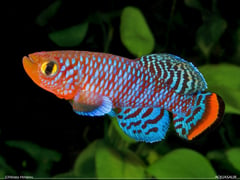
Nothobranchius rachoviiBluefin Nothobranch
Nothobranchiidae · Ahl, 1926
The bluefin nothobranch, Nothobranchius rachovii, is a killifish of seasonal pools and swamps in eastern Mozambique. Its habitats dry out for several months each year and the adults die, while the eggs survive in the substrate and hatch when the rains return. Northern and southern populations once included in it are now described as N. krysanovi and N. pienaari, and N. rachovii sensu stricto is restricted to the lower Pungwe and Zambezi basins.
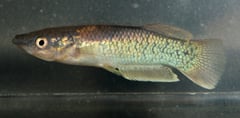
Pachypanchax arnoulti
Aplocheilidae · Loiselle, 2006
Pachypanchax arnoulti is a killifish endemic to western Madagascar, where it occurs in the Mahavavy du Sud and Betsiboka river systems. It was in the hobby for many years as the congener P. omalonotus and appears under that name in most older aquarium literature, so a degree of hybridisation has undoubtedly occurred. The absence of metallic gold spots on the flanks separates it from that species. Its populations have declined dramatically since the 1950s.
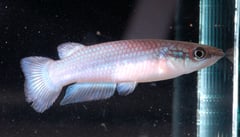
Pachypanchax omalonotusPowder-blue Panchax
Aplocheilidae · Duméril, 1861
The powder-blue panchax, Pachypanchax omalonotus, is a killifish from Nosy Be and the adjacent Sambirano River system in northwestern Madagascar. Many fish in the hobby identified as P. omalonotus are in fact P. arnoulti, as are those in much older aquarium literature, and a degree of hybridisation has undoubtedly occurred. Metallic gold spots on the flanks separate it from that species, and males are polymorphic, with yellow, red and blue morphs in different populations.
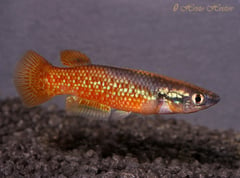
Pachypanchax sakaramyiMadagascar Panchax
Aplocheilidae · Holly, 1928
The Madagascar panchax, Pachypanchax sakaramyi, is a killifish from high-gradient forest streams around the Ambohitra Massif in northern Madagascar. The only remaining riverine populations are in a short stretch of the Sakaramy River and the upper Antongombato River, most of the original populations having been lost to invasive species, deforestation and the diversion of the Sakaramy's source. Despite its conservation status it is relatively well-established in the aquarium hobby.
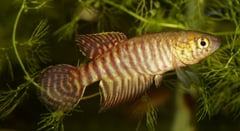
Simpsonichthys myersi
Rivulidae · de Carvalho, 1971
Simpsonichthys myersi is an annual killifish from minor coastal river basins in eastern Brazil, in Bahia and Espírito Santo states. Its range lies between the rio Jucuruçu and the rio Doce. It inhabits rain-fed pools and swamps that dry out each year, when the adults die and the eggs wait in diapause until the rains return. Whether it is conspecific with S. izecksohni remains unclear.
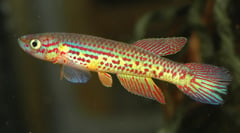
Aphyosemion bochtleriBochtler's Lyretail
Nothobranchiidae · Radda, 1975
Bochtler's lyretail, Aphyosemion bochtleri, is a killifish from northern Gabon, where it occurs in the upper Ivindo River basin of the Ogooué system. It was described from a rainforest stream near Mintoum. Considered a synonym of A. herzogi for a number of years, it is currently recognised as distinct.
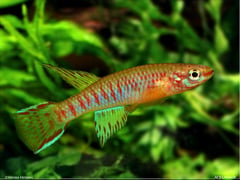
Aphyosemion elbertiRed-Barred Lyretail
Nothobranchiidae · Ahl, 1924
The red-barred lyretail, Aphyosemion elberti, is a killifish from central Cameroon and the upper Mambéré basin in the Central African Republic. Its range follows the Sanaga River system across Cameroon. It was described from 'Jade Plateau, Cameroon', which apparently corresponds to the Lebo River in what is now the Central African Republic.
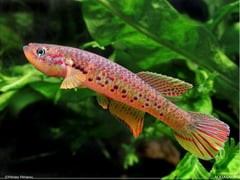
Aphyosemion herzogiHerzog's Lyretail
Nothobranchiidae · Radda, 1975
Herzog's lyretail, Aphyosemion herzogi, is a killifish described from northern Gabon and also found in Equatorial Guinea and southern Cameroon. In Gabon it occurs in the Ivindo and Okano drainages, both tributaries of the Ogooué system. It is also known from the upper parts of some Benito River tributaries in Equatorial Guinea and from the Ntem River in Cameroon.
Aphyosemion loennbergiiLönnberg's Lyretail
Nothobranchiidae · Boulenger, 1903
Lönnberg's lyretail, Aphyosemion loennbergii, is a killifish from southwestern Cameroon, described from the Kienké river (formerly the 'Kribi'). It has a wider distribution in the region and also occurs in the Lokundje and Nyong drainages.
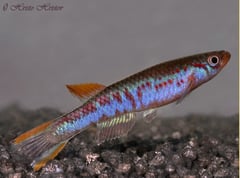
Aphyosemion mimbon
Nothobranchiidae · Huber, 1977
Aphyosemion mimbon is a small killifish from headwater drainages in northwestern Gabon, described from a tributary of the Mvé River. It has also been recorded from the Abanga, Mbei, Komo and Nkam, and may occur across the border in southeastern Equatorial Guinea.
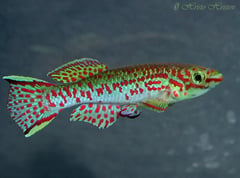
Fundulopanchax gardneriSteel-blue Killifish
Nothobranchiidae · Boulenger, 1911
The steel-blue killifish, Fundulopanchax gardneri, is native to the Cross River system in Nigeria and Cameroon and the Benue River drainage. Also known as Gardner's killi or blue lyretail, the common aquarium forms are among the best choices for those new to killifishes. Wild populations come in numerous colour forms, three of them described as subspecies. Its eggs can withstand a period of drying but will also hatch when kept submerged.
Aphyosemion rectogoense
Nothobranchiidae · Radda & Huber, 1977
Aphyosemion rectogoense is a killifish known only from the Batéké plateau region and surrounding area in southeastern Gabon. It has been recorded from the Léconi-Djouya and upper Mpassa rivers, part of the much larger Ogooué basin, and the type locality is 6 km west of Léconi township.
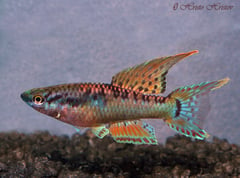
Aphyosemion bivittatumTwo-Banded Lyretail
Nothobranchiidae · Lönnberg, 1895
The two-banded lyretail, Aphyosemion bivittatum, is a killifish that appears restricted to coastal plains along the Cameroon and Nigeria border. Its range includes the Korup and Cross River National Parks, and the type locality is close to a waterfall on the Ndian River in southwestern Cameroon.
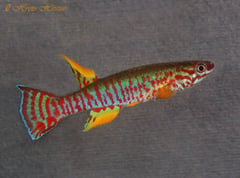
Aphyosemion bualanumBouala Lyretail
Nothobranchiidae · Ahl, 1924
The Bouala lyretail, Aphyosemion bualanum, is a killifish from the upper Benue and Mayo Kébbi systems in Cameroon, Central African Republic and Chad. It is listed as endangered by the IUCN. Before 1990 the name was misused for various populations of A. elberti.
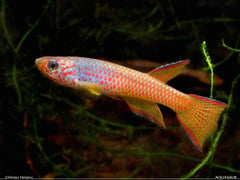
Aphyosemion cognatumRed-Spotted Lyretail
Nothobranchiidae · Meinken, 1951
The red-spotted lyretail, Aphyosemion cognatum, is a killifish from the Democratic Republic of Congo. Its range appears extensive in the middle and lower Congo regions. The type material came from a commercial shipment from Kinshasa and was presumed to have been collected nearby. Specimens from Lac Fwa in the Sankuru River drainage, many hundreds of kilometres from Kinshasa, have been identified as this species.
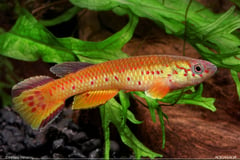
Aphyosemion congicumCongo Lyretail
Nothobranchiidae · Ahl, 1924
The Congo lyretail, Aphyosemion congicum, is a killifish from western Democratic Republic of Congo. It may be restricted to the area between the Kwango and Gamba rivers, but the type series came from a commercial shipment and its natural range remains unconfirmed. The Kwango drains to the Congo through the Kasai.
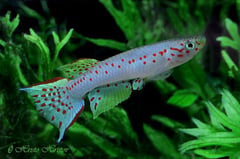
Aphyosemion decorseiDecorse's Lyretail
Nothobranchiidae · Pellegrin, 1904
Decorse's lyretail, Aphyosemion decorsei, is a killifish from the middle Ubangi River basin in the Central African Republic. The Ubangi is a major tributary of the Congo. The type locality is Bessou in Lobaye prefecture, and its range probably extends into northern Republic of Congo and Democratic Republic of Congo.
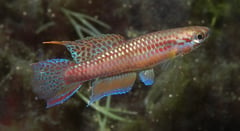
Aphyosemion erythronReddish Lyretail
Nothobranchiidae · Sonnenberg, 2008
The reddish lyretail, Aphyosemion erythron, is a small killifish that appears endemic to southwestern Equatorial Guinea. Described from Río Muni, it has also been collected in the Río Aye, Río Ecucu and lower Río Benito drainages. It was referred to as A. sp. Ecurya before its description.
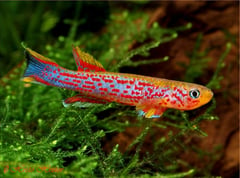
Aphyosemion hanneloreaeHannelore's Lyretail
Nothobranchiidae · Radda & Pürzl, 1985
Hannelore's lyretail, Aphyosemion hanneloreae, is a killifish from Malinga in the Du Chaillu mountains of Ngounié province, southern Gabon. The type locality lies very close to the Republic of the Congo, and the species may also occur across the border.
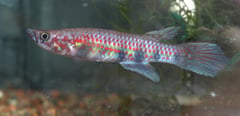
Epiplatys mesogramma
Nothobranchiidae · Huber, 1980
Epiplatys mesogramma is a killifish endemic to the Ubangi (or Oubangui) River drainage in southwestern Central African Republic. The Ubangi is the largest right-bank tributary of the Congo and drains an enormous region, but this species is known from only a handful of localities.