Pao baileyi
Hairy Puffer
Formerly Tetraodon baileyi
Last revised 2026Edit this page
On this page11 sections
Quick factsEdit
Difficulty6 of 8 measures
- Space
- medium tank
- Water
- unknown
- Temp
- needs a steady temperature
- Diet
- needs snails to wear down its teeth
- Temperament
- territorial
- Social
- fine alone
- Compatibility
- choose tankmates carefully
Other demands
Each of these can raise the rating on its own, whatever the measures above say.
- Hardiness
- unknown
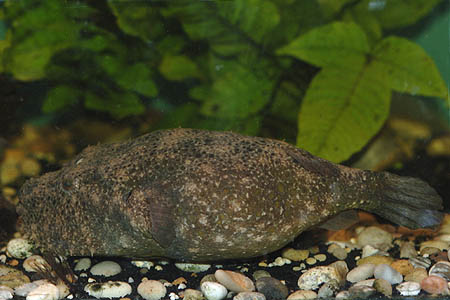
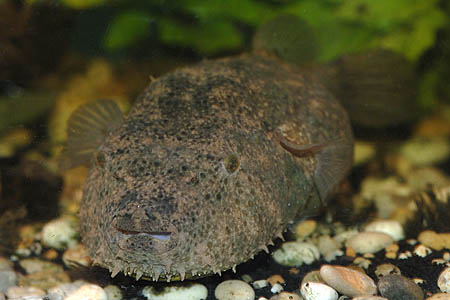
The hairy puffer, Tetraodon baileyi, is a puffer from Thailand and Laos, where it inhabits rocky areas of large rivers, including whitewater. Rare in the hobby, it is covered in cirri of uncertain function and is completely scaleless. An aggressive and intolerant fish, it should be kept alone and fed snails and unshelled shellfish to keep its teeth ground down.
Distribution
EditHabitat
Write a noteEditInhabits rocky areas of large rivers, including areas of whitewater.
Aquarium size
Write a noteEdit75 ∗ 30 ∗ 30 cm30 ∗ 12 ∗ 12 in - ~68 litres~18 US gal.
Maintenance
Write a noteEditA biotope aquarium would consist of a sandy substrate littered with smooth, water worn rocks. Arrange these to provide some hiding places for the fish, and try to provide a moderate current through the tank. It can also be kept in planted aquaria as it will not chew leaves.
Water conditions
EditTemperature: 23 – 27 °C73 – 81 °F
pH: No precise details available, although at least one batch of fish was collected in water of around neutral pH. Assume a range between 6.5-7.5.
Hardness: Again, no accurate data is available. Somewhere between 5-12°H is suggested.
These recommendations come from this profile’s own figures. They contain affiliate links, so we may earn a commission.
Diet
Write a noteEditRelishes all kinds of shellfish, as well as worms and other live and frozen foods. It should be fed snails and unshelled shellfish (such as crab legs, mussels etc.) regularly, in order to maintain it's sharp teeth. As with other puffers, these grow continuously and become a problem for the fish if they are not kept ground down.
Behaviour and compatibility
Write a noteEditA generally aggressive and intolerant species that really should be kept alone. Its beak-like mouth can easily bite chunks from other fish, or in extreme cases rip them to pieces. It's also very aggressive towards conspecifics and should never be kept in groups.
Sexual dimorphism
Write a noteEditMales are said to have a greater number of cirri (the hair-like growths that characterise this species) than females, but this is unconfirmed as others report that females do not possess cirri at all.
Reproduction
Write a noteEditNot thought to have been achieved in aquaria, probably due to its temperament (and pricetag!) restricting the number of hobbyists prepared to make a serious attempt.
Notes
EditPuffer fish are so called as they have the ability to inflate their elastic stomachs with water or air. This is usually a response to some kind of threat, although in the aquarium many specimens appear to inflate themselves for no apparent reason. The fish becomes 2 or 3 times it's normal size, which makes the fish both big enough to scare away many potential predators, and difficult to swallow.
Many parts of the body of puffers contain the deadly neurotoxin tetrodoxin. This is the same poison found in the notorious blue-ringed octopus. When ingested in sufficient quantities, it can cause paralysis and death. As yet there is no known antitoxin and to humans it is over 1000 times deadlier than cyanide. Grotesquely, the victim usually remains conscious as he or she becomes paralysed. It's a famous delicacy in Japan, but is prepared only by highly-trained chefs, and even then many people have died from eating it.
The hairy puffer is rare in the hobby, and tends to command a relatively high price when it is available. The exact nature of the cirri that cover the fish is unknown, but would appear to be related to gender, or possibly camouflage. It can change colour depending on its mood, and, uniquely among puffers, is completely scaleless.
Species images · 2
These photographs are used with each photographer's permission.
Send a photographHow the name has changed
Moved from Tetraodon baileyi to Pao baileyi.
2013The fishes of the inland waters of southeast Asia: a catalogue and core bibliography of the fishes known to occur in freshwaters, mangroves and estuaries.
Distribution
Profile completeness20 of 24
Community
Questions about Pao baileyi?
Ask on Discord