Hobbyist group · Other groups
Tetraodontiformes
- Species
- 20
- Families
- 1
- Genera
- 4
- Photographed
- 20 of 20
- Difficulty rated
- 20 of 20
Families
Where they come fromnative records only
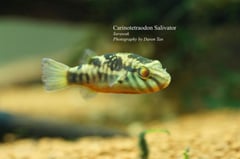
Carinotetraodon salivator
Tetraodontidae · Lim & Kottelat, 1995
Carinotetraodon salivator is a small red-eyed puffer known only from Sarawak, Borneo, in the Lupar, Sarawak and Rajang river systems. Sometimes traded as the 'striped redeye puffer' or 'zebra puffer', it has distinct dark bars on the head and body in both sexes, a colour pattern unique within the genus. Unlike most congeners, there is evidence that it prefers flowing water.
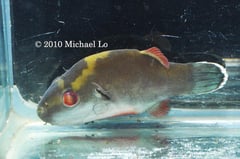
Carinotetraodon borneensis
Tetraodontidae · Regan, 1903
Carinotetraodon borneensis is a small red-eyed puffer known only from southern Sarawak, Malaysia (Borneo), in the Sarawak, Sadong and Rajang rivers. Uncommon in the hobby, it is sometimes mixed among shipments of C. salivator, which has distinct dark bars on the head and body in both sexes. Males in particular tend to be territorial, but a group can be kept where there is enough cover and space.
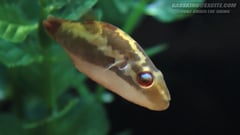
Carinotetraodon irrubescoRed-tailed Redeye Puffer
Tetraodontidae · Tan, 1999
The red-tailed redeye puffer, Carinotetraodon irrubesco, is a small freshwater puffer endemic to Indonesia, known from Sumatra and West Kalimantan. Males have a reddish caudal fin and lack the black spot at the dorsal-fin base seen in the other red-eyed puffers, and the eyes bulge clearly above the head. It has been collected only among submerged riparian vegetation of terrestrial origin, in murky brown water.

Carinotetraodon lortetiRedeye Puffer
Tetraodontidae · Tirant, 1885
The redeye puffer, Carinotetraodon lorteti, is a small freshwater puffer from the lower Mekong basin and the Chao Phraya watershed in Indochina. It inhabits slow-moving to standing water in shady forest streams, minor tributaries and floodplains, often among dense vegetation. It tends to bite the fins of tankmates and is territorially aggressive, so is best kept alone, though a group can be kept with enough space and a suitable layout.

Colomesus asellusAmazon Puffer
Tetraodontidae · Müller & Troschel, 1849
The Amazon puffer, Colomesus asellus, is a freshwater puffer found throughout much of the Amazon basin, with records north to Guyana and Venezuela. Also traded as the South American puffer or 'SAP', it is told from congeners by a transverse row of dermal flaps across the chin. It lives mostly in well-oxygenated river habitats, is intolerant of organic waste, and forms loose aggregations, so a group of 6 or more is best, away from the general community.
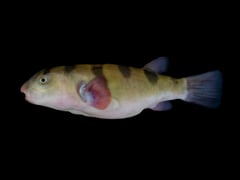
Colomesus psittacusBanded Puffer
Tetraodontidae · Bloch & Schneider, 1801
The banded puffer, Colomesus psittacus, is a large puffer of coastal waters from Colombia and Venezuela through the Guianas to northeastern Brazil. It also occurs in Trinidad and Tobago and the Caribbean islands, and inhabits mangrove swamps, estuaries and the lower reaches of rivers. Growing to 290 mm SL, it is the largest of its genus and has six dark bands across the back. Likely to prove aggressive in all but the largest systems, it is not a popular aquarium fish.
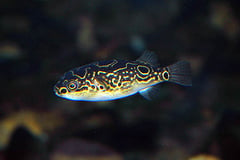
Tetraodon biocellatusFigure Eight Puffer
Tetraodontidae · authority not recorded
The figure eight puffer, Tetraodon biocellatus, is a small puffer from Cambodia, Malaysia and Indonesia. It lives in rivers and coastal waters, most often in freshwater but frequently in brackish conditions. Very sensitive to deteriorating water quality, it tends to live longer with a little marine salt added. It nips the fins of slow-moving or long-finned fish, and single specimens usually live longer in captivity than groups.
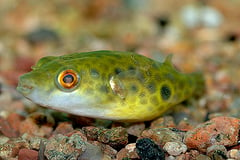
Tetraodon cochinchinensisFang's Puffer
Tetraodontidae · authority not recorded
Fang's puffer, Tetraodon cochinchinensis, is a freshwater puffer from Thailand, Cambodia, Laos and Vietnam. It belongs to the 'target' puffer group, whose members share a range and look very similar, and is told from them by a clear red spot towards the rear of the body. An aggressive and intolerant fish, it should be kept alone.
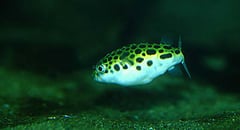
Tetraodon fluviatilisGreen Puffer
Tetraodontidae · authority not recorded
The green puffer, Tetraodon fluviatilis, is a widespread puffer from South and Southeast Asia, found in slow-moving rivers and estuaries. It is often confused with T. nigroviridis and T. schoutedeni but has a more slender, streamlined shape. Though often sold in freshwater, it is a true brackish species and needs a specific gravity of around 1.005 to 1.010 to survive long term.
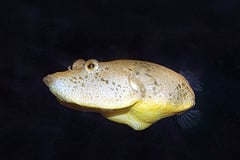
Tetraodon miurusCongo Puffer
Tetraodontidae · authority not recorded
The Congo puffer, Tetraodon miurus, is a predatory puffer from large rivers in the Republic of Congo and the Democratic Republic of Congo. A true ambush predator, it spends most of its time buried in the substrate, so a deep bed of sand is essential. It will eat any fish it can fit in its mouth, takes chunks from larger ones, and is not really safe with anything else.
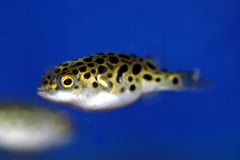
Tetraodon nigroviridisGreen Spotted Puffer
Tetraodontidae · authority not recorded
The green spotted puffer, Tetraodon nigroviridis, is a widespread puffer from South and Southeast Asia, found in both brackish and fresh water. It is often confused with T. fluviatilis and T. schoutedeni. Although often sold as a community fish, it nips slow-moving or long-finned tankmates and some individuals become spiteful with age.
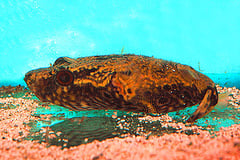
Tetraodon palembangensisHumpback Puffer
Tetraodontidae · authority not recorded
The humpback puffer, Tetraodon palembangensis, is a predatory puffer from Thailand, Laos, Malaysia and Indonesia. An ambush predator, it is very inactive and some specimens move only when food is offered, so it is seen in the trade infrequently and suits the true enthusiast. It is unsuitable for the community tank, though several can share a large tank with plenty of hiding places.
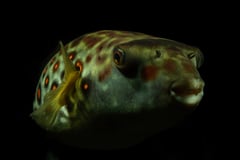
Tetraodon pustulatusCross River Pufferfish
Tetraodontidae · Murray, 1857
The Cross River pufferfish, Tetraodon pustulatus, is a puffer endemic to the Cross River basin of Nigeria and Cameroon. It lives in the moderately fast-flowing main channels and is assessed as endangered by the IUCN. Imports are scarce and costly. Primarily a molluscivore, it can share a tank with smaller, quick, peaceful fish, but similarly sized tankmates may be bitten.
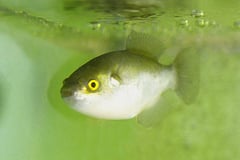
Xenopterus naritusGolden Puffer
Tetraodontidae · authority not recorded
The golden puffer, Xenopterus naritus, is a pufferfish from estuarine rivers in China, Myanmar, Thailand, Vietnam and Indonesia. Much of the available information describes it as a freshwater species, but it appears to be estuarine, and all museum specimens were collected in brackish or marine conditions, so it needs marine salt in aquaria. An aggressive, intolerant fish, it requires its own aquarium and can easily bite chunks from other fish.
Carinotetraodon travancoricusDwarf Puffer
Tetraodontidae · authority not recorded
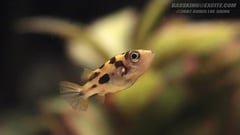
The dwarf puffer, Carinotetraodon travancoricus, is a tiny freshwater puffer endemic to the state of Kerala in southern India. Also known as the Malabar puffer and probably the smallest species of puffer, it usually inhabits sluggish, heavily vegetated inland waters. A popular import, it is often sold without the information needed for its long-term care, and tends to nip the fins of slow-moving or long-finned fish.
Tetraodon baileyiHairy Puffer
Tetraodontidae · authority not recorded
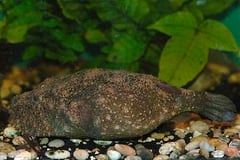
The hairy puffer, Tetraodon baileyi, is a puffer from Thailand and Laos, where it inhabits rocky areas of large rivers, including whitewater. Rare in the hobby, it is covered in cirri of uncertain function and is completely scaleless. An aggressive and intolerant fish, it should be kept alone and fed snails and unshelled shellfish to keep its teeth ground down.
Tetraodon suvattiiArrowhead Puffer
Tetraodontidae · authority not recorded
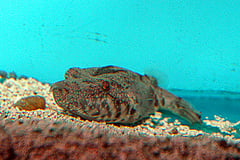
The arrowhead puffer, Tetraodon suvattii, is a predatory puffer from Thailand and Laos, found over rocky or muddy substrates in main river channels. A true ambush predator, it spends most of its time buried in the substrate and will mimic rocks if it cannot dig in. It will eat any fish that fits in its mouth and takes chunks from larger ones, so it is best kept on its own.
Colomesus tocantinensis
Tetraodontidae · Amaral, Brito, Silva & Carvalho, 2013
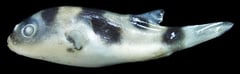
Colomesus tocantinensis is a small freshwater pufferfish from Brazil, known only from the Tocantins River near Porto Nacional in Tocantins state. The type series measured up to 34.9 mm, though it should grow larger. It is distinguished from C. asellus and C. psittacus by fewer anal and dorsal-fin rays, a ventrally notched opercle, no dermal flaps on the chin, and a pale yellow back with five dark bands.
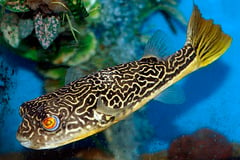
Tetraodon mbuGiant Puffer
Tetraodontidae · authority not recorded
The giant puffer, Tetraodon mbu, is a freshwater pufferfish from rivers and lakes in Central and East Africa, including Lake Tanganyika. Among the most aggressive puffers available, it can reach 75 cm and should be kept alone in a tank of around 240 by 90 by 90 cm. A molluscivore in nature, it needs snails and unshelled shellfish regularly to keep its continuously growing teeth worn down.
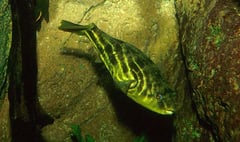
Tetraodon lineatusFahaka Puffer
Tetraodontidae · authority not recorded
The fahaka puffer, Tetraodon lineatus, is a large freshwater puffer from lakes and rivers across northern and West Africa, reaching 43 cm. Also known as the Nile puffer, it was previously named T. fahaka. One of the most aggressive puffers available, it learns to interact with its owner, but should be kept alone and needs no salt in its water.