Reganochromis calliurus
Last revised 2026Edit this page
On this page11 sections
Quick factsEdit
Difficulty5 of 8 measures
- Space
- large tank
- Water
- needs alkaline water
- Temp
- needs a steady temperature
- Diet
- unknown
- Temperament
- peaceful
- Social
- best in a pair
- Compatibility
- unknown
Other demands
Each of these can raise the rating on its own, whatever the measures above say.
- Hardiness
- unknown
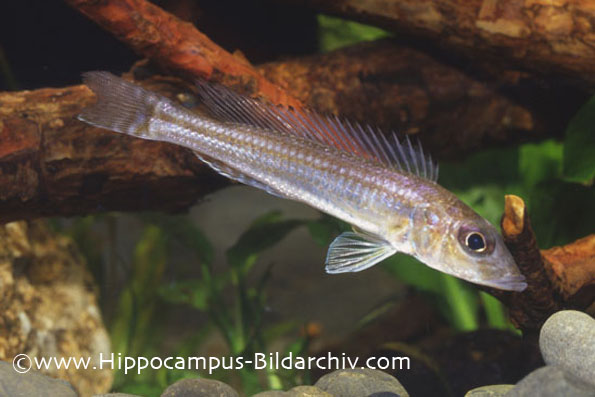
Reganochromis calliurus is a cichlid endemic to Lake Tanganyika, where it usually swims at 60 metres depth or more over sand or mud. Its deep-water lifestyle makes it difficult to collect, and it is rarely seen in the hobby. A peaceful biparental mouthbrooder, it should be kept in pairs and not with boisterous species such as mbuna.
Distribution
EditHabitat
Write a noteEditThis is a deep water (usually swimming at 60 metres depth or more) species found in coastal areas, usually over sandy or muddy substrates.
Aquarium size
Write a noteEdit120 ∗ 45 ∗ 38 cm48 ∗ 18 ∗ 15 in - ~205 litres~54 US gal
Maintenance
Write a noteEditA fairly sparse set up is recommended, with a substrate of sand. Some rocky structures can be added around the back of the aquarium for breeding purposes and to give the fish some security.
Water conditions
EditTemperature: 24 – 27 °C75 – 81 °F
pH: 8.0-9.2
Hardness: 8-25°H
These recommendations come from this profile’s own figures. They contain affiliate links, so we may earn a commission.
Diet
Write a noteEditIt will accept most foods offered but live and frozen varieties should form the bulk of the diet. Vegetable matter does not feature in the natural diet but any meaty fare offered should not be animal in origin.
Behaviour and compatibility
Write a noteEditA peaceful fish that should not be kept with boisterous species such as mbuna, or other Tanganyikans with different dietary requirements. Good tankmates include Gnathochromis permaxillaris and Frontosa. It should be maintained in pairs and a large aquarium is required if more than one pair is to be kept as they become territorial once they have found a partner.
Sexual dimorphism
Write a noteEditReproduction
Write a noteEditPossible but tricky. Bi-parental mouth-brooder. The breeding aquarium should be set up as suggested above. A pH of 8.0-9.0 and a temperature of 24 – 25.5 °C75 – 78 °F are ideal. We recommend the purchase of a group of at least 6-8 young fish and allowing things to develop naturally. You will know when a pair has formed as they will often be seen together in a cave and will become territorial towards conspecifics.
Spawning occurs in the cave and both parents share brooding duties, often swapping the brood between themselves. They may also both hold fry at the same time if the brood is very large. They usually remain in the cave during this period.
The free swimming fry are released after around 3 weeks and will accept brine shrimp nauplii or microworm from this point.
Notes
EditA rarely seen species in the hobby due to its deep water lifestyle and the associated difficulties with collecting it.
Species images · 1
These photographs are used with each photographer's permission.
Send a photographDistribution
Profile completeness19 of 24
79% complete
Also missing: taxonomic authority, a common name, etymology.
Community
Questions about Reganochromis calliurus?
Ask on Discord