Schistura caudofurca
Formerly Noemacheilus laterivittatus Zhu & Wang, 1985 · Nemacheilus laterivittatus Zhu & Wang, 1985 · Schistura laterivittata
Last revised 2026Edit this page
On this page13 sections
Quick factsEdit
Difficulty5 of 8 measures
- Space
- large tank
- Water
- flexible
- Temp
- needs cool water
- Diet
- unknown
- Temperament
- unknown
- Social
- needs to be in a group
- Compatibility
- choose tankmates carefully
Other demands
Each of these can raise the rating on its own, whatever the measures above say.
- Hardiness
- unknown
- Needs strong current, with the filter turning the tank over 8–12 times an hour
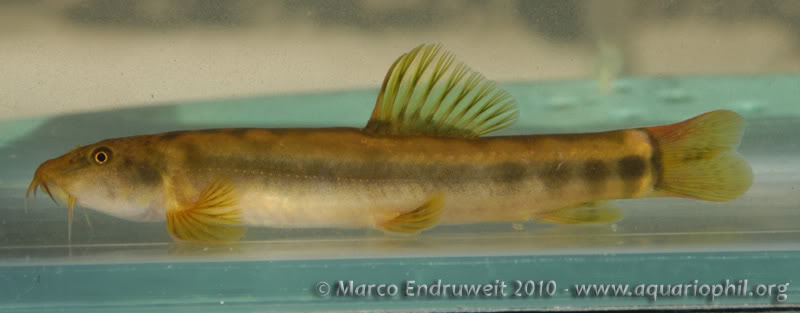
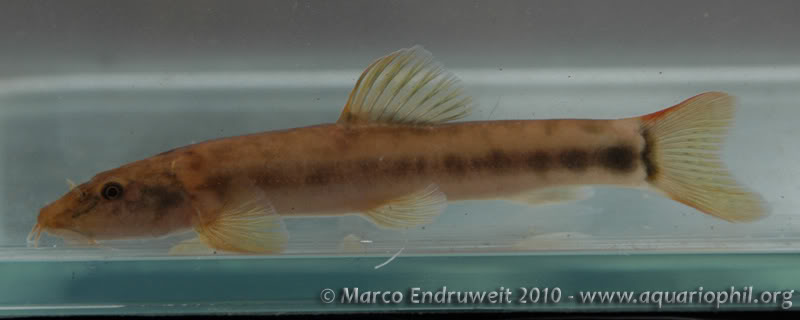
Schistura laterivittata is a nemacheilid loach recorded only from the Babianjiang River in the Red River basin, Yunnan Province, China. Most recent authors have treated it as a synonym of S. caudofurca, but this appears to be a case of misidentification: S. caudofurca has a deeply forked caudal-fin and no dark lateral body stripe. It is expected to occur in Vietnamese waters as well.
Etymology
EditSchistura: from the Greek schizein, meaning 'to divide', and oura, meaning 'tail', in reference to the caudal-fin shape of many species.
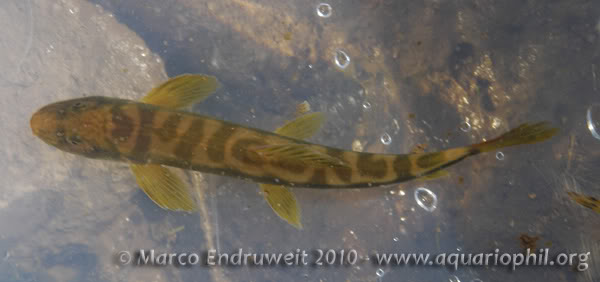
laterivittata: from the Latin lateralis, meaning ‘belonging to the sides or flanks’ and vittatus, meaning ‘barred', in reference to the colour pattern of this species.
Distribution
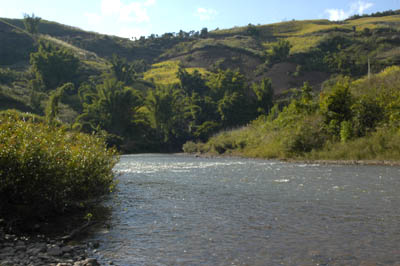
EditType locality is 'Babianjiang River, 24°20'N, 100°10'E, Jingdong County, Yunnan Province, China'.
The Babianjiang joins the Mengyejiang River to form the Langmajiang River, a tributary of the Lixianjiang (Black River) within the Red River basin.
The Red River is known as Yuanjiang in China and it flows from Yunnan province into northern Vietnam where it's known as Sông Cái, so although S. laterivittata has only been recorded in Yunnan to date it's expected to occur in Vietnamese waters.
Habitat
Write a noteEditAs is typical of many Schistura it's known only from clear, well-oxygenated streams around watersheds and headwaters. These are often shaded by forest cover with the substrate invariably composed of coarse sand, gravel, rocks and boulders with no aquatic plants.
Flow rate and turbidity are likely to vary somewhat depending on the time of year and weather conditions with the Red River basin located in a tropical monsoon region and notorious for its violent floods.
At one locality in the Mengyejiang River S. callichromus was collected from a 40 m wide riffle section flowing over rocks and pebbles. The water was 20 – 40 cm8 – 16 in deep with a temperature of 17 ºC, pH 8.8, 170 µS/cm, 85 mg/l (ppm, TDS).
The fish were observed hunting invertebrates in the spaces between the rocks and sympatric species included Schistura callichroma, Schistura sp., Sinogastromyzon tonkinensis, Beaufortia daon, Pseudecheneis paviei, and Glyptothorax quadriocellatus.
Aquarium size
Write a noteEditEven a small group will need an aquarium with base dimensions of 120 ∗ 30 cm48 ∗ 12 in or similar.
Maintenance
Write a noteEditLikely to fare best in a tank designed to resemble a flowing stream or river with a substrate of variably-sized rocks, sand, fine gravel, and some water-worn boulders.
Use a powerful external filter, additional powerhead(s), or airstone(s) to achieve the desired flow rate and oxygenation, and carry out weekly water changes of 30-50 % aquarium volume.
Water conditions
EditThese recommendations come from this profile’s own figures. They contain affiliate links, so we may earn a commission.
Diet
Write a noteEditSchistura species are omnivorous although the bulk of their diet consists of small insects, worms, crustaceans, and other zooplankton with only relatively small amounts of plant matter and other organic detritus consumed.
In the aquarium they will accept dried foods of a suitable size but should not be fed these exclusively.
Daily meals of small live and frozen fare such as Daphnia, Artemia, bloodworm, etc., will result in the best colouration and condition.
In a set-up with moving water they will often shoot up to snatch morsels passing in the flow.
Behaviour and compatibility
Write a noteEditAquarium behaviour is currently unknown though it certainly appears to be a robust fish and we wouldn't recommend combining it with slow-moving, long-finned, or very placid tankmates.
Wild specimens have been observed to live in social aggregations of up to 6 individuals so keeping a group may be feasible in larger aquaria.
Sexual dimorphism
Write a noteEditNone recorded.
Reproduction
Write a noteEditUnrecorded.
Notes
EditAt time of writing this species has probably not been maintained in aquaria.
It's been considered a synonym of Schistura caudofurca (Mai, 1978) by the majority of recent authors following Kottelat (2001) but this appears to be a case of misidentification since the two species exhibit several notable differences based on their respective descriptions (Endruweit, 2010)[4].
In S. caudofurca the pelvic-fin reaches the anal-fin (vs. not reaching anal-fin in S. laterivittata), the caudal-fin is deeply forked to half of its length (vs. emarginate) and there is no dark lateral body stripe (vs. dark body stripe present, faint in some specimens).
Schistura is the most species-rich genus among nemacheilid loaches with some 190 members and it continues to grow with over 100 having been described since 1990. It may represent a polyphyletic lineage and is often arranged into a number of loosely-defined species 'groups', some of which are quite dissimilar to one another.
Among these are an assemblage in which some or all of the body bars are vertically split and another which exhibit reductions in body size (adult size <50 mm2.0 in SL), the number of pelvic and pectoral-fin rays and often the number of caudal-fin rays and lateral line length, for example.
Some species, such as S. geisleri, also appear to be unrelated to any of the others.
Most inhabit flowing streams or areas close to waterfalls where there naturally exist high concentrations of dissolved oxygen, and a handful are troglobytic, i.e., cave-dwelling, in existence. The latter have reduced pigmentation and are completely blind in many cases.
Schistura spp. are distinguished from other nemacheilids by a combination of morphological characters which include: a moderately arched mouth which is 2-3.5 times wider than it is long; a median 'interruption' in the lower lip which does not form two lateral triangular pads and can vary from smooth to furrowed in texture; diverse colour pattern but usually dark with relatively regular bars; usually a black bar at the caudal-fin base which can be broken into two spots or smaller bars; one or two black markings along the base of the dorsal-fin; lack of acuminate scales on the caudal peduncle; caudal-fin shape variable from truncate to forked but usually emarginate; presence or absence of a median notch in the lower jaw; clear sexual dimorphism in some species.
The family Nemacheilidae is widely-distributed across most of Eurasia with the Indian subcontinent, Southeast Asia and China representing particular centres of species diversity.
References
- Tang, Q., H. Liu, R. Mayden and B. Xiong (2006). Comparison of evolutionary rates in the mitochondrial DNA cytochrome b gene and control region and their implications for phylogeny of the Cobitoidea (Teleostei: Cypriniformes). Molecular Phylogenetics and Evolution 39(2), 347-357
- Šlechtová, V., J. Bohlen and H. H. Tan (2007). Families of Cobitoidea (Teleostei; Cypriniformes) as revealed from nuclear genetic data and the position of the mysterious genera Barbucca, Psilorhynchus, Serpenticobitis and Vaillantella. Molecular Phylogenetics and Evolution 44(3), 1358-1365
- Kottelat, M. (1990). Indochinese nemacheilines. A revision of nemacheiline loaches (Pisces: Cypriniformes) of Thailand, Burma, Laos, Cambodia and southern Viet Nam. Verlag Dr. Friedrich Pfeil, München, Germany, 1-262
- Endruweit, M. (ed) (2012). Aquariophil World Wide Web electronic publication, www.aquariophil.org, accessed on 2012.05.17, Accessed on 12.10.04
- Kottelat, M. (2001). Freshwater fishes of northern Vietnam. A preliminary check-list of the fishes known or expected to occur in northern Vietnam with comments on systematics and nomenclature. Environment and Social Development Unit, East Asia and Pacific Region. The World Bank, i-iii + 1-123 + 1-18
- Kottelat, M. (2012). Conspectus cobitidum: an inventory of the loaches of the world (Teleostei: Cypriniformes: Cobitoidei). Raffles Bulletin of Zoology Supplement 26, 1-199
Species images · 4
These photographs are used with each photographer's permission.
Send a photographHow the name has changed
Renamed from Schistura laterivittata to Schistura caudofurca.
2012Conspectus cobitidum: an inventory of the loaches of the world (Teleostei: Cypriniformes: Cobitoidei).
Distribution
Profile completeness20 of 24
83% complete
Also missing: a common name, water condition notes.
Community
Questions about Schistura caudofurca?
Ask on Discord