Trichromis salvini
Salvini · Salvin's Cichlid
Formerly Cichlasoma salvini
Last revised 2026Edit this page
On this page11 sections
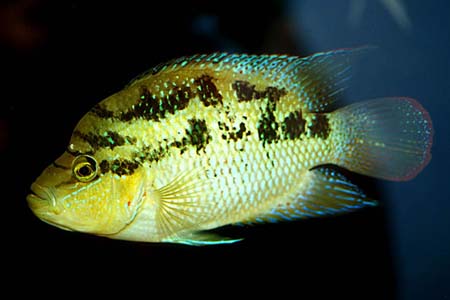
Quick factsEdit
Difficulty4 of 8 measures
- Space
- large tank
- Water
- flexible
- Temp
- needs a steady temperature
- Diet
- unknown
- Temperament
- territorial
- Social
- unknown
- Compatibility
- unknown
Other demands
Each of these can raise the rating on its own, whatever the measures above say.
- Hardiness
- unknown
Salvin's cichlid, Trichromis salvini, is a Central American cichlid native to eastern parts of southern Mexico, Guatemala and Belize. It has a well-deserved reputation for aggression, especially when breeding, and will prey on any fish it can fit in its mouth. It does not need a huge tank, with males reaching around 6 inches and females 4.5, and a true pair is best obtained by growing on six juveniles. It is still often sold as Cichlasoma salvini.
Distribution
EditHabitat
Write a noteEditUnlike many members of the genus this species apparently spends quite a lot of its time hunting in the flowing central parts of rivers and tributaries.
Aquarium size
Write a noteEdit36"L x 15"H x 12"W (90cm x 37.5cm x 30cm) - 102 litres
Maintenance
Write a noteEditSalvini tend to prefer a sand substrate. A lot of hiding places are a necessity if you intend to keep more than one Salvini, or if you intend to keep the Salvini with other aggressive fish. Plants will be appreciated but Salvini require a large open area for swimming too.
Water conditions
EditTemperature: 22 – 26 °C72 – 79 °F
pH: 6.5 to 8.0
Hardness: 8 - 15°dH
These recommendations come from this profile’s own figures. They contain affiliate links, so we may earn a commission.
Diet
Write a noteEditOmnivorous. Will generally eat anything offered, including flake. Feed a good quality cichlid pellet as staple but vary regularly with live and frozen foods. Also occasionally offer a good quality vegetable/spirulina flake or other vegetable matter.
Behaviour and compatibility
Write a noteEditIt's primarily carnivorous, the natural diet consisting of aquatic invertebrates and small fish. Aggressive for its size. Only house with similarly aggressive, similarly sized north/central American fish like Jack Dempseys. Very territorial. Will predate on any fish it can fit in its mouth.
Sexual dimorphism
Write a noteEditMales have more vivid colouration, and their dorsal and anal fin tips are more pointed. Also, there is a more noticeable contrast between the males' black and white patches. Females have a patch in the centre of their dorsal fins, and a dark spot at the bottom of their gill plates.
Reproduction
Write a noteEditThese fish may take time to pair up. As with most central and north American cichlids, the best way of obtaining a true pair is to grow 6 juveniles on. Buying two mature fish certainly does not mean that they will pair up and if they don't, aggression will soon ensue.
Parents will initially clean the surfaces of a number of chosen spawning sites.
Female will lay upto 500 eggs spread about the aquarium at these spawning sites. Both parents will guard eggs and fry, exhibiting good parental care.
Adults will provide fry with an early nutritional source. For this reason, do not seperate fry from their parents until a month after they have hatched.
Notes
EditSalvin's Cichlid has a well deserved reputation for aggression, especially when breeding.
They are regularly available in the trade and make an extremely colourful addition to any north/central American aggression tank. Take care when choosing tank mates, however. If only this species is kept in the tank, it will be quite shy until mature or until the natural domination order has been established. If a single fish of this species is kept alone, it will be extremely shy, usually choosing to hide until feeding time.
Not recommended for the beginner, though if the aggression issues are adequately dealt with, the Salvini offers a beautiful, hardy fish which doesn't require a huge tank like some of the north and central American cichlids.
Species images · 3


These photographs are used with each photographer's permission.
Send a photographHow the name has changed
Moved from Cichlasoma salvini to Trichromis salvini.
Distribution
Profile completeness20 of 24
83% complete
Also missing: etymology.
Community
Questions about Trichromis salvini?
Ask on Discord