Every species
Filters

Belontia signataCeylonese Combtail
(Günther, 1861)
Max length120mm SL5in SLTank120 × 30cm48 × 12inTemp20–27°C68–81°FpH6.0–7.5The Ceylonese combtail, Belontia signata, is a labyrinth fish endemic to the central and southern river systems of Sri Lanka. Also referred to as the 'Ceylon fighting fish', it differs from B. hasselti in its reddish body and the absence of mosaic patterning in the unpaired fins. At least three putative phenotypes have been recorded, one described as the questionably valid subspecies B. s. jonklaasi. It is not recommended for the average community aquarium.
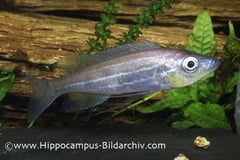
Benthochromis tricoti
(Poll, 1948)
Max length165mm TL6in TLTank150 × 60cm60 × 24inTemp24–27°C75–81°FpH7.5–9.0Benthochromis tricoti is a deep-water cichlid endemic to Lake Tanganyika, where it lives in open water and feeds on zooplankton. The species is seldom seen in the hobby as it is difficult to collect and ship, and the similar B. horii, described in 2008, had been confused with it and traded under its name. It needs a long tank with the upper two thirds left clear for swimming, and calm tankmates.

Betadevario ramachandrani
Pramod, Fang, Rema Devi, Liao, Indra, Jameela Beevi & Kullander, 2010
Max length61mm SL2.4in SLTank120 × 30cm48 × 12inTemp18–23°C64–73°FpH6.0–7.0Betadevario ramachandrani is a danionin cyprinid known only from two sites in the upper Sita River drainage near Agumbe, Karnataka, India. Agumbe lies in heavily forested country in the Western Ghats and is among the rainiest places in India. An active species, it suits a tank set up like a flowing stream at 18 to 23 °C, and its constant movement and vigorous feeding can stress less active tankmates.

Betta akarensis
Regan, 1910
Max length80mm SL3.1in SLTank60 × 30cm24 × 12inTemp21–27°C70–81°FpH5.5–7.5Betta akarensis is a paternal mouthbrooding labyrinth fish from Borneo, collected in Brunei and the Malaysian state of Sarawak. It lends its name to the Betta akarensis group of closely related species and is considered one of the more widely distributed Bornean Betta. Most are collected from blackwater, though it also lives in clear flowing streams, roadside ditches and larger ponds.

Betta albimarginata
Kottelat & Ng, 1994
Max length30mm SL1.2in SLTank45 × 30cm18 × 12inTemp23–28°C73–82°FpH4.0–6.5Betta albimarginata is a small mouthbrooding labyrinth fish that appears endemic to the Sebuku River drainage in East Kalimantan, Indonesian Borneo. It lives among marginal plant roots and leaf litter in forest streams only 5 to 10 cm deep. With B. channoides it forms the Betta albimarginata group, and the two look very similar: in B. albimarginata the unpaired fins have a broad white distal band and a broad dark submarginal band around a plain red inner portion.

Betta antoni
Tan & Ng, 2006
Max length50mm SL2.0in SLTank60 × 30cm24 × 12inTemp22–27°C72–81°FpH5.5–7.0Betta antoni is a mouthbrooding labyrinth fish that appears endemic to the lower Kapuas basin in West Kalimantan, Indonesian Borneo. Known as Betta sp. 'Sanggau' before its description, it belongs to the Betta akarensis group. It inhabits quiet margins and still pools in clear, flowing forest hill streams, and live fish show blue iridescence on the body scales and a distinct black lower lip.

Betta balunga
Herre, 1940
Max length50mm SL2.0in SLTank60 × 30cm24 × 12inTemp22–27°C72–81°FpH5.0–7.0Betta balunga is a mouthbrooding labyrinth fish from Borneo, found from Tawau in Sabah, Malaysia, south to the Sebuku and Mahakam basins in Indonesia. A member of the Betta akarensis group, it has a reddish-orange iris in life. In the Sebuku it lives in very shallow forest streams among roots and leaf litter, and in the Mahakam basin in sluggish blackwater streams among submerged marginal vegetation.

Betta bellicaSlender Betta
Sauvage, 1884
Max length90mm SL3.5in SLTank80 × 30cm31 × 12inTemp25–30°C77–86°FpH4.0–7.0The slender betta, Betta bellica, is a bubble-nesting labyrinth fish from Peninsular Malaysia and northeastern Sumatra, Indonesia. It lends its name to the B. bellica group of long, slender fishes with iridescent green markings on each scale. Most often found in peat swamp forests and blackwater streams, it feeds almost entirely on insects and is a prodigious jumper, seen leaping to take prey from overhanging leaves. Populations are often labelled by locality to preserve pure bloodlines.

Betta brownorum
Witte & Schmidt, 1992
Max length30mm SL1.2in SLTank45 × 30cm18 × 12inTemp24–30°C75–86°FpH3.0–6.0Betta brownorum is a small bubble-nesting labyrinth fish endemic to Borneo, found in southern and western Sarawak and in West Kalimantan. A member of the B. coccina group, it is a stenotypic inhabitant of peat swamp forests and their blackwater streams. Both sexes carry a large iridescent green lateral blotch on a reddish-magenta body, though patterning within the group can be similar and confusingly variable.

Betta burdigala
Kottelat & Ng, 1994
Max length35mm SL1.4in SLTank45 × 30cm18 × 12inTemp22–30°C72–86°FpH4.0–6.0Betta burdigala is a small bubble-nesting labyrinth fish endemic to the island of Bangka, off the east coast of Sumatra, Indonesia. A stenotypic inhabitant of peat swamps and blackwater streams, it belongs to the B. coccina group and is most similar to B. uberis. The species is exceptionally rare in the hobby, and many fish traded or pictured under its name are B. uberis or another congener.

Betta channoidesSnakehead Betta
Kottelat & Ng, 1994
Max length40mm SL1.6in SLTank45 × 30cm18 × 12inTemp23–30°C73–86°FpH4.0–6.5The snakehead betta, Betta channoides, is a small mouthbrooding labyrinth fish from the Mahakam basin in East Kalimantan, Indonesian Borneo. It inhabits shallow forest streams with brownish, acidic water, among leaf litter and marginal plant roots. With the very similar B. albimarginata it forms the Betta albimarginata group, and displaying males are scarlet, with an almost entirely red dorsal fin edged by a thin white band.

Betta chloropharynxGreen Throat Mouthbrooder
Kottelat & Ng, 1994
Max lengthnot recordedTank80 × 30cm31 × 12inTemp24–28°C75–82°FpH3.5–6.0The green throat mouthbrooder, Betta chloropharynx, is a labyrinth fish described from Bangka, an island off the east coast of Sumatra, Indonesia. A member of the Betta waseri group, it is told apart from all others in the group by its lighter throat markings, which form a shape like a horizontal figure of eight. It generally inhabits peat swamps and blackwater streams, and a Sumatran population once thought conspecific was described as B. pardalotos in 2009.

Betta coccinaScarlet Betta
Vierke, 1979
Max length40mm SL1.6in SLTank45 × 30cm18 × 12inTemp22–30°C72–86°FpH4.0–6.0The scarlet betta, Betta coccina, is a small bubble-nesting labyrinth fish from Jambi and Riau provinces in Sumatra and Johor in Peninsular Malaysia. It lends its name to the B. coccina group and is a stenotopic inhabitant of peat swamp forests and associated streams. Males carry an iridescent green lateral blotch that females lack, and populations are often labelled by locality, such as Jambi, Riau or Johor, to preserve pure bloodlines.

Betta cracens
Tan & Ng, 2005
Max length60mm SL2.4in SLTank80 × 30cm31 × 12inTemp22–27°C72–81°FpH5.5–6.5Betta cracens is a mouthbrooding labyrinth fish from the Jambi area of Sumatra, Indonesia, and it may also occur on nearby Bangka island. The most slender member of the B. pugnax complex, it is rare in the hobby, and most fish sold under the name are misidentified or mislabelled B. pugnax, B. raja or related species. Fish collected on Bangka have appeared in the hobby as Betta sp. 'Bangka'.

Betta dennisyongi
Tan, 2013
Max length36mm SL1.4in SLTank45 × 30cm18 × 12inTemp22–27°C72–81°FpH5.0–7.0Betta dennisyongi is a small mouthbrooding labyrinth fish from the western coast of central Aceh province, northwestern Sumatra, Indonesia. It belongs to the B. rubra group and is typically exported mixed with the similar B. rubra, so the two may have been inadvertently hybridised before its description by Tan (2013). It has been collected among submerged leaf litter in lowland hill streams and acidic freshwater swamps.

Betta dimidiata
Roberts, 1989
Max length40mm SL1.6in SLTank45 × 30cm18 × 12inTemp22–27°C72–81°FpH5.2–6.5Betta dimidiata is a small mouthbrooding labyrinth fish that appears endemic to the upper Kapuas drainage in West Kalimantan, Indonesian Borneo. It is often confused in the trade with B. krataios, formerly B. sp. 'Kapuas', but the caudal fin separates them: rounded in B. krataios, spade-shaped and more extended in adult B. dimidiata. It inhabits shaded forest swamp streams and pools, some only a few centimetres deep.

Betta edithae
Vierke, 1984
Max length60mm SL2.4in SLTank80 × 30cm31 × 12inTemp20–27°C68–81°FpH5.0–7.0Betta edithae is a paternal mouthbrooding labyrinth fish from Indonesia, recorded across Kalimantan, southern Sumatra, Bangka, Belitung and Bintan. The only member of the B. edithae group, it is separated from all other Betta spp. by its opaque or translucent branchiostegal membrane and posterior opercle. Fish from Bintan differ from Bornean specimens in several characters, and it remains unclear whether all populations are conspecific.

Betta enisae
Kottelat, 1995
Max length60mm SL2.4in SLTank45 × 30cm18 × 12inTemp21–24°C70–75°FpH5.5–7.0Betta enisae is a paternal mouthbrooding labyrinth fish known only from parts of the River Kapuas basin in West Kalimantan, Indonesian Borneo. A member of the B. pugnax complex, whose species are notoriously difficult to tell apart, it has transverse bars in the caudal fin. Populations differ in colour and pattern and are often labelled with collection details such as Putussibau or Sentarum. It inhabits cool, shaded forest streams and swamp pools stained with humic acids.

Betta falx
Tan & Kottelat, 1998
Max length50mm SL2.0in SLTank60 × 30cm24 × 12inTemp22–27°C72–81°FpH4.7–6.8Betta falx is a small paternal mouthbrooding labyrinth fish endemic to Sumatra, Indonesia, where most collections come from Jambi province. A member of the B. picta group, it has greenish blue iridescent opercular scales and a reddish distal band on the anal and caudal fins. It inhabits shaded forest swamp streams and pools, some only a few centimetres deep, with negligible mineral content and a low pH.

Betta foerschi
Vierke, 1979
Max length50mm SL2.0in SLTank60 × 30cm24 × 12inTemp22–28°C72–82°FpH4.0–6.0Betta foerschi is a paternal mouthbrooding labyrinth fish from a handful of localities in Central and West Kalimantan, Indonesian Borneo. It lends its name to the B. foerschi group, whose members have iridescent blue or green unpaired fins and two reddish-yellow bars on the opercle. Fish traded as B. foerschi are often the closely-related B. mandor, and the two can be difficult to tell apart.