Every species
Filters

Barbonymus schwanefeldiiTinfoil barb
(Bleeker, 1854)
Max length355mm SL14in SLTank210 × 60cm84 × 24inTemp20–28°C68–82°FpH6.0–8.0The tinfoil barb, Barbonymus schwanefeldii, is a large cyprinid found across much of Southeast Asia, from the Mekong to Borneo and Sumatra. Usually sold at 50 to 75 mm, it grows to 355 mm SL, and tinfoil barbs are among the species most often returned to shops having outgrown their aquarium. Selectively-bred 'golden' and 'blushing' strains exist, and the species has also been subjected to artificial dyeing.
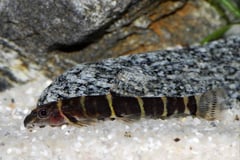
Barbucca diabolica
Roberts, 1989
Max length50mm SL2.0in SLTank60 × 30cm24 × 12inTemp20–25°C68–77°FpH5.5–7.5Barbucca diabolica is a small 'scooter' loach from the upper-middle Kapuas basin in West Kalimantan, Indonesian Borneo, with one specimen from Johor. Barbucca spp. keep near-continuous belly contact with solid surfaces and often swim inverted or vertically. Most fish seen have red eyes and six dark body stripes, but several undescribed species exist and more than one may have been exported. Kottelat (2012) erected the family Barbuccidae for the genus.

Barilius vagra
(Hamilton, 1822)
Max length125mm SL5in SLTank150 × 60cm60 × 24inTemp18–26°C64–79°FpH6.0–7.5Barilius vagra is a cyprinid widely distributed in the Ganges and Brahmaputra river systems of northern India, Nepal and Bangladesh. Poorly known in the hobby but exported on occasion, it has 10 to 14 vertical bars on each flank that do not extend below the lateral line. It inhabits well-oxygenated, fast-flowing rivers and tributaries with gravel, cobble and boulder substrates, and its speed and vigorous feeding make it unsuitable for the general community.
Bario oligolepisGlass Tetra
authority not recorded
Max length50mm SL2.0in SLTank60 × 38cm24 × 15inTemp24–28°C75–82°FpH5.5–7.2The glass tetra, Bario oligolepis, is a characin from northern South America, with populations in Venezuela, the Guianas, Peru and Brazil. One of a handful of species that closely resemble the red-eye tetra, it is seen much less often in the hobby and is also known as the glassy tetra. It inhabits slow-moving rivers, tributaries and floodplain lakes. Very peaceful, it does not compete well with boisterous or much larger tankmates.

Bario sanctaefilomenaeRed-eye Tetra
authority not recorded
Max length70mm SL2.8in SLTank90 × 38cm36 × 15inTemp22–26°C72–79°FpH6.0–8.0The red-eye tetra, Bario sanctaefilomenae, is a characin from Brazil, Paraguay and Argentina, living mostly in clear rivers that feed the Pantanal. All fish in the trade are captive-bred in huge numbers and are unfussy about water chemistry and diet. Somewhat boisterous, it suits a community of active tankmates such as similarly sized tetras, rainbowfish and barbs, and can intimidate sedate species such as anabantoids or dwarf cichlids.
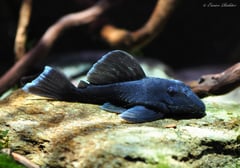
Baryancistrus begginiL239
Lujan, Arce & Armbruster, 2009
Max length81mm SL3.2in SLTank80 × 30cm31 × 12inTemp26–30°C79–86°FpH5.5–7.5Known as L239 before description, Baryancistrus beggini is a small loricariid from the Orinoco and lower río Guaviare in Venezuela and Colombia. Its body and fins are uniformly black to brownish with a turquoise to bluish sheen. Placement in Baryancistrus is tentative. Territorial with conspecifics but somewhat delicate, it is not recommended for the general community aquarium.
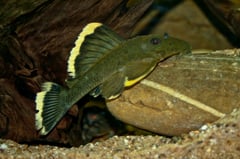
Baryancistrus chrysolomusMango Pleco
Rapp Py-Daniel, Zuanon & Ribeiro de Oliveira, 2011
Max length219mm SL9in SLTank120 × 45cm48 × 18inTemp27–32°C81–90°FpH6.0–7.5The mango pleco, Baryancistrus chrysolomus, traded as L047, is a loricariid endemic to the rio Xingu basin in Pará state, Brazil. A broad, usually yellowish band along the edges of the dorsal and caudal fins throughout life separates it from B. xanthellus, whose bands shrink to tips in adults. It grows to around 220 mm SL, and males in particular become highly intolerant of conspecifics as they age.
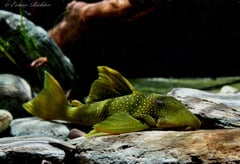
Baryancistrus demantoidesGreen Phantom Pleco
Werneke, Sabaj Pérez, Lujan & Armbruster, 2005
Max length151mm SL6in SLTank120 × 45cm48 × 18inTemp26–30°C79–86°FpH5.5–7.5The green phantom pleco, Baryancistrus demantoides, is a suckermouth catfish known only from where the río Ventuari meets the Orinoco in Venezuela. It closely resembles Hemiancistrus subviridis, which lives alongside it, and both have been marketed as L200. B. demantoides is the less common and more expensive of the two, sometimes sold as 'L200 high-fin' or 'L200a' for its longer dorsal-fin spine. Males become increasingly intolerant of conspecifics as they age.
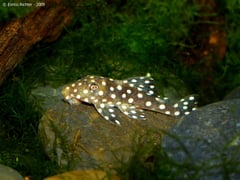
Baryancistrus sp. L142Big White Spot Pleco
authority not recorded
Max length250mm SL10in SLTank120 × 45cm48 × 18inTemp27–32°C81–90°FpH6.0–7.5The big white spot pleco, Baryancistrus sp. L142, is an undescribed suckermouth catfish from the rio Tapajós in Pará state, Brazil. It appears restricted to a short stretch of the river between Itaituba and Pimenta, in shallow, fast-flowing, warm water. The species is also traded as 'snowball pleco', a name first applied to Hypancistrus inspector and now used for several similar white- or yellow-spotted fishes. Males become highly intolerant of conspecifics as they age.
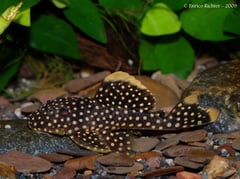
Baryancistrus xanthellusGold Nugget Pleco
Rapp Py-Daniel, Zuanon & Ribeiro de Oliveira, 2011
Max length224mm SL9in SLTank120 × 45cm48 × 18inTemp27–32°C81–90°FpH6.0–8.0The gold nugget pleco, Baryancistrus xanthellus, is a suckermouth catfish endemic to the rio Xingu basin in Pará state, Brazil. It lives in whitewater rapids in the Volta Grande do rio Xingu, between Belo Monte falls and the mouth of the rio Iriri. Before its description it was traded as L018, L085, L177 and LDA060, and L081 is the same fish. Males become highly intolerant of conspecifics as they age.

Batasio feruminatus
Ng & Kottelat, 2008
Max length60mm SL2.4in SLTank90 × 30cm36 × 12inTemp16–24°C61–75°FpH6.0–7.0Batasio feruminatus is a small bagrid catfish from the Ataran River system in southern Myanmar, to which it is possibly endemic. Some Ataran tributaries extend across the border into Thailand. Like its congeners it is an obligate inhabitant of shallow, fast-flowing, highly-oxygenated headwater streams. B. feruminatus alone in the genus has both an oblique dark bar in front of the dorsal fin and a thin black midlateral stripe.
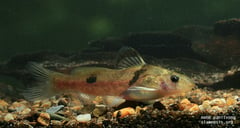
Batasio fluviatilis
(Day, 1888)
Max length72mm SL2.8in SLTank120 × 30cm48 × 12inTemp16–24°C61–75°FpH6.0–7.0Batasio fluviatilis is a small bagrid catfish from southern Thailand and Peninsular Malaysia, below the Isthmus of Kra. Like its congeners it is an obligate inhabitant of shallow, fast-flowing, highly-oxygenated headwater streams, and it is largely unsuitable for the 'general' community aquarium. Batasio havmolleri is considered a junior synonym, and this is one of the Batasio species that has been spawned in captivity.
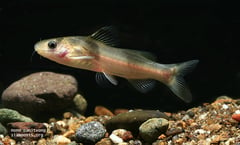
Batasio tigrinus
Ng & Kottelat, 2001
Max length80mm SL3.1in SLTank120 × 30cm48 × 12inTemp17–23°C63–73°FpH6.0–7.0Batasio tigrinus is a small bagrid catfish that appears endemic to the Khwae Noi basin, often called the River Kwai, in western Thailand. The Khwae Noi is part of the larger Mae Klong watershed. Like its congeners it is an obligate inhabitant of shallow, fast-flowing, highly-oxygenated headwater streams, and it is largely unsuitable for the 'general' community aquarium.

Batasio travancoriaMalabar Batasio
Hora & Law, 1941
Max length100mm SL3.9in SLTank120 × 30cm48 × 12inTemp18–25°C64–77°FpH6.0–7.0The Malabar batasio, Batasio travancoria, is a bagrid catfish endemic to southern Kerala, India, in the Pamba, Chittar and Kallada drainages. Its darkish midlateral stripe and poorly-defined post-opercular spot separate it from B. sharavtiensis, the only other described member of the genus in southwestern India. Like its congeners it is an obligate inhabitant of shallow, fast-flowing, highly-oxygenated headwater streams.
Beaufortia cyclica
Chen, 1980
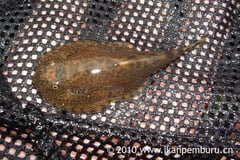
Max length40mm SL1.6in SLTank80 × 30cm31 × 12inTemp16–24°C61–75°FpH6.0–8.5Beaufortia cyclica is a hillstream loach known from a handful of localities in the Xi River drainage and the Tuoniang river system in southern China. Its flattened head and body and horizontal paired fins form a sucking cup that lets it cling to rocks in shallow, fast-flowing, highly-oxygenated headwaters. Kottelat (2012) states that B. cyclica may be a synonym of B. elongata.
Beaufortia kweichowensisButterfly Loach
(Fang, 1931)
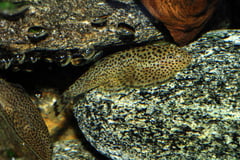
Max length75mm SL3.0in SLTank60 × 30cm24 × 12inTemp16–24°C61–75°FpH6.5–8.0The butterfly loach, Beaufortia kweichowensis, is a hillstream loach from the Xi Jiang (West River) system in southern China. In many countries it is the most common gastromyzontid in the shops, one of several loaches traded as 'butterfly loach', 'Hong Kong plec' or 'Chinese hillstream loach' regardless of species. The name B. leveretti is often applied to it. It needs clean, well-oxygenated, fast-flowing water, and 16 to 24 °C is recommended.
Beaufortia szechuanensis
(Fang, 1930)
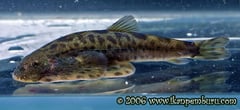
Max length69mm SL2.7in SLTank75 × 30cm30 × 12inTemp16–24°C61–75°FpH6.5–8.0Beaufortia szechuanensis is a hillstream loach from the upper Yangtze River basin in Sichuan province, southwestern China. It has been recorded from several tributary systems including the Qing, Wu and Da Ning He. Its flattened head and body and horizontal paired fins form a sucking cup that lets it cling to rocks in shallow, fast-flowing, highly-oxygenated headwaters.
Bedotia madagascariensisMadagascan Rainbow Fish
Regan, 1903
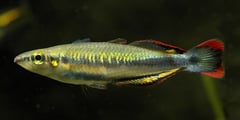
Max length100mm SL3.9in SLTank120 × 30cm48 × 12inTemp23–32°C73–90°FpH4.5–7.5The Madagascan rainbow fish, Bedotia madagascarensis, comes from small streams and the lower reaches of rivers in eastern Madagascar. First imported in the 1950s, it continues to be misidentified and traded as Bedotia geayi, a congener from the Mananjary River system further south. Males are told apart by the caudal fin, where the midlateral stripe extends into black central rays, and B. geayi males also have a red spot on the lower jaw.
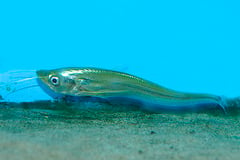
Belodontichthys dinema
(Bleeker, 1851)
Max length1000mm TL39in TLTank180 × 60cm72 × 24inTemp22–27°C72–81°FpH5.6–7.0Belodontichthys dinema is a large, open-water predatory catfish from the Malay Peninsula, Sumatra and Borneo that reaches 100 cm TL in the wild. It eats only fish and needs a very large aquarium without tankmates small enough to swallow. Fish exported from Thailand or elsewhere in Indochina under this name are likely to be B. truncatus, the species found in the Mekong and Chao Phraya basins.

Belontia hasseltiJava Combtail
(Cuvier, 1831)
Max length200mm SL8in SLTank120 × 30cm48 × 12inTemp21–26°C70–79°FpH4.5–8.5The Java combtail, Belontia hasselti, is a labyrinth fish from peninsular Thailand, Peninsular Malaysia, Singapore, Sumatra, Borneo and Java. Also known as the 'Malay combtail', it mostly inhabits acidic forest peat swamps with little water movement. It differs from its only congener, B. signata, in its brownish grey body and the mosaic pattern in its unpaired fins. Growing to 200 mm SL, it will eat very small fishes and is not recommended for the average community aquarium.