Every species
Filters
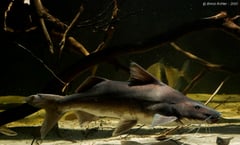
Brachyplatystoma vaillantiiPiramutaba
(Valenciennes, 1840)
Max length1050mm SL41in SLTanknot recordedTemp22–28°C72–82°FpH6.0–8.0The piramutaba, Brachyplatystoma vaillantii, is a large migratory pimelodid catfish from the Amazon and Orinoco watersheds and rivers of the Guianas. Juveniles feed in the Amazon delta before migrating upstream in massive numbers, when they are subject to intensive capture by commercial and artisanal fisheries. Sexually mature adults have been observed in the rio Caquetá basin, some 3500 km from the estuary. It grows to 1050 mm SL.
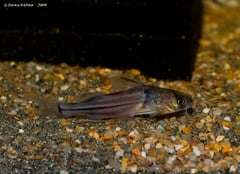
Brachyrhamdia meesi
Sands & Black, 1985
Max length61mm SL2.4in SLTank80 × 30cm31 × 12inTemp24–28°C75–82°FpH6.0–7.5Brachyrhamdia meesi is a small heptapterid catfish described from near Belém, at the mouth of the Amazon in Brazil. Its precise distribution is unclear, with one record from the Río Madre de Dios basin in Peru. Rare in the hobby, it is normally imported as bycatch among other fishes, particularly Otocinclus, and juveniles may mimic Otocinclus or smaller Corydoras. A dark vertical bar through the eye separates it from the similar B. marthae.
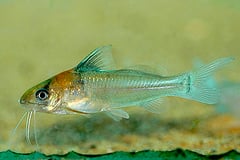
Brachyrhamdia rambarraniFalse Adolfoi
(Axelrod & Burgess, 1987)
Max length55mm SL2.2in SLTank80 × 30cm31 × 12inTemp24–28°C75–82°FpH4.0–7.0The false adolfoi, Brachyrhamdia rambarrani, is a heptapterid catfish from the Rio Unini, a blackwater tributary of the lower rio Negro in Brazil. It occurs with, and mimics, Hoplisoma davidsandsi, sharing its basic colour pattern, while the common name comes from its resemblance to H. adolfoi. Rarely seen in the trade, it tends to turn up as a contaminant among shipments of other species.
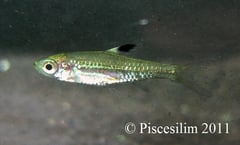
Brevibora cheeya
Liao & Tan, 2011
Max length55mm SL2.2in SLTank80 × 30cm31 × 12inTemp20–25°C68–77°FpH4.0–7.0Brevibora cheeya is a small cyprinid from Peninsular Malaysia, Sumatra and the island of Bangka. The type locality is a slow-flowing, acidic stream in coastal heath forest over sand and peat. Very rare in the trade, it is normally imported only as bycatch among other fishes. A complete lateral line, more scales in the lateral row and a larger adult size separate it from the better-known B. dorsiocellata.
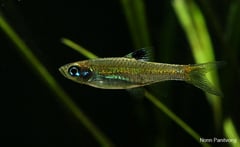
Brevibora dorsiocellataEyespot Rasbora
(Duncker, 1904)
Max length23mm SL0.9in SLTank45 × 30cm18 × 12inTemp20–25°C68–77°FpH5.0–7.5The eyespot rasbora, Brevibora dorsiocellata, is a small cyprinid from southern Thailand, Peninsular Malaysia, Borneo and Sumatra. It is also traded as the 'green-eyed', 'emerald-eyed' or 'hi-spot' rasbora. The common, commercially produced form is plain-coloured with a greenish-blue reflective patch in the eye, while a probably wild-caught form seen from time to time has russet red at the base of the tail. Some Bornean records may refer to B. cheeya.
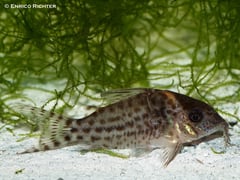
Brochis agassiziiSpotted Cory
(Steindachner, 1876)
Max length70mm SL2.8in SLTanknot recordedTemp22–27°C72–81°FpH6.0–8.0The spotted cory, Brochis agassizii, long known as Corydoras agassizii, is an armoured catfish from the Amazon around the border of Brazil and Peru, described from near Tabatinga. Its name is commonly misapplied to similar-looking fishes, and it can be hard to identify even when the collection locality is known. It is most often confused with B. ambiacus, and fish matching that species appear far more common in the trade.
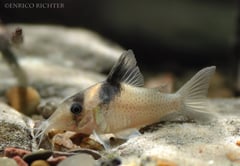
Brochis amandajanea
(Sands, 1995)
Max length65mm SL2.6in SLTanknot recordedTemp23–27°C73–81°FpH6.0–7.5Brochis amandajanea, long known as Corydoras amandajanea, is an armoured catfish from the Rio Miuã system of streams off the upper Rio Negro in Brazil. It is rare in the aquarium trade and appears to be variable in colour pattern, some individuals having larger dark spots on the body. Little has been written about it since its description, and the congener B. cryptica was described from the same locality.
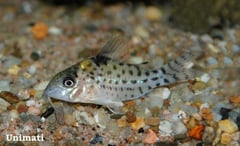
Brochis ambiacus
(Cope, 1872)
Max length65mm SL2.6in SLTanknot recordedTemp21–27°C70–81°FpH6.0–8.0Brochis ambiacus, long known as Corydoras ambiacus, is an armoured catfish from the upper Amazon tributaries of Peru, Brazil, Colombia and Ecuador, described from the Río Ampiyacu. Its name is commonly misapplied to similar-looking fishes, particularly B. agassizii, and the colour pattern is variable. Cope described a large black spot covering the front half of the dorsal fin, and fish matching this are far more common in the trade than those matching B. agassizii.
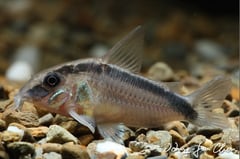
Brochis arcuataSkunk Cory; C020
(Elwin, 1938)
Max length55mm SL2.2in SLTanknot recordedTemp20–28°C68–82°FpH5.0–7.5The skunk cory, Brochis arcuata, long known as Corydoras arcuatus, is an armoured catfish from the upper Amazon region in Brazil, Peru, Ecuador and Colombia. It is among the more popular Corydoras in the hobby and is also known as the 'arched cory' or C020. Several similar-looking congeners exist, particularly Hoplisoma urucu, in which the black body stripe ends behind the eye, and the larger C. narcissus from the rio Purus.
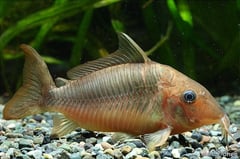
Brochis britskiiGiant Brochis
Nijssen & Isbrücker, 1983
Max length90mm SL3.5in SLTank120 × 45cm48 × 18inTemp20–26°C68–79°FpH6.0–7.0The giant brochis, Brochis britskii, long known as Corydoras britskii, is an armoured catfish restricted to the upper rio Paraguay in Mato Grosso state, Brazil. It grows to around 90 mm SL and can be told from B. splendens and B. multiradiata, the other two species long kept in Brochis, by its 15 to 18 dorsal-fin rays. It forms aggregations in smaller tributaries and still waters such as backwaters, oxbows and marginal lakes.
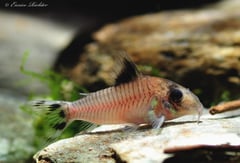
Brochis condiscipulus
(Nijssen & Isbrücker, 1980)
Max length65mm SL2.6in SLTank90 × 30cm36 × 12inTemp20–26°C68–79°FpH6.0–7.5Brochis condiscipulus, long known as Corydoras condiscipulus, is an armoured catfish native to the Oyapock (Oiapoque) river system in French Guiana and Amapá state, Brazil. It often occurs alongside the similar-looking Hoplisoma oiapoquense, from which it differs in its larger adult size, narrower body, shorter pectoral spine and longer snout.
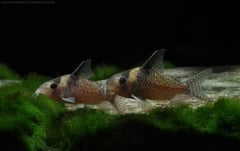
Brochis delphax
(Nijssen & Isbrücker, 1983)
Max length60mm SL2.4in SLTank90 × 30cm36 × 12inTemp22–27°C72–81°FpH5.5–7.5Brochis delphax, long known as Corydoras delphax, is an armoured catfish from the Río Inírida and other parts of the upper Orinoco basin in Colombia. The name is used often in the trade, sometimes for misidentified congeners, while B. delphax itself is often traded as C. punctatus. A relatively elongated snout, body spots that fade in adults and spots in the caudal fin are said to separate it from B. agassizii, Hoplisoma brevirostre and others.
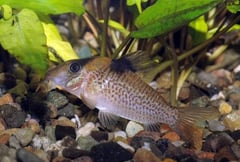
Brochis ephippiferaSaddle Cory
(Nijssen, 1972)
Max length60mm SL2.4in SLTanknot recordedTemp20–25°C68–77°FpH6.0–7.5The saddle cory, Brochis ephippifera, long known as Corydoras ephippifer, is an armoured catfish native to Amapá state in northeastern Brazil. It resembles several congeners, including B. agassizii, Hoplisoma brevirostre, B. delphax and H. melanistium, but seems unique among them in having all fins except the dorsal transparent and unmarked. Detailed observations from the wild are scarce.
Brochis geryi
authority not recorded
Max length70mm SL2.8in SLTank60 × 38cm24 × 15inTemp22–26°C72–79°FpH6.0–7.2Brochis geryi, long known as Corydoras geryi, is an armoured catfish from the Río Mamoré basin in Bolivia. Not commonly seen, it is one of the larger corys in the hobby at around 7 cm.
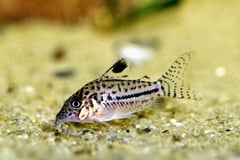
Brochis gomezi
(Castro, 1986)
Max length60mm SL2.4in SLTank90 × 30cm36 × 12inTemp20–26°C68–79°FpH6.0–7.5Brochis gomezi, long known as Corydoras gomezi, is an armoured catfish from the western Amazon basin in Colombia and Peru, including the 'Tres Fronteras' region. Collection records are scarce and its range is unclear. It resembles B. leopardus, B. orphnopterus, C018 and C131, but has separate, distinct spots on the upper body, six bands on the caudal fin and a relatively slender body.
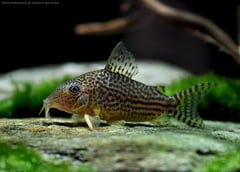
Brochis haraldschultziMosaic Cory
(Knaack, 1962)
Max length85mm SL3.3in SLTank120 × 30cm48 × 12inTemp24–28°C75–82°FpH5.5–7.5The mosaic cory, Brochis haraldschultzi, long known as Corydoras haraldschultzi, is an armoured catfish endemic to the rio Guaporé (Río Iténez) in northeastern Bolivia and western Brazil. It resembles Hoplisoma sterbai but has a more extended snout and grows larger, to 85 mm SL. Its head carries dark vermiculations and spots on a light background, where H. sterbai has light markings on dark. The type locality was once modified to the rio Tocantins, well over 1000 km away, but the original Guaporé locality appears to be correct.
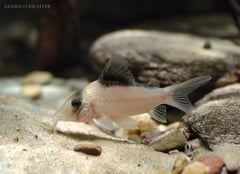
Brochis imitatorImitator Cory
(Nijssen & Isbrücker, 1983)
Max length65mm SL2.6in SLTank90 × 30cm36 × 12inTemp20–26°C68–79°FpH4.0–7.0The imitator cory, Brochis imitator, long known as Corydoras imitator, is an armoured catfish endemic to the upper rio Negro basin in northern Brazil and southern Venezuela. It is one of several rio Negro congeners with an oblique dark bar along the dorsal surface of the body, a group that includes Hoplisoma adolfoi, H. burgessi and H. duplicareum. It inhabits pristine blackwater tributaries and flooded forest with tea-coloured water, very little hardness and a pH of 4.0-6.0.
Brochis incolicanaC001
(Burgess, 1993)
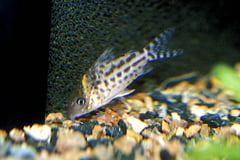
Max length80mm SL3.1in SLTank120 × 30cm48 × 12inTemp20–26°C68–79°FpH4.0–7.0Brochis incolicana (C001), long known as Corydoras incolicana, is an armoured catfish from the rio Içana in the upper rio Negro basin, northern Brazil. It presumably also occurs in eastern Colombia, where the Içana forms the border. The first fish to receive a 'C' number, in 1993, it was described the same year in a hobbyist magazine and is difficult to identify accurately. The colour pattern is said to be extremely variable, but the dark bar through the eye and the dark marking at the dorsal-fin base are apparently consistent.
Brochis lambertiC009
(Nijssen & Isbrücker, 1986)
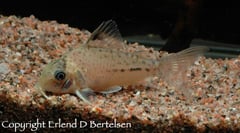
Max length55mm SL2.2in SLTank80 × 30cm31 × 12inTemp20–26°C68–79°FpH6.0–8.0Brochis lamberti (C009), long known as Corydoras lamberti, is an armoured catfish known only from the lower Río Pastaza, a tributary of the Río Marañón in Loreto, northern Peru. Similar-looking fish are known from tributaries close to Iquitos, and it is unclear whether these, 'C009' and B. lamberti are the same species. It is rare in the hobby and difficult to identify without collection details, so it may have been traded under other names.
Brochis leopardusLeopard Cory
(Myers, 1933)
Max length61mm SL2.4in SLTank60 × 38cm24 × 15inTemp20–25°C68–77°FpH6.0–7.2The leopard cory, Brochis leopardus, long known as Corydoras leopardus, is a spotted armoured catfish from the western Amazon basin in Peru, Ecuador, Bolivia and Brazil. It looks very like Hoplisoma julii and H. trilineatum, but has a longer, more pointed snout and grows larger. Dias et al. (2024) moved it to the genus Brochis and put the two lookalikes in Hoplisoma, so the resemblance does not reflect a close relationship. The type specimens were aquarium imports.