Every species
Filters

Channa luciusForest Snakehead
(Cuvier, 1831)
Max length400mm SL16in SLTank150 × 60cm60 × 24inTemp20–30°C68–86°FpH5.0–7.5The forest snakehead, Channa lucius, is a predatory snakehead from Indochina, Peninsular Malaysia and the Greater Sunda Islands. Also referred to as the 'splendid' or 'shiny' snakehead, it occurs on Sumatra, Borneo and Java, grows to 400 mm SL and favours forest swamps and tributaries. Like others in the genus it breathes atmospheric air, and it needs a dimly-lit tank with plenty of cover and a tightly-fitting lid, since Channa spp. are notorious for their ability to escape.
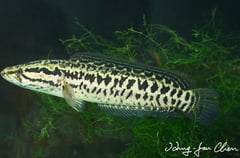
Channa maculataBlotched Snakehead
(Lacepède, 1801)
Max length300mm SL12in SLTanknot recordedTempnot recordedpHnot recordedThe blotched snakehead, Channa maculata, is a snakehead from coastal drainages of southeastern China, including Hong Kong, and northern Vietnam. It is frequently confused with C. argus but has fewer fin rays and lateral line scales and carries 2-3 rounded blotches on the caudal peduncle. An important food fish, it has become established in Japan, Taiwan, the Philippines, Madagascar and Hawaii, and hybrids with C. argus appear to be quite common in aquaculture.
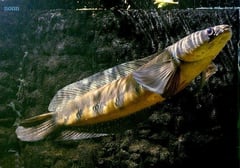
Channa marulioidesEmperor Snakehead
(Bleeker, 1851)
Max length650mm SL26in SLTanknot recordedTemp22–30°C72–86°FpH6.0–8.0The emperor snakehead, Channa marulioides, is a large snakehead from southern Thailand, Malaysia and Indonesia, including Borneo and Sumatra. Colour pattern varies with locality, and it is often confused with C. marulius and C. melanoptera, all three presenting taxonomic problems. Growing to 650 mm SL, it is pelagic, turns aggressive towards its own kind at sexual maturity and is suitable only for public installations or the very largest private aquaria.

Channa maruliusBullseye Snakehead
(Hamilton, 1822)
Max length600mm SL24in SLTanknot recordedTemp15–28°C59–82°FpH6.0–8.0The bullseye snakehead, Channa marulius, is a large snakehead recorded from Pakistan across southern Asia to southern China, Laos and Vietnam. Also called the 'giant', 'cobra' or 'Indian' snakehead, it is widely accepted to represent a complex of related species in need of further research. Reports of 120-180 cm remain to be proven, with 500-600 mm a more common adult size, and it is suitable only for public installations or the very largest private aquaria.
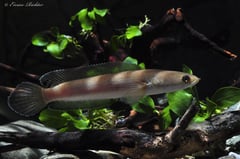
Channa melasomaBlack Snakehead
(Bleeker, 1851)
Max length300mm SL12in SLTank120 × 45cm48 × 18inTemp22–32°C72–90°FpH4.0–7.0The black snakehead, Channa melasoma, is a snakehead from southern Thailand, Peninsular Malaysia, Singapore, Borneo, Sumatra and the Philippines. It can be told apart from the similar C. baramensis, once considered a synonym, by lacking a black spot in the centre of many body scales and a barred caudal fin. In nature it appears to favour clear forest streams with mud and leaf litter, but it has also been recorded from acidic blackwater in peat swamp forest.

Channa micropeltesGiant Snakehead
(Cuvier, 1831)
Max length1300mm SL51in SLTanknot recordedTemp20–30°C68–86°FpH6.0–8.0The giant snakehead, Channa micropeltes, is a predatory fish from Southeast Asia that grows to well over a metre. Juveniles are sold as 'red' or 'redline' snakehead, but it is suitable only for public installations or the very largest private aquaria. Unlike most Channa species it is pelagic and needs plenty of room to swim, and adults become aggressive at sexual maturity.
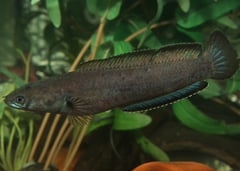
Channa orientalisCeylon snakehead
Bloch & Schneider, 1801
Max length100mm SL3.9in SLTank90 × 30cm36 × 12inTemp23–26°C73–79°FpH5.0–7.5The Ceylon snakehead, Channa orientalis, is a small snakehead without pelvic fins, endemic to the wet zone of southwestern Sri Lanka. Its name has been widely misapplied to Channa populations elsewhere in South and Southeast Asia, most of them now considered C. gachua. Probably endangered in the wild, it is a paternal mouthbrooder that forms lasting pair bonds, and captive breeding should be the priority when keeping it.
Channa pleurophthalmaOcellated Snakehead
(Bleeker, 1851)
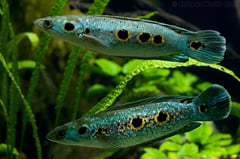
Max length350mm SL14in SLTank240 × 60cm96 × 24inTemp22–28°C72–82°FpH6.0–7.5The ocellated snakehead, Channa pleurophthalma, is a snakehead native to southeastern Sumatra and the Kapuas and Barito basins of Indonesian Borneo. It lives in streams and mangroves and is among the few snakeheads known to form aggregations throughout its life. Unlike most Channa spp. it is pelagic and needs plenty of swimming room, with a tank of at least 240 x 60 cm recommended for a fish reaching 350 mm SL.

Channa sp. 'fire and ice'
authority not recorded
Max length150mm SL6in SLTank120 × 30cm48 × 12inTemp22–28°C72–82°FpH6.0–7.5Channa sp. 'fire and ice' is an unidentified snakehead apparently collected in the border region between Myanmar and western Thailand. Named for the red and blue colour pattern on its head, it first appeared in the aquarium trade in 2009 and has also been sold as C. sp. 'cherry'. A paternal mouthbrooder, it has been bred in captivity, and young fish turn highly aggressive towards one another as they mature.

Channa sp. 'five stripe'
authority not recorded
Max lengthnot recordedTank90 × 30cm36 × 12inTemp15–28°C59–82°FpH6.0–8.0Channa sp. 'five stripe' is an unidentified snakehead apparently collected near Alipurduar in West Bengal, close to India's border with Bhutan. It carries a series of five oblique dark bars on the upper flank and has also been traded as C. sp. 'Kerala', a misnomer since Kerala is in southwestern India. It must not be kept at a constant temperature but given defined winter and summer periods, and it is a paternal mouthbrooder bred fairly regularly in captivity.
Channa stewartiiAssamese Snakehead
(Playfair, 1867)
Max length297mm TL12in TLTank120 × 45cm48 × 18inTemp16–25°C61–77°FpH6.0–8.0The Assamese snakehead, Channa stewartii, is a snakehead of the C. gachua group from the Brahmaputra and Ganges basins of India, Bangladesh and Nepal. It is also listed from Bhutan and Myanmar and grows to about 30 cm TL. Keepers give it a cooler winter of about 16-18 °C, it is aggressive towards its own kind, and the male broods the eggs in his mouth.
Characodon lateralisRainbow Characodon
Günther, 1866
Max length65mm SL2.6in SLTank120 × 30cm48 × 12inTemp18–24°C64–75°FpH6.0–8.0The rainbow characodon, Characodon lateralis, is a goodeid putatively restricted to springs below the El Saltito waterfall in Durango, Mexico. Populations above the waterfall in the upper Río Mezquital appear to be the congener C. audax, and the names 'rainbow goodeid' and 'red prince' have been applied to both. Endangered in the wild, each population differs in colour and shape and should be kept separately in aquaria, never mixed with the aquarium strain of unclear origin.

Charax condeiSmall-scale Glass Tetra
authority not recorded
Max length55mm SL2.2in SLTank60 × 38cm24 × 15inTemp23–25°C73–77°FpH6.0–7.4The small-scale glass tetra, Charax condei, is a characin known only from the Rio Negro basin, Brazil, where it inhabits blackwater streams. Rarely seen, it occasionally shows up in the trade as a contaminant among shipments of more popular species, and older literature sometimes calls it Asiphonichthys condei. A micropredator, it threatens much smaller tankmates and should be kept in a group of at least six.

Chela cachiusNeon Hatchet Fish
(Hamilton, 1822)
Max length50mm SL2.0in SLTank90 × 30cm36 × 12inTemp18–24°C64–75°FpH6.0–8.0The neon hatchet fish, Chela cachius, is a deep-bodied cyprinid mostly recorded from the Ganges and Brahmaputra systems of India and Bangladesh. Its extremely deep body means it is unlikely to be confused with any related species, and it is the only valid member of the genus. A habitat generalist, it is an active schooling fish that is best kept in a group of at least 8-10 in a tank with a tightly-fitting cover, since it is an accomplished jumper.
Chilodus punctatusSpotted Headstander
Müller & Troschel, 1844
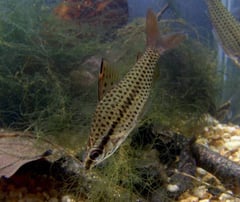
Max length80mm SL3.1in SLTank90 × 30cm36 × 12inTemp20–28°C68–82°FpH5.0–7.5The spotted headstander, Chilodus punctatus, is a headstander from much of the Amazon, the western Orinoco and coastal rivers of Guyana and Suriname. Also called the 'checkered headstander', it lives in slow-moving rivers, oxbows and floodplain lakes, and its colour pattern appears to vary with locality. Shy and peaceful, it is sensitive to dissolved organic wastes and should never be introduced to a biologically-immature aquarium.
Chiloglanis polypogonAfrican Suckermouth Catfish
authority not recorded
Max length55mm SL2.2in SLTank45 × 30cm18 × 12inTemp22–26°C72–79°FpH6.5–7.0Chiloglanis polypogon is an African suckermouth catfish from Nigeria and Cameroon, where it inhabits fast-flowing hilltop streams. Like most of the almost 50 described Chiloglanis, it is seen only rarely in the trade and the species are very difficult to tell apart. It needs strong water flow and well-oxygenated water, and it is peaceful with its own kind and with other rheophilic species.

Chindongo demasoni
(Konings, 1994)
Max length75mm SL3.0in SLTank120 × 45cm48 × 18inTemp24–28°C75–82°FpH7.6–8.8Chindongo demasoni is a dwarf mbuna endemic to Lake Malawi, where it occurs around Pombo Rocks off the Tanzanian coast. It hugs rock surfaces more than most mbuna and is often seen swimming on its side or upside down as it explores caves and crevices. One of the most aggressive and territorial mbuna, it will attack fish several times its own size and is not recommended for the beginner. It is still often sold as Pseudotropheus demasoni.

Chindongo elongatusElongate Mbuna
(Fryer, 1956)
Max length135mm SL5in SLTank120 × 38cm48 × 15inTemp24–28°C75–82°FpH7.6–8.8The elongate mbuna, Chindongo elongatus, is a slender cichlid endemic to Lake Malawi, found in Mbamba Bay and Nkata Bay. Over 30 different forms occur in the lake and they hybridise freely, so they should not be mixed in the aquarium. In nature females defend territories containing 'gardens' of algae. One of the most aggressive and territorial mbuna, it is not recommended for the beginner.

Chindongo flavus
(Stauffer, 1988)
Max length90mm SL3.5in SLTank90 × 45cm36 × 18inTemp24–28°C75–82°FpH7.6–8.8Chindongo flavus is a mbuna endemic to Lake Malawi, recorded only at Chinyankwazi Island and Chinyamwezi Reef. Not especially aggressive for a mbuna, it suits the general mbuna community, but it should not be kept with any member of the C. elongatus complex: the species interbreed and their males clash heavily. Males are far more colourful than females.

Chindongo socolofiPowder Blue Cichlid
(Johnson, 1974)
Max length115mm SL5in SLTank90 × 45cm36 × 18inTemp24–28°C75–82°FpH7.6–8.8The powder blue cichlid, Chindongo socolofi, is a mbuna endemic to Lake Malawi, found along the Mozambique coast between Cobue and Tumbi Point. It is still often sold as Pseudotropheus socolofi. Also known as 'Eduard's mbuna' and 'Pindani', it is one of the most popular Rift Lake cichlids and somewhat peaceful for a mbuna. Both sexes share the same powder blue colouration, which makes it hard to sex. Most fish on sale are tank-bred, and an albino form exists in aquaria.