Every species
Filters

Chagunius baileyi
Rainboth, 1986
Max length200mm SL8in SLTank180 × 60cm72 × 24inTemp18–25°C64–77°FpH6.0–7.5Chagunius baileyi is a large cyprinid endemic to the Salween and Sittaung river basins in Myanmar and western Thailand. Rarely kept, it turns up occasionally as bycatch among shipments of wild fish from Thailand and Myanmar. It looks almost identical to C. chagunio and C. nicholsi, and the three are most easily separated by collection details since their ranges do not overlap. At up to 200 mm it needs a very large tank with plenty of open swimming space.

Chagunius chagunio
(Hamilton, 1822)
Max length450mm SL18in SLTank240 × 90cm96 × 36inTemp20–25°C68–77°FpH6.0–7.5Chagunius chagunio is a large cyprinid endemic to the Ganges and Brahmaputra river basins in northern India, Nepal and Bangladesh. Growing to 400-450 mm, it can only be considered suitable for public aquaria and a very small minority of private aquarists. Rarely seen in the trade, it looks almost identical to C. baileyi and C. nicholsi but has more circumferential and circumpeduncular scales.

Chalceus erythrurusTucanfish
authority not recorded
Max length200mm SL8in SLTank120 × 45cm48 × 18inTemp22–26°C72–79°FpH6.0–7.0The tucanfish, Chalceus erythrurus, is a large characin from parts of the Amazon basin in Peru and Brazil. It lives in the surface waters of floodplain rivers and lakes. The red or yellow caudal fin separates it from the pink-tailed C. macrolepidotus. Fast and a renowned jumper, it needs a lot of swimming space and a well-fitting cover, and it does best singly or in a group of more than six.

Chalceus macrolepidotusPink-tailed Chalceus
authority not recorded
Max length250mm SL10in SLTank120 × 45cm48 × 18inTemp23–28°C73–82°FpH6.0–7.5The pink-tailed chalceus, Chalceus macrolepidotus, is a large characin found throughout northern South America, from Colombia to French Guiana. It inhabits the surface layers of highly oxygenated rivers. Its very large scales tend to fall off during transport, so new imports can be delicate, though once acclimatised it usually proves fairly hardy. It does best singly or in a group of more than six, since smaller groups tend to scrap.

Chalinochromis sp. 'ndobhoi'
authority not recorded
Max length120mm SL5in SLTank120 × 45cm48 × 18inTemp24–28°C75–82°FpH8.0–9.0Chalinochromis sp. 'ndobhoi' is an undescribed cichlid from a limited stretch of Lake Tanganyika's eastern shore in Tanzania. Also traded as C. sp. 'ndoboi' or 'ndobnoi', it is told apart from C. brichardi and C. popelini by two or three series of irregular dark blotches along the body. It lives among rocky structures, males become highly territorial as they mature, and it should never be mixed with other Chalinochromis because they will hybridise.

Champsochromis caeruleusMalawi Trout
authority not recorded
Max length325mm SL13in SLTank180 × 60cm72 × 24inTemp24–27°C75–81°FpH7.5–8.5The Malawi trout, Champsochromis caeruleus, is a large predatory cichlid endemic to Lake Malawi, where it roams from rocky shores to open water. Also known as the trout cichlid, it is only occasionally offered for sale because its solitary lifestyle makes it difficult to collect. It is told apart from C. spilorhynchus by its more elongate shape, and at up to 32.5 cm this active, pelagic species needs a tank of at least 180 x 60 x 60 cm.

Champsochromis spilorhynchus
authority not recorded
Max length350mm SL14in SLTank180 × 60cm72 × 24inTemp24–27°C75–81°FpH7.5–8.5Champsochromis spilorhynchus is a large predatory cichlid known from Lake Malawi, Lake Malombe and the upper Shire River. It is only occasionally offered for sale because its solitary lifestyle makes it difficult to collect, and it is much sought after by enthusiasts. A deeper body and distinctive black markings on the snout separate it from C. caeruleus. At up to 35 cm, this active, pelagic species needs a very large tank with plenty of swimming space.
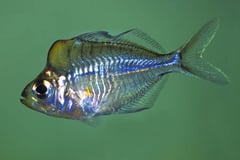
Chanda pulcinellaHumphead Perchlet
(Kottelat, 2003)
Max length100mm SL3.9in SLTank90 × 30cm36 × 12inTemp23–27°C73–81°FpH7.0–7.5The humphead perchlet, Chanda pulcinella, is a freshwater ambassid endemic to Myanmar, where it inhabits large, fast-flowing, clear streams. Described in 2003, it takes its name from the scaleless hump on its head, formed from an extension of the spine and apparently smaller in females. Artificially dyed specimens have reached the market and should be avoided, since the process is cruel and usually shortens the fish's life considerably.
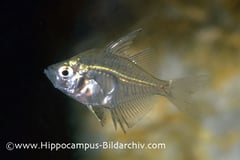
Chanda rangaIndian Glass Fish
Hamilton, 1822
Max length80mm SL3.1in SLTank80 × 30cm31 × 12inTemp20–30°C68–86°FpH6.5–8.0The Indian glass fish, Chanda ranga, is a small ambassid from South and Southeast Asia, with translucent skin that shows its bones and organs. For many years it was injected with luminous dyes on Asian fish farms and sold as 'painted' glass fish, and most injected fish do not survive more than a few months. It is found most often in freshwater, frequently soft and acidic, and needs no added salt. Parambassis lala and C. siamensis are often imported under its name.
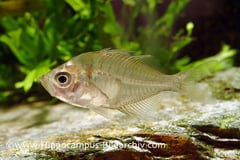
Chanda siamensis
Fowler, 1937
Max length60mm SL2.4in SLTank45 × 30cm18 × 12inTemp22–27°C72–81°FpH6.5–7.5Chanda siamensis is a small glass fish from Thailand, Laos, Cambodia, Vietnam, Malaysia, Singapore and Indonesia. An occasional import, it is sometimes sold as C. ranga, the Indian glass fish, but lacks patterning behind the eye and has a more elongate body. C. siamensis inhabits lowland rivers and flooded fields and is exclusively a freshwater fish, so it should never be kept under brackish conditions.

Channa andraoLal Cheng
Britz, 2013
Max length110mm SL4in SLTank80 × 30cm31 × 12inTemp14–28°C57–82°FpH6.0–8.0Traded for years as 'Lal Cheng', Channa andrao is a snakehead endemic to the Brahmaputra River basin in northeastern India. It stays at a manageable size while showing much of the behaviour and colour of larger members of the genus. It lacks pelvic fins and is most often confused with C. bleheri, from which it differs in fin markings and in being a paternal mouthbrooder.
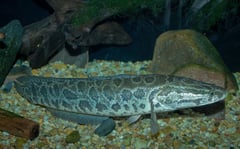
Channa argusNorthern Snakehead
(Cantor, 1842)
Max length850mm SL33in SLTanknot recordedTemp0–30°C32–86°FpH6.0–8.0The northern snakehead, Channa argus, is a large snakehead native to eastern China, southeastern Russia and the Korean peninsula. Growing to 850 mm, it is largely unsuitable for the home aquarium given its size and natural behaviour. Introduced populations, first intended for aquaculture, are now established in Japan, the United States, central Asia and parts of eastern Europe.
Channa asiaticaChinese Snakehead
(Linnaeus, 1758)
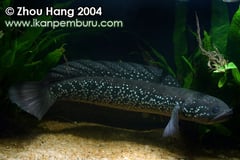
Max length350mm SL14in SLTank100 × 40cm39 × 16inTemp15–25°C59–77°FpH6.0–8.0The Chinese snakehead, Channa asiatica, is a snakehead native to central and southern China and northern Vietnam. One of several Channa lacking pelvic fins, it is told apart from them by vertical black bars on a brownish body and numerous white spots on the body and fins. It is best kept in a species tank. Pairs build no bubble nest, and both parents defend several thousand floating eggs and the fry.

Channa aurantimaculataOrange-spotted Snakehead
Musikasinthorn, 2000
Max length400mm SL16in SLTank150 × 60cm60 × 24inTemp10–28°C50–82°FpH6.0–8.0The orange-spotted snakehead, Channa aurantimaculata, is a snakehead endemic to the Brahmaputra basin in Assam and Arunachal Pradesh, India. Also traded as 'golden cobra snakehead', it has seven or eight large, irregular orange blotches on a dark upper body. Aggressively territorial towards its own kind, it needs a species tank, and violence can break out suddenly even in pairs kept together for a long time.
Channa baramensisBaram Snakehead
(Steindachner, 1901)
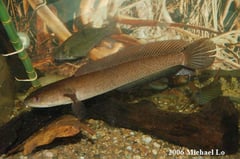
Max length220mm SL9in SLTank120 × 45cm48 × 18inTemp22–28°C72–82°FpHnot recordedThe Baram snakehead, Channa baramensis, is a snakehead endemic to Borneo, known from Sarawak, western Sabah and Brunei. It was treated as a synonym of C. melasoma until its revalidation by Ng et al. (1996). A black spot in the centre of many body scales and, in fish over 120 mm SL, a barred caudal fin separate it from C. melasoma and the similar C. cyanospilos.

Channa barca
(Hamilton, 1822)
Max length900mm SL35in SLTanknot recordedTemp10–28°C50–82°FpH6.0–8.0Channa barca is a large snakehead from the Brahmaputra basin in Assam and Nagaland, northeastern India, where it is scarce. Rarely available but considered highly desirable in the hobby, it grows to 800-900 mm. In the wild it lives in vertical burrows around the margins of wetlands that dry out in winter, and its restricted range and specialised habitat have led to it being recommended as a concern for conservation.

Channa bleheriRainbow snakehead
Vierke, 1991
Max length170mm SL7in SLTank120 × 30cm48 × 12inTemp14–28°C57–82°FpH6.0–8.0The rainbow snakehead, Channa bleheri, is a snakehead endemic to the Brahmaputra basin in Assam and Arunachal Pradesh, northeastern India. A popular aquarium fish, it lacks pelvic fins and has reddish orange markings on the caudal fin. Both parents guard the floating eggs. It has been recommended as a concern for conservation because of its restricted range and burrow habitat, though it is unclear whether collection for the trade affects wild populations.

Channa burmanica
Chaudhuri, 1919
Max length200mm SL8in SLTank120 × 45cm48 × 18inTemp10–22°C50–72°FpH6.0–8.0Channa burmanica is a snakehead that appears endemic to the headwaters of the Ayeyarwady in northern Myanmar, known only from the Mali Hka drainage. It is exceptionally rare in the aquarium trade, and its name has been applied to other snakeheads, including an unidentified fish known as C. sp. 'fire and ice'. It lacks pelvic fins, and aquarium specimens suggest orangey-brown patches between the eye and upper lip are typical.

Channa diplogrammaMalabar Snakehead
(Day, 1865)
Max length480mm SL19in SLTanknot recordedTemp22–32°C72–90°FpH6.0–8.0The Malabar snakehead, Channa diplogramma, is a large snakehead endemic to the southern Western Ghats in Kerala and Tamil Nadu, India. Treated as a synonym of the Indochinese C. micropeltes for over a century, it was revalidated in 2011 and has 103-105 lateral line scales, more than any other Channa. Its colour pattern changes markedly with age, and unlike most snakeheads it is pelagic and needs plenty of room to swim.

Channa gachuaDwarf Snakehead
(Hamilton, 1822)
Max length200mm SL8in SLTank120 × 45cm48 × 18inTemp18–28°C64–82°FpH5.0–8.0The dwarf snakehead, Channa gachua, is a snakehead recorded across an enormous range from Iran to Taiwan and Bali. There is significant evidence that C. gachua as currently understood is a complex of similar-looking species in need of taxonomic review. A mouthbrooder bred regularly in captivity, it can share a well-chosen community with peaceful fishes too large to be prey, but populations should not be mixed as some may hybridise.