Every species
Filters
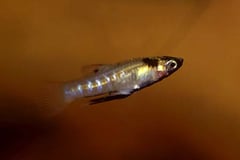
Girardinus metallicusMetallic Girardinus
authority not recorded
Max length60mm SL2.4in SLTank45 × 30cm18 × 12inTemp22–27°C72–81°FpH6.5–8.0The metallic girardinus, Girardinus metallicus, is a small livebearer from Cuba. It lives in streams, ponds and ditches where the water is commonly stagnant and often brackish. Introduced to the aquarium trade in the early 20th century, it disappeared soon after and reappeared in a Berlin zoo in 1965. Breeding is very easy provided soft, acidic water is avoided.
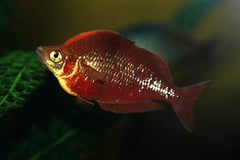
Glossolepis incisaRed Rainbowfish
Weber, 1907
Max length150mm SL6in SLTank120 × 30cm48 × 12inTemp24–29°C75–84°FpH7.0–8.0The red rainbowfish, Glossolepis incisa, is a rainbowfish from the Lake Sentani region of northern New Guinea, Indonesia. Also known as the salmon-red or New Guinea rainbowfish, it is usually found in shoals around heavily vegetated areas. Mass-bred fish have far less colour than wild ones. It is quite skittish and does far better in a shoal of at least 6-8.
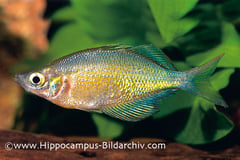
Glossolepis wanamensisLake Wanam Rainbowfish
authority not recorded
Max length100mm SL3.9in SLTank90 × 30cm36 × 12inTemp25–30°C77–86°FpH7.0–8.0The Lake Wanam rainbowfish, Glossolepis wanamensis, is a rainbowfish endemic to Lake Wanam in Papua New Guinea. It is now considered critically endangered, a decline thought to result from introduced tilapia, Gambusia and carp and a big rise in the number of people living around the lake. A captive breeding programme has been set up, but it has been argued that most fish in the hobby are contaminated by cross-breeding with G. multisquamata.

Gnathochromis permaxillaris
authority not recorded
Max length150mm SL6in SLTank120 × 30cm48 × 12inTemp22–27°C72–81°FpH7.5–9.0Gnathochromis permaxillaris is a deep-water cichlid endemic to Lake Tanganyika, recorded foraging at depths of up to 200 metres. The upper lip of adults is extended to extraordinary proportions, so the mouth faces downwards when opened, and the fish uses it to sift invertebrates from the sand. It is rare in the trade because it is difficult to collect in numbers, it is sensitive to deteriorating water quality, and the colour morphs should not be mixed as they may hybridise.
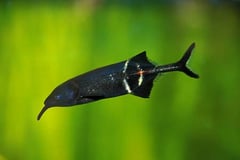
Gnathonemus petersiiElephantnose Fish
authority not recorded
Max length225mm SL9in SLTank120 × 45cm48 × 18inTemp23–28°C73–82°FpH6.0–7.5The elephantnose fish, Gnathonemus petersii, is a mormyrid with a vast African range, recorded in ten countries from Mali and Benin to Zambia. It uses its 'trunk' to find food hidden in the substrate, so it needs a soft substrate, and it needs dim lighting. Like other mormyrids it produces a weak electric field that it uses to navigate, hunt and communicate. It is very sensitive to deteriorating water conditions and to many medications, including salt.
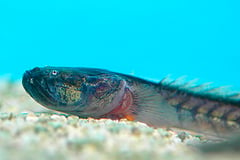
Gobioides broussonnetiiViolet Goby
authority not recorded
Max length625mm SL25in SLTank120 × 60cm48 × 24inTemp22–26°C72–79°FpH7.5–9.0The violet goby, Gobioides broussonnetii, is an estuarine goby from the southern USA, Central America, the Caribbean and northeastern South America. Also sold as the dragon or Peruvian goby, it grows very large (to 62.5 cm), has specialised feeding requirements and needs brackish water, as it does not survive for long in freshwater. The smaller, riverine G. peruanus is often imported under its name and is told apart by its smaller adult size and thicker, more purple body.
Gymnarchus niloticusAba Aba
authority not recorded
Max length1650mm SL65in SLTank360 × 120cm142 × 48inTemp23–28°C73–82°FpH6.5–8.0The aba aba, Gymnarchus niloticus, is a large predatory fish from much of the northern half of Africa, and the only species in its genus. An extended dorsal fin gives it the alternative name upside-down knifefish, although it is more closely related to the mormyrids, and it uses a weak electrical discharge to navigate and communicate. Growing to 165 cm and extremely aggressive, it is simply not suited to the home aquarium in any respect.
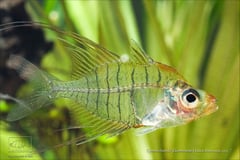
Gymnochanda filamentosa
Fraser-Brunner, 1955
Max length32mm SL1.3in SLTank60 × 30cm24 × 12inTemp20–28°C68–82°FpH4.0–6.0Gymnochanda filamentosa is a small glassfish known from Johor in southern Peninsular Malaysia and the Kapuas system in West Kalimantan, Borneo. Males carry filamentous dorsal and anal-fin rays, and the body is transparent to translucent yellowish-brown in life. It occurs in swampy, acidic waters over silt and peat, and has appeared in the ornamental trade but is evidently delicate and recommended only to experienced aquarists.
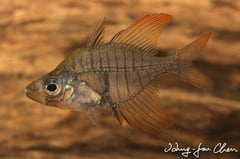
Gymnochanda verae
Tan & Lim, 2011
Max length26mm SL1.0in SLTank60 × 30cm24 × 12inTemp20–28°C68–82°FpH4.0–6.0Gymnochanda verae is a small glassfish known only from the Gantung area of Belitung Island, in Indonesia's Bangka-Belitung Islands province. Mature males have extended anal and second dorsal fins forming a triangular profile, with the outer parts of those fins and of the caudal-fin lobes carmine red in life. Females have neither elongated rays nor colour. It has appeared in the ornamental trade but is evidently delicate and recommended only to experienced aquarists.

Gymnocorymbus bondiSilver Tetra
authority not recorded
Max length50mm SL2.0in SLTank60 × 38cm24 × 15inTemp22–27°C72–81°FpH5.5–7.5The silver tetra, Gymnocorymbus bondi, is a characid from the Rio Orinoco basin in Colombia and Venezuela. It inhabits small tributaries, streams and creeks. Juveniles have reddish unpaired fins that fade as they mature, and the fairly bland adults are not often seen in the hobby. Peaceful and hardy, it is sometimes labelled G. socolofi, a name now considered a junior synonym of G. bondi.

Gymnocorymbus ternetziBlack Widow Tetra
authority not recorded
Max length60mm SL2.4in SLTank75 × 30cm30 × 12inTemp20–26°C68–79°FpH6.0–7.0The black widow tetra, Gymnocorymbus ternetzi, is a characid from the Rio Paraguay and Guaporé basins in Brazil, Bolivia and Argentina. All the fish in the trade are captive bred and unfussy about water chemistry and diet. The intense black of juveniles fades as they grow. Long-finned and 'golden' (leucistic) forms exist, the latter often sold as the 'white skirt tetra', and artificially dyed fish also turn up, a stressful process that often shortens their lifespan considerably.

Gymnogeophagus balzaniiParaguay Eartheater
authority not recorded
Max length200mm SL8in SLTanknot recordedTemp21–25°C70–77°FpH6.5–7.5The Paraguay eartheater, Gymnogeophagus balzanii, is a cichlid from the Rio Paraná basin in Brazil, Paraguay and Argentina, and the Rio Uruguay. It is found away from the main river channels in sluggish tributaries and creeks. A sand-sifting, delayed maternal mouthbrooder, it is recommended only to the specialist able to give it the specific conditions it needs, and males can be very intolerant of other cichlids. Colour forms vary with locality.

Gymnostomus ariza
(Hamilton, 1807)
Max length300mm SL12in SLTanknot recordedTempnot recordedpHnot recordedGymnostomus ariza is a cyprinid widely distributed from the Indus basin in Pakistan through India, Bangladesh and Myanmar. Growing to around 300 mm SL, it inhabits flowing streams and tributaries with clear water. It has a confusing taxonomic history, having been placed in Bangana, Cirrhinus and Labeo in recent years. It breeds in temporarily-inundated zones in the wet season and is also produced commercially for food.

Gymnothorax tile'Freshwater' Moray Eel
(Hamilton, 1822)
Max length600mm SL24in SLTank120 × 60cm48 × 24inTemp20–28°C68–82°FpH7.5–9.0The 'freshwater' moray eel, Gymnothorax tile, is a moray from coastal regions of the Indo-West Pacific, from eastern India to the Philippines. Although typically sold as a freshwater fish, this is not strictly the case, and the profile treats a marine salt mix as mandatory. It has small pale spots on a darker head and body, where the congener G. polyuranodon has much larger dark spots on a paler background. Highly piscivorous, it is best kept alone in all but the very largest aquaria.
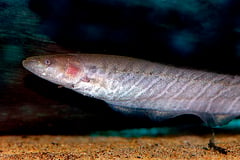
Gymnotus carapoBanded Knifefish
authority not recorded
Max length600mm SL24in SLTank180 × 60cm72 × 24inTemp22–28°C72–82°FpH6.0–7.5The banded knifefish, Gymnotus carapo, is a gymnotid knifefish recorded across Central and South America, from Mexico to Argentina. Several species once considered G. carapo have been described since 1994, and its massive natural range will likely turn out to be far more restricted. It uses a weak electric field to navigate and communicate, and a modified swimbladder acts as an accessory breathing organ. It grows to 60 cm and is sensitive to many medications, particularly copper.
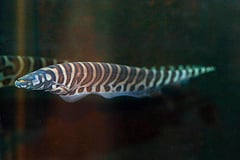
Gymnotus pedanopterusZebra Knifefish
authority not recorded
Max length280mm SL11in SLTanknot recordedTemp22–28°C72–82°FpH6.0–7.0The zebra knifefish, Gymnotus pedanopterus, is a gymnotid knifefish from Peru and Brazil, one of over 20 Gymnotus species described since 1994. It grows to at least 28 cm and inhabits sluggish or still, turbid waters. Like other gymnotids it produces a weak electric field that it uses to navigate and communicate, and it is sensitive to many aquarium medications, particularly those containing copper.

Gyrinocheilus aymonieriSucking 'Loach'
(Tirant, 1883)
Max length280mm SL11in SLTank150 × 45cm60 × 18inTemp22–26°C72–79°FpH6.0–8.0The sucking 'loach', Gyrinocheilus aymonieri, is a stream fish from the Mae Klong, Chao Phraya, Mekong and Dong Nai basins in Indochina. Often sold as a loach, or as the 'Indian' or 'Chinese' algae eater, it is neither a loach nor native to either country. It can live for more than 15 years and is largely unsuitable for the general community aquarium. It is farmed in large numbers, including albino, 'golden', 'piebald' and 'short-bodied' forms.

Haludaria fasciataMelon Barb
(Jerdon, 1849)
Max length70mm SL2.8in SLTank90 × 30cm36 × 12inTemp22–26°C72–79°FpH6.0–7.5The melon barb, Haludaria fasciata, is a small cyprinid endemic to the Western Ghats of southern India, in Goa, Karnataka, Kerala and Tamil Nadu. It exists in a number of colour forms, and it is undecided whether they are geographical variants or a complex of closely-related species. Also traded as the 'ember barb', 'banded barb' and 'black spot barb', it is relatively peaceful and hardy, but a vigorous feeder that may outcompete slower or more timid fishes.
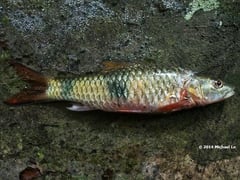
Hampala bimaculata
(Popta, 1905)
Max length500mm SL20in SLTanknot recordedTempnot recordedpHnot recordedHampala bimaculata is a large riverine cyprinid endemic to Borneo, recorded from Sarawak, Sabah, East Kalimantan and Brunei. Its adult size of up to 500 mm SL more-or-less precludes it as an aquarium fish, and it is poorly known in the ornamental trade. Of the Hampala species with two body blotches, it has saddle-shaped markings, with the anterior blotch beneath the posterior half of the dorsal-fin.

Hampala disparSpotted Hampala Barb
Smith, 1934
Max length350mm SL14in SLTank240 × 60cm96 × 24inTemp20–25°C68–77°FpH6.0–8.0The spotted hampala barb, Hampala dispar, is a cyprinid endemic to the Mekong basin in northern Laos, Thailand and Cambodia. It needs plenty of space but, at up to 350 mm SL, makes a more suitable aquarium fish than the larger and more commonly traded H. macrolepidota. It has a single dark blotch on the body and less well-defined marginal stripes on the caudal lobes, although juveniles of the two can appear very similar.