Every species
Filters

Hampala macrolepidotaHampala Barb
Kuhl & van Hasselt, 1823
Max length700mm SL28in SLTanknot recordedTemp20–26°C68–79°FpH5.5–8.0The hampala barb, Hampala macrolepidota, is a cyprinid ranging from Myanmar through Thailand to the Mekong, and south to Borneo, Sumatra and Java. Also known as 'jungle perch' or 'sidebar barb', it can grow to over 2 feet and 5 kg and is a powerful, pelagic predator and not an aquarium subject in all but the most extreme circumstances. Prized as a food and sport fish, it has been introduced to numerous water bodies.
Hampala sabana
Inger & Chin, 1962
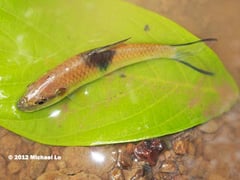
Max length410mm SL16in SLTanknot recordedTempnot recordedpHnot recordedHampala sabana is a large riverine cyprinid endemic to the Malaysian state of Sabah in northern Borneo. It inhabits clear, well-oxygenated running water and apparently favours deeper, slower-moving stretches. It has a single body marking and a higher count of circumpeduncular scales than its congeners. Growing to 410 mm SL, it is poorly known in the ornamental trade, and its size more-or-less precludes it as an aquarium fish.

Hampala salweenensis
Doi & Taki, 1994
Max length201mm SL8in SLTank240 × 60cm96 × 24inTemp20–26°C68–79°FpH6.0–8.0Hampala salweenensis is a riverine cyprinid endemic to the Salween basin in northwestern Thailand and Myanmar. It has two roundish dark blotches on each flank, one beneath the dorsal-fin origin and one on the caudal peduncle, and a black marginal band on both caudal-fin lobes. It is poorly known in the aquarium hobby, and the full extent of its distribution within the watershed is unclear.

Haplochromis latifasciatus
authority not recorded
Max length125mm SL5in SLTank120 × 30cm48 × 12inTemp23–28°C73–82°FpH7.2–8.2Haplochromis latifasciatus is a cichlid found only in Lake Kyoga and the adjacent Lake Nawampasa, satellite lakes north of Lake Victoria in Uganda. Critically endangered in nature and possibly extinct in Lake Kyoga, it is quite easily bred in aquaria. It is often sold under the invalid name Astatotilapia latifasciata, or as Haplochromis sp. 'zebra obliquidens' or H. obliquidens, a Victorian species from a different lake. A maternal mouthbrooder, it must not be kept with Victorian Mbipi as they may hybridise.
Haplochromis polli
Thys van den Audenaerde, 1964
Max lengthnot recordedTanknot recordedTemp24–28.3°C75–83°FpHnot recordedHaplochromis polli is a cichlid described from Pool Malebo (Stanley Pool), the lake-like widening of the Congo River between Kinshasa and Brazzaville. It has been recorded south to Pioka and Maninga in the Lower Congo and north to Kwamouth. Mostly benthic and not very gregarious, it is best kept as a single male with several females, since the dominant individual will not normally tolerate others in its territory.
Hara jerdoniAsian Stone Catfish
authority not recorded
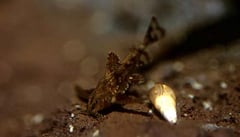
Max length30mm SL1.2in SLTank30 × 20cm12 × 8inTemp18–24°C64–75°FpH5.6–7.6The Asian stone catfish, Hara jerdoni, is a tiny sisorid catfish from India and Bangladesh, found in slow-moving streams and small rivers. It grows to around 30 mm SL and is told apart from others in the genus by its elongated pectoral spines. It and its congeners also go by the name moth catfish, after their patterning and shape when viewed from above. Very peaceful, it prefers soft substrates and is outcompeted by active bottom-dwelling species.

Hasemania nanaSilvertip Tetra
authority not recorded
Max length50mm SL2.0in SLTank60 × 38cm24 × 15inTemp23–28°C73–82°FpH6.0–8.0The silvertip tetra, Hasemania nana, is a characid from the Rio São Francisco basin in Brazil. It inhabits creeks and tributaries away from the main river channels. Hasemania is one of the few characid genera whose members lack an adipose fin. All the fish in the trade are captive bred and unfussy about water chemistry and diet, and it is sometimes sold as the 'copper tetra'.
Hassar orestisBlack-top Mouse Catfish
authority not recorded
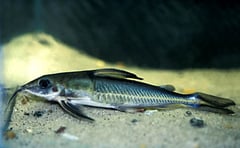
Max length180mm SL7in SLTank120 × 38cm48 × 15inTemp22–27°C72–81°FpH6.0–7.5The black-top mouse catfish, Hassar orestis, is a doradid catfish recorded in Ecuador, Colombia, Venezuela, Guyana, Peru and Brazil. It can be delicate when first imported, and fish without a rounded belly or with sunken eyes are emaciated and seldom survive long. It resembles Tenellus leporhinus, which has longer first fin rays and a clear dorsal fin with a dark patch at the base. Like other doradids it produces audible sounds, and its pectoral spines tangle easily in nets.

Helostoma temminckiiKissing Gourami
Cuvier, 1829
Max length250mm SL10in SLTank150 × 45cm60 × 18inTemp22–30°C72–86°FpH6.0–8.0The kissing gourami, Helostoma temminckii, is an anabantoid from southern Indochina and the Malay Archipelago, and the sole member of its family. The widely traded pinkish-white form is a leucistic variant bred for ornamental purposes, and the 'balloon' variety is intentionally disfigured and much shorter-lived. Its often belligerent behaviour, adult size and life span of over 20 years make it unsuitable for most home aquaria. The 'kissing' appears at least in part related to establishing social dominance.
Hemiancistrus guahiborumL106
authority not recorded
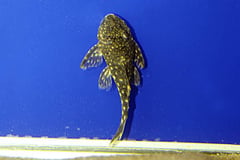
Max length150mm SL6in SLTank120 × 30cm48 × 12inTemp22–26°C72–79°FpH6.0–7.5L106, Hemiancistrus guahiborum, is a suckermouth catfish known only from the Rio Orinoco drainage in Venezuela. Also known as the spotted orange seam plec, it lives amongst rocks in flowing water and needs well-oxygenated water with some current. Described in 2005, it may be the same species as the undescribed L122, although the flatter profile of L122 suggests the two are distinct.
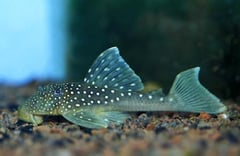
Hemiancistrus sp.Blue Phantom Plec
authority not recorded
Max length180mm SL7in SLTank120 × 30cm48 × 12inTemp25–30°C77–86°FpH6.0–7.0The blue phantom plec (L128) is a suckermouth catfish known only from the northern Rio Orinoco drainage in Venezuela. Its identity is unresolved. It closely resembles Hemiancistrus subviridis, the green phantom plec (L200), and the colour of the two grades from one into the other along the same river system, suggesting colour forms of one species, but this awaits scientific confirmation. Newly imported fish can be delicate, and emaciated fish with sunken eyes do not often survive for long.
Hemiancistrus subviridisGreen Phantom Plec
Werneke, Sabaj Pérez, Lujan & Armbruster, 2005
Max length150mm SL6in SLTanknot recordedTemp26–30°C79–86°FpH6.0–7.8Hemiancistrus subviridis is a suckermouth catfish from the upper Orinoco and Casiquiare drainages in southern Venezuela, where it lives in cracks between granite rocks in flowing water. Known in the hobby as the green phantom plec, it shares the code L200 with Baryancistrus demantoides. Only B. demantoides has a membrane joining its dorsal and adipose fins. It looks very like L128, the blue phantom plec, and along the Orinoco the two fish grade into each other in colour.

Hemibagrus filamentus
(Fang & Chaux, 1949)
Max length420mm SL17in SLTanknot recordedTempnot recordedpHnot recordedHemibagrus filamentus is a bagrid catfish from the middle and lower Mekong river system in Laos, Cambodia and Thailand. It appears to be unknown in the aquarium trade but is a valued food fish within its native range, growing to 420 mm SL. It inhabits slowly-flowing or standing waters, including main river channels and lakes, and riverine populations typically migrate into flooded forest during the wet season.
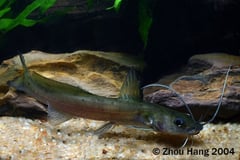
Hemibagrus macropterus
Bleeker, 1870
Max length408mm SL16in SLTanknot recordedTempnot recordedpHnot recordedHemibagrus macropterus is a bagrid catfish from the Zhujiang (Pearl River), Changjiang (Yangtze) and Qiantang Jiang in central and southern China. It inhabits swiftly-flowing rivers and tributaries with rocky substrates and grows to 408 mm SL. Virtually unknown in the aquarium trade, it is fished for food, and dam construction and pollution have affected it in parts of its range, where it may be locally extirpated.

Hemibagrus microphthalmus
(Day, 1877)
Max length1500mm SL59in SLTanknot recordedTempnot recordedpHnot recordedHemibagrus microphthalmus is a very large bagrid catfish from the Salween, Irrawaddy and Sittaung systems of Myanmar and western Thailand. It also occurs in the Manipur River drainage in northeastern India. Known to reach 1500 mm SL and to live for several decades, it cannot be considered a suitable home aquarium subject, and it is likely to prove aggressively territorial.

Hemibagrus peguensis
(Boulenger, 1894)
Max length286mm SL11in SLTanknot recordedTempnot recordedpHnot recordedHemibagrus peguensis is a bagrid catfish from the Irrawaddy, Bago and Sittaung drainages of Myanmar and the Chindwin basin in northeastern India. Sometimes referred to as 'Sittang mystus', it has been widely confused with H. menoda in the past and seems virtually unknown in the aquarium hobby. It grows to 286 mm SL and can be told from H. menoda by its almost truncate snout.
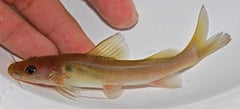
Hemibagrus planiceps
(Valenciennes, 1840)
Max length263mm SL10in SLTanknot recordedTempnot recordedpHnot recordedHemibagrus planiceps is a bagrid catfish endemic to western Java, known only from seven river systems including the Citarum and Ciliwung. It occurs in the upper parts of river basins, in clear, fast-flowing water over rock or sand. It has been confused in the past with H. gracilis, H. velox and H. bongan, and the population once thought to inhabit northwestern Peninsular Malaysia has been described as H. divaricatus.

Hemibagrus punctatusPorthole Bagrid
(Jerdon, 1849)
Max length197mm SL8in SLTanknot recordedTemp20–27°C68–81°FpH6.0–7.0The porthole bagrid, Hemibagrus punctatus, is a catfish known only from the Cauvery (Kaveri) river system in southern India. The IUCN lists it as Critically Endangered (possibly extinct), and at its confirmed localities in the Kabini, Bhadra and Moyar systems it was last collected in 1998 or earlier. It has been available only very occasionally in the aquarium trade, and its flanks carry dark spots arranged in vertical columns.

Hemibagrus spilopterus
Ng & Rainboth, 1999
Max length500mm SL20in SLTanknot recordedTemp20–27°C68–81°FpH6.0–8.0Hemibagrus spilopterus is a bagrid catfish from the Mekong and several other river systems in Laos, Vietnam, Cambodia and Thailand. Relatively common in the ornamental trade, it has been widely misidentified as H. nemurus, a Javan species that may never have been exported for aquaria. Given its size of up to 500 mm SL, its aggressive nature and a lifespan of several decades, it shouldn't be considered a home aquarium subject in all but the most exceptional circumstances.

Hemibagrus wyckiiCrystal-eyed Catfish
(Bleeker, 1858)
Max length710mm SL28in SLTanknot recordedTemp20–27°C68–81°FpH6.0–8.0The crystal-eyed catfish, Hemibagrus wyckii, is a bagrid with an enormous distribution across central Indochina and western Indonesia. Juveniles are sometimes available in the aquarium trade, but buying them is strongly discouraged: it reaches 710 mm SL, is aggressively territorial and can live for several decades. Despite the common name, the blue eye is not given as a distinguishing character in any diagnosis we've seen.