Hara jerdoni
Asian Stone Catfish
Last revised 2026Edit this page
On this page11 sections
Quick factsEdit
Difficulty6 of 8 measures
- Space
- small tank
- Water
- flexible
- Temp
- flexible
- Diet
- unknown
- Temperament
- peaceful
- Social
- needs to be in a group
- Compatibility
- fine with others
Other demands
Each of these can raise the rating on its own, whatever the measures above say.
- Hardiness
- unknown
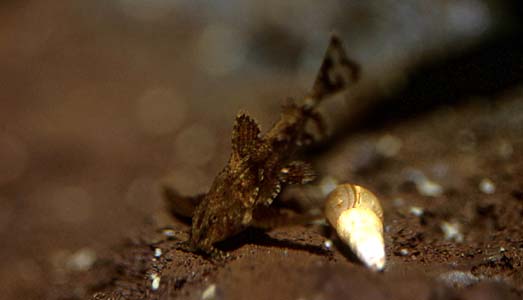
The Asian stone catfish, Hara jerdoni, is a tiny sisorid catfish from India and Bangladesh, found in slow-moving streams and small rivers. It grows to around 30 mm SL and is told apart from others in the genus by its elongated pectoral spines. It and its congeners also go by the name moth catfish, after their patterning and shape when viewed from above. Very peaceful, it prefers soft substrates and is outcompeted by active bottom-dwelling species.
Distribution
EditHabitat
Write a noteEditInhabits slow-moving streams and small rivers. It's preferred habitats are characterised by soft substrates.
Aquarium size
Write a noteEdit30 ∗ 20 ∗ 20 cm12 ∗ 8 ∗ 8 in - ~12 litres~3 US gal. Not only is this species tiny, it's also very inactive, and so doesn't need much room. If keeping it in a very small tank you must pay extreme care to water parameters (see below).
Maintenance
Write a noteEditProvide as many hiding places as possible, along with a soft, sandy substrate. The addition of some dried beech or oak leaves and pieces of driftwood would simulate the natural habitat of the fish nicely. The water must be kept clean, relatively cool and well-oxygenated or the fish will suffer as its natural waters are high in dissolved oxygen.
Water conditions
EditTemperature: 18 – 24 °C64 – 75 °F
pH: 5.6-7.6
Hardness: 8-15°H
These recommendations come from this profile’s own figures. They contain affiliate links, so we may earn a commission.
Diet
Write a noteEditIt will accept most small foods, including dried pellets, but should be offered a diet composed mainly of live and frozen varieties, such as bloodworm, daphnia etc. It's strictly a noctunal feeder so add food after lights out to ensure it gets its share.
Behaviour and compatibility
Write a noteEditA very peaceful little cat that fits well into communities of other small species, or into a biotope setup with other Asian stream-dwelling species, such as Dario sp. and danios. Don't keep it with any active bottom-dwelling species or it will be out-competed for food easily. It can be kept with others of its own kind without any problems, and in fact prefers to be kept in a group.
Sexual dimorphism
Write a noteEditUnknown. It is likely that females will appear broader than males when full of eggs.
Reproduction
Write a noteEditHas been bred in aquaria, but unfortunately very few details are available. Apparently the eggs were deposited in spawning mops.
Notes
EditThis delightful little species can be distinguished from others in the genus by its elongated pectoral spines. It, and others in the genus (and also the closely related genus Erithistes), also go by the common name of moth catfish due to their patterning and shape when viewed from above.
Species images · 1
These photographs are used with each photographer's permission.
Send a photograph