Every species
Filters
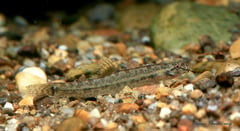
Lepidocephalichthys hasselti
(Valenciennes, 1846)
Max length60mm SL2.4in SLTank60 × 30cm24 × 12inTemp23–26°C73–79°FpH5.5–7.5Lepidocephalichthys hasselti is a cobitid loach described from Java and recorded from Myanmar to Vietnam, Peninsular Malaysia, Sumatra and Borneo. Its wide distribution makes it relatively common in the aquarium hobby. Colour and pattern vary with locality and have led to problems with identification, and the flanks usually show a row of dark blotches or a solid stripe with a light, unpigmented stripe above.
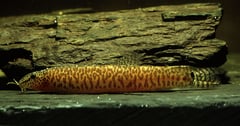
Lepidocephalichthys jonklaasi
(Deraniyagala, 1956)
Max length45mm SL1.8in SLTank60 × 30cm24 × 12inTemp20–25°C68–77°FpH5.5–7.5Lepidocephalichthys jonklaasi is a cobitid loach endemic to the 'wet zone' of south-western Sri Lanka, known from at least five localities. Records exist from the Gin, Kalu, Nilwala and Bentota river basins plus a small blackwater creek near the Kottawa Forest Reserve. Its conservation status perhaps precludes its suitability for the hobby. Broad dark bars on the caudal fin and large, vertically elongated black spots on the flanks identify it.
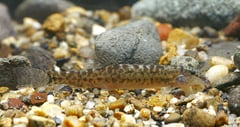
Lepidocephalichthys kranos
Havird & Page, 2010
Max length45mm SL1.8in SLTank60 × 30cm24 × 12inTemp23–26°C73–79°FpH5.5–7.5Lepidocephalichthys kranos is a cobitid loach from the Chao Phraya system in Thailand and the Mekong in Thailand, Laos and Vietnam. Some private collectors have kept it. Its colour pattern tends to form a mosaic, unlike the irregular spotting of most congeners, and the body deepens steeply behind the snout to give a 'hunched' appearance. It can often be found living with L. hasselti.
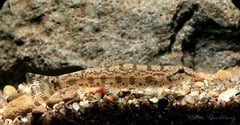
Lepidocephalichthys micropogon
(Blyth, 1860)
Max length55mm SL2.2in SLTank60 × 30cm24 × 12inTemp20–25°C68–77°FpH6.0–7.5Lepidocephalichthys micropogon is a cobitid loach from Myanmar, western Thailand, Bangladesh and Assam, India. Known from the Salween, Sittaung, Irrawaddy and Brahmaputra drainages and occasionally exported as bycatch, it grows to 55 mm SL and has a strongly forked caudal fin with broad, dark V-shaped bars. Kottelat (2012) treats L. manipurensis as a synonym, though Havird and Page (2010) list the two separately.
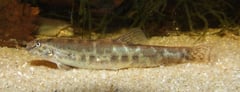
Lepidocephalichthys sp. 'LE1'Vietnamese Marbled Hog-faced Loach
authority not recorded
Max length55mm SL2.2in SLTank45 × 30cm18 × 12inTemp23–26°C73–79°FpH6.0–7.5The Vietnamese marbled hog-faced loach, Lepidocephalichthys sp. 'LE1', is a cobitid loach from central Vietnam. Unconfirmed reports suggest it is collected in the coastal province of D'Nang. It has been traded only a handful of times and referred to as Lepidocephalichthys cf. hasselti and Lepidocephalus cf. thermalis, but appears to be an undescribed member of the former genus.
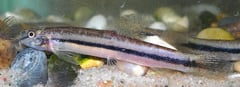
Lepidocephalichthys sp. 'LE2'
authority not recorded
Max length60mm SL2.4in SLTank45 × 30cm18 × 12inTemp26°C79°FpH6.0–7.5Lepidocephalichthys sp. 'LE2' is a cobitid loach from northern West Bengal, India, and most likely an undescribed species. It was apparently collected in the Buxa Tiger Reserve alongside the dwarf snakehead traded as Channa sp. 'Assam' or 'Lal Cheng'. It shows characters of both L. alkaia and L. guntea, has been referred to as L. cf. guntea, and the specimens pictured reached the UK in 2007.
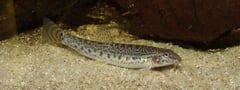
Lepidocephalichthys thermalis
(Valenciennes, 1846)
Max length50mm SL2.0in SLTank45 × 30cm18 × 12inTemp22–26°C72–79°FpH6.0–8.0Lepidocephalichthys thermalis is a cobitid loach from Sri Lanka and Peninsular India, described from the hot waters of Cania, Sri Lanka. Available sporadically, it makes an excellent choice for those new to keeping loaches. Unlike most of the genus it shows a preference for headwaters and clear, flowing streams. It was for a number of years included in Lepidocephalus until Havird and Page (2010) placed it in Lepidocephalichthys.
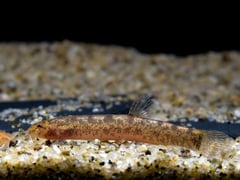
Lepidocephalichthys tomaculum
Kottelat & Lim, 1992
Max length39mm SL1.5in SLTank45 × 30cm18 × 12inTemp23–29°C73–84°FpH3.5–7.0Lepidocephalichthys tomaculum is a small cobitid loach from Peninsular Malaysia, with a single tentative record from Lampung Province, Sumatra. It inhabits shallow, slow-moving streams, swamps, oxbows and backwaters over mud, silt or peat. Occasionally available as bycatch, it has a reddish brown body with thin dark bars across the back, and where it lives with L. hasselti identification can be difficult.
Lepidocephalichthys zeppelini
Havird & Tangjitjaroen, 2010
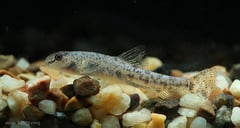
Max length26mm SL1.0in SLTank45 × 30cm18 × 12inTemp20–26°C68–79°FpH6.0–7.5Lepidocephalichthys zeppelini is a tiny cobitid loach from the Mekong system in Thailand and Vietnam. Adults reach only 25.8 mm SL, and the lamina circularis of mature males forms a large, finely serrated flange. Many adults at the type locality were collected from remnant ephemeral pools in otherwise dry agricultural land.
Lepidocephalus macrochir
(Bleeker, 1854)
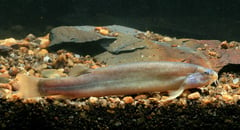
Max length90mm SL3.5in SLTank75 × 30cm30 × 12inTemp22–26°C72–79°FpH5.5–7.5Lepidocephalus macrochir is a cobitid loach described from Sumatra and since recorded from Thailand, Peninsular Malaysia, Java and Borneo. It is traded sporadically as the 'pinky loach', 'deep water kuhli loach' and 'Borneo high body cave loach'. Although sometimes said to be a cave loach, Thai collectors report it from deep water, and in aquaria it spends a lot of time buried in soft substrates.
Lepidosiren paradoxaSouth American Lungfish
authority not recorded
Max length1250mm SL49in SLTank240 × 90cm96 × 36inTemp24–28°C75–82°FpH6.0–8.0The South American lungfish, Lepidosiren paradoxa, is found across the Amazon, Rio Paraguay and lower Paraná basins. The only lungfish known from South America, it is an obligatory air breather and survives the dry season by aestivating in a mucous cocoon inside a burrow in the mud. It can reach 125 cm and live for well over 20 years, so whether it should be considered an aquarium subject at all is debatable.
Lepisosteus oculatusSpotted Gar
Winchell, 1864
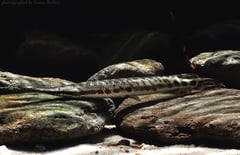
Max length1250mm SL49in SLTanknot recordedTemp12–20°C54–68°FpH6.0–8.0The spotted gar, Lepisosteus oculatus, ranges from Lakes Erie and Michigan south through the Mississippi basin to the Gulf of Mexico drainages. Given its size and a lifespan of several decades it should not be considered a home aquarium subject, and only some public aquaria can maintain it long-term. A modified, vascularised swim bladder allows it to breathe atmospheric air to a certain extent.
Leporacanthicus galaxiasGalaxy Plec
authority not recorded
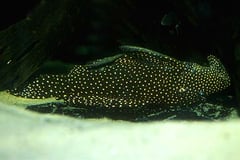
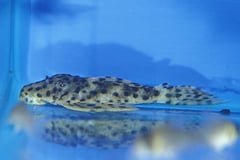
Max length250mm SL10in SLTank120 × 45cm48 × 18inTemp22–26°C72–79°FpH5.6–7.0The galaxy plec, Leporacanthicus galaxias (L029), is a suckermouth catfish from the Amazon, Tocantins and other river basins in Brazil. Also sold as the vampire or tusken plec, it lives in rapids and other fast-flowing waters. Four similar undescribed variants, L007, L240, L241 and L294, are known as L. cf. galaxias and are best referred to by their L numbers.
Leporacanthicus heterodonGolden Vampire Plec
authority not recorded
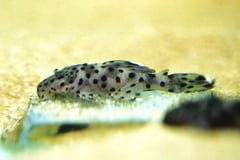
Max length100mm SL3.9in SLTank120 × 30cm48 × 12inTemp22–26°C72–79°FpH6.0–7.0The golden vampire plec, Leporacanthicus heterodon, is a suckermouth catfish from the Rio Xingu basin in Brazil. It lives in rapids and other fast-flowing waters. The 'vampire' name refers to the two large teeth in the upper jaw shared by the genus, probably used to grip prey such as snails.
Leporacanthicus joselimaiSultan Plec
authority not recorded
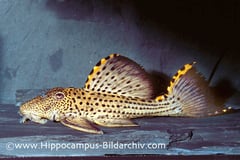
Max length150mm SL6in SLTank120 × 30cm48 × 12inTemp25–27°C77–81°FpH6.0–7.5The sultan plec, Leporacanthicus joselimai (L264), is a suckermouth catfish from the Rio Tapajós in Brazil. It lives in rapids and other fast-flowing waters among rocks and driftwood snags. Young fish have white fin tips that fade with growth and often disappear completely. Territorial with conspecifics, particularly males, it has been bred in the hobby as a cave spawner.
Leporacanthicus triactisThree Beacon Plec
authority not recorded
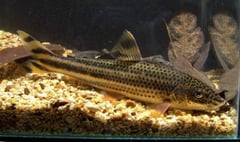
Max length245mm SL10in SLTank120 × 45cm48 × 18inTemp24–27°C75–81°FpH6.0–7.6The three beacon plec, Leporacanthicus triactis (L091), is a suckermouth catfish from the upper Orinoco basin in Colombia and Venezuela. Several colour forms are available with varying amounts of orange in the fins, some sold as 'dragon fin' or 'tiger fin', and the colour is retained as the fish matures. It lives in rapids and is territorial with conspecifics, particularly males.
Leporellus vittatus
(Valenciennes, 1850)
Max length300mm SL12in SLTank210 × 60cm84 × 24inTemp18–26°C64–79°FpH5.5–7.5Leporellus vittatus is an anostomid with a huge natural range across the Amazon, Paraná-Paraguay, São Francisco and Orinoco river systems. Unlike most anostomids it is adapted to a benthic existence in flowing water and spends most of its time on or around the substrate. Occasionally exported, it requires quite specialised conditions, an aquarium of at least 210 by 60 cm and ideally a group of six or more.
Leporinus brunneus
Myers, 1950
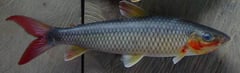
Max length256mm SL10in SLTank210 × 60cm84 × 24inTemp20–28°C68–82°FpH4.0–6.5Leporinus brunneus is an anostomid from the rios Madeira and Negro in Brazil, the Orinoco in Venezuela and Colombia, and the Casiquiare canal. The largest officially recorded specimen measured 256 mm, and an aquarium with base dimensions of at least 210 by 60 cm is needed.
Leporinus fasciatusBanded Leporinus
(Bloch, 1794)
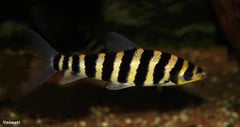
Max length270mm SL11in SLTank210 × 60cm84 × 24inTemp20–28°C68–82°FpH5.0–7.5The banded leporinus, Leporinus fasciatus, is an anostomid from the Amazon and Orinoco systems and coastal Guyana, Suriname and French Guiana. Young fish are often sold without warning of their size and requirements, and it is fairly ubiquitous in public aquarium displays. It is frequently confused with L. affinis, and its dark body bars multiply with age, from five in young fish to around ten in adults.
Leporinus fridericiThreespot Leporinus
(Bloch, 1794)
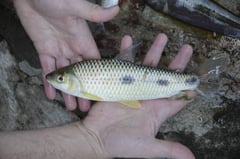
Max length400mm SL16in SLTank240 × 90cm96 × 36inTemp20–28°C68–82°FpH5.0–8.0The threespot leporinus, Leporinus friderici, is an anostomid from much of the Amazon system, with further records from the Guianas and Trinidad. It grows to 350 to 400 mm and needs an aquarium with base dimensions of at least 240 by 90 cm. Across this enormous range the fish differ in morphology and, especially, colour pattern.