Every species
Filters
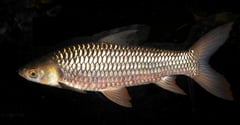
Leptobarbus hoeveniiMad Barb
(Bleeker, 1851)
Max length1000mm SL39in SLTanknot recordedTemp20–26°C68–79°FpH6.0–8.0The mad barb, Leptobarbus hoevenii, is a large pelagic cyprinid apparently native to Peninsular Malaysia, Borneo, Sumatra and Java. A popular sport fish growing to 800 to 1000 mm, it is wholly unsuitable for private aquaria but is readily available at 100 to 150 mm. The congener L. rubripinna was referred to as L. hoevenii for decades and both are traded under the same name. L. hoevenii lacks the broad dark midlateral stripe and has dark grey pelvic and anal fins.

Leptobarbus rubripinnaRed-finned Cigar Shark
(Fowler, 1937)
Max length1000mm SL39in SLTanknot recordedTemp20–26°C68–79°FpH6.0–8.0The red-finned cigar shark, Leptobarbus rubripinna, is a large pelagic cyprinid from the Mekong, Chao Phraya and Mae Klong river systems of Indochina. For decades it was referred to as its congener L. hoevenii, and both are still traded under the same name. A popular sport fish growing to 800 to 1000 mm, it is wholly unsuitable for private aquaria despite being readily available at 100 to 150 mm. It has a broad dark midlateral stripe and orange to red pelvic and anal fins.
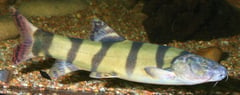
Leptobotia elongataImperial Flower Loach
(Bleeker, 1870)
Max length500mm SL20in SLTank360 × 90cm142 × 36inTemp15.5–21°C60–70°FpH6.5–7.5The imperial flower loach, Leptobotia elongata, is a large botiid loach native to the middle and upper Yangtze River in China. Growing to 400 to 500 mm SL, it has declined drastically in the wild through damming, pollution and habitat degradation, and it is rare in the aquarium trade and prohibitively expensive when available. Also known as the 'royal clown' loach, a name since applied to the smaller L. pellegrini, it is a species for the specialist able to house it long term.
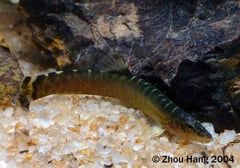
Leptobotia guilinensis
Chen, 1980
Max length100mm SL3.9in SLTank120 × 30cm48 × 12inTemp15.5–21°C60–70°FpH6.5–7.5Leptobotia guilinensis is a botiid loach from southern China, described from Guangxi Province and also recorded from neighbouring Hunan. The species is rarely exported for the aquarium hobby, and fish labelled as such are usually Sinibotia pulchra or other related species. In the formal description Chen states that it is closely related to the fish now called Sinibotia zebra but lacks stripes on the head. Its habitat is unconfirmed but presumably clear, well-oxygenated running water over rocks and gravel.
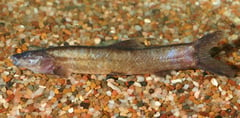
Leptobotia microphthalma
Fu & Ye, 1983
Max length150mm SL6in SLTank120 × 45cm48 × 18inTemp15.5–21°C60–70°FpH6.5–7.5Leptobotia microphthalma is a botiid loach from the upper Yangtze basin in southwestern China, known from the Min and Jialing rivers. Its near-vestigial eyes and the variable hypopigmentation seen in many individuals suggest a deep water or even subterranean existence. Poorly known in the hobby, it is superficially similar to L. tientainensis and differs in a more deeply forked caudal-fin and a smaller eye, although eye size varies considerably between individuals.
Leptobotia pellegrini
Fang, 1936
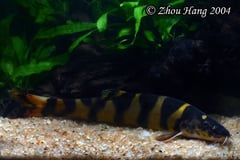
Max length200mm SL8in SLTank120 × 45cm48 × 18inTemp20–24°C68–75°FpH6.5–8.0Leptobotia pellegrini is a botiid loach from southern China, described from Sichuan province and also known from the Pearl River (Zhu Jiang) basin. Often traded as 'royal clown loach', a name also applied to L. elongata, it differs from that species chiefly in adult size, reaching around 200 mm SL against 500 mm. It is also more slender with a darker head, and its relatively wide distribution probably explains why it is commoner in the hobby.
Leptobotia rubrilabris
(Dabry de Thiersant, 1872)
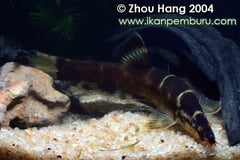
Max length150mm SL6in SLTank120 × 45cm48 × 18inTemp15.5–21°C60–70°FpH6.5–7.5Leptobotia rubrilabris is a riverine botiid loach native to the middle and upper Yangtze River in China, with most records from Sichuan and Hunan. Fish labelled as this species in the trade are typically Sinibotia pulchra or other related species. In nature it favours clear, well-oxygenated running water over rocks and gravel, from boulder-filled headwater streams to larger, turbid river channels, and much of the Yangtze has been degraded by dam construction and pollution.
Leptobotia taeniops
(Sauvage, 1878)
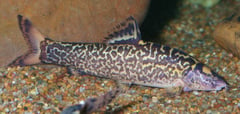
Max length150mm SL6in SLTank120 × 45cm48 × 18inTemp15.5–21°C60–70°FpH6.5–7.5Leptobotia taeniops is a botiid loach native to the middle and upper Yangtze River in China, recorded mostly from Hunan including Dongting Lake. Poorly known in the hobby, it is available occasionally and normally traded as 'honeycomb loach'. It exists in a number of colour forms from plain to reticulated and brown to pink, with reticulated populations towards the eastern end of its range, and it was previously included in the related genus Parabotia.
Leptodoras linnelliElongate Mouse Catfish
authority not recorded
Max length230mm SL9in SLTank120 × 45cm48 × 18inTemp18–22°C64–72°FpH5.8–7.0The elongate mouse catfish, Leptodoras linnelli, is a doradid catfish from river drainages of northern South America in Venezuela, Guyana and Brazil. It is found over sandy substrates in deeper, flowing sections of rivers and prefers cooler water than many related species. Totally unaggressive and schooling in nature, it is seldom exported and usually turns up only as bycatch among shipments of Opsodoras leporhinus or Hassar orestis.

Lestradea perspicax
authority not recorded
Max length135mm SL5in SLTank120 × 30cm48 × 12inTemp24–27°C75–81°FpH7.8–9.0Lestradea perspicax is a cichlid endemic to the northern end of Lake Tanganyika, where it inhabits shallow water over sandy substrates. There is some confusion over the taxonomy of this species and its congener L. stappersi, which was originally regarded as a subspecies of perspicax and is now considered distinct. Very peaceful, and a maternal mouthbrooder in nature, it is not often seen in the hobby.
Limia melanogasterBlack-bellied Limia
authority not recorded
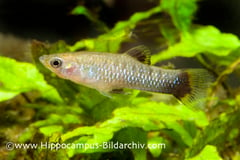
Max length40mm SL1.6in SLTank60 × 30cm24 × 12inTemp22–28°C72–82°FpH7.5–8.5The black-bellied limia, Limia melanogaster, is a small livebearer endemic to Jamaica, where it usually lives in small streams. Originally placed in Limia, it was later treated as a member of Poecilia and has since been returned to Limia, but much of the literature still refers to it as Poecilia. Peaceful and easy to breed, it is not often seen for sale in the hobby.
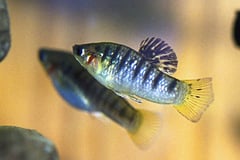
Limia nigrofasciataHump-backed Limia
authority not recorded
Max length63mm SL2.5in SLTank45 × 30cm18 × 12inTemp22–26°C72–79°FpH7.0–8.0The hump-backed limia, Limia nigrofasciata, is a livebearer from Haiti and the Dominican Republic, found in shallow, heavily vegetated water. It usually swims in large shoals and also occurs in brackish conditions at several locations. Adult males develop a characteristic hump along the spine, caused by deposition of fatty tissue, and the species breeds very easily provided soft, acidic water is avoided.
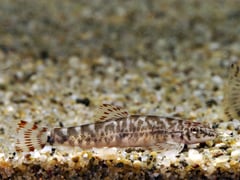
Liniparhomaloptera disparisBroken-band Hillstream Loach
(Lin, 1934)
Max length80mm SL3.1in SLTank80 × 30cm31 × 12inTemp20–24°C68–75°FpH6.5–8.0The broken-band hillstream loach, Liniparhomaloptera disparis, is a gastromyzontid from the Pearl River system of southern China and from Hong Kong. It is restricted to shallow, fast-flowing, highly oxygenated headwaters with riffles and runs. Sometimes available as bycatch among shipments of Rhinogobius duospilus, it also appears on trade lists under the fictitious name 'Homaloptera hoffmani'. It has been bred in aquaria and buries its eggs within the substrate.
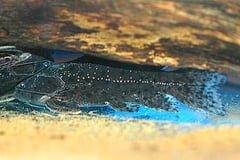
Liosomadoras morrowiFalse Jaguar Catfish
authority not recorded
Max length150mm SL6in SLTank120 × 30cm48 × 12inTemp20–25°C68–77°FpH6.0–7.0The false jaguar catfish, Liosomadoras morrowi, is an auchenipterid catfish from the Río Ucayali basin in Peru. It is often confused with its congener L. oncinus, from which it differs in its duller patterning. Nocturnal, peaceful and shy, it will eat small fish during the hours of darkness, and fertilisation is internal, with the male's extended anal fin used in a similar way to a livebearer's gonopodium.
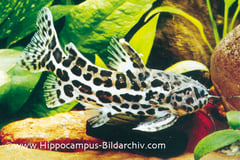
Liosomadoras oncinusJaguar Catfish
authority not recorded
Max length250mm SL10in SLTank120 × 45cm48 × 18inTemp20–28°C68–82°FpH4.8–7.2The jaguar catfish, Liosomadoras oncinus, is an auchenipterid catfish from the Ucayali, Amazonas and Negro river basins in South America. Often confused with L. morrowi, it has brighter patterning and grows larger, to around 250 mm SL. Formerly placed in the Doradidae because of its opercular spines, it is nocturnal and generally peaceful but eats small fish after dark. Its water requirements depend on where it was collected.

Lobocheilos melanotaenia
(Fowler, 1935)
Max length200mm SL8in SLTank180 × 60cm72 × 24inTemp20–26°C68–79°FpH6.0–8.0Lobocheilos melanotaenia is a grazing cyprinid from the Mekong in Laos, Thailand, Cambodia and Vietnam, plus the Dong Nai, Chao Phraya and Mae Klong. One of the most abundant species in the seasonal cyprinid migrations of the mainstream Mekong, it is available on a sporadic basis. It is told from L. rhabdoura by its deeper body, narrower mouth and a dark area in the dorsal-fin. It can be aggressive at feeding times and is not particularly tolerant of conspecifics.

Lobocheilos rhabdoura
(Fowler, 1934)
Max length220mm SL9in SLTank180 × 60cm72 × 24inTemp20–26°C68–79°FpH6.0–8.0Lobocheilos rhabdoura is a grazing cyprinid from Indochina, found in the Mekong, Chao Phraya and Mae Klong systems and south to Peninsular Malaysia. One of the most abundant species in the seasonal cyprinid migrations of the mainstream Mekong, it is available on a sporadic basis. It differs from L. melanotaenia in its shallower body, wider mouth and larger snout tubercules. It can be aggressive at feeding times and is not particularly tolerant of conspecifics.
Lophiobagrus cyclurusAfrican Bullhead
authority not recorded
Max length100mm SL3.9in SLTank75 × 30cm30 × 12inTemp23–26°C73–79°FpH7.5–9.0The African bullhead, Lophiobagrus cyclurus, is a small claroteid catfish endemic to Lake Tanganyika. It hides among rocks by day and forages after dark, and it lives in most communities of Tanganyikan catfish and cichlids, though very small fish will be eaten. It is rumoured to secrete a poisonous mucus when stressed that can kill other fish in the aquarium, which is one reason to house it in as large a tank as possible.
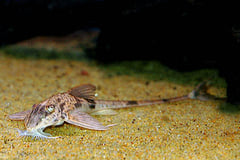
Loricaria simillimaMarbled Whiptail
authority not recorded
Max length180mm SL7in SLTanknot recordedTemp24–27°C75–81°FpH5.6–7.8The marbled whiptail, Loricaria simillima, is a whiptail catfish recorded from Venezuela, Ecuador, Peru, Brazil, Paraguay and Argentina. There is a great deal of uncertainty about its identity, and several species or subspecies are probably involved, with darker fish collected from blackwaters and lighter ones from whitewater habitats. The fish in the trade is quite possibly not L. simillima at all. It has been bred in aquaria and shows parental care.

Luciocephalus pulcherGiant Pikehead
authority not recorded
Max length200mm SL8in SLTank120 × 30cm48 × 12inTemp22–26°C72–79°FpHnot recordedThe giant pikehead, Luciocephalus pulcher, is a predatory anabantoid from blackwater peat swamps in Thailand, Malaysia, Indonesia and Brunei. Highly piscivorous and notoriously difficult to wean off live foods, it travels poorly and is often sold in a weakened, emaciated state. Once settled it is quite hardy. The male is a mouthbrooder, holding the eggs for around 30 days, and it is best kept in a species tank in acidic water.