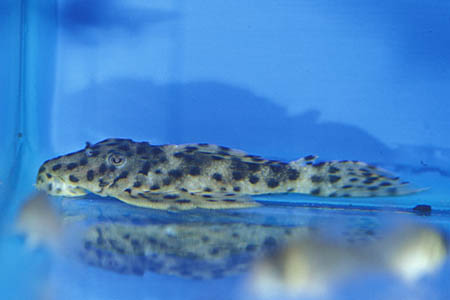
Leporacanthicus heterodon
Golden Vampire Plec
On this page11 sections
Quick facts
Difficulty4 of 8 measures
More bars, more demanding. Hardiness is not averaged with the rest.
- Space
- large tank
- Water
- mild adjustment
- Temp
- steady heat
- Diet
- unknown
- Temperament
- peaceful
- Social
- unknown
- Compatibility
- unknown
Hardiness on its own can raise the rating, whatever the measures above say.
- Hardiness
- unknown
The vampire part of the common name is derived from the unique upper jaw dentition exhibited by members of this genus, consisting of, you guessed it, two large teeth or "fangs". The exact use for these is unknown, but they're probably utilised to grip prey items such as snails or other aquatic invertebrates in some way. When buying one of these (or any Loricariid), be sure to check the fish has a rounded belly and that its eyes aren't sunken, as these are classic signs of ema...
Distribution
Habitat
A reophilic species that lives in rapids and other fast-flowing waters.
Aquarium size
Given its territorial nature and potential size, a tank in the region of 120 ∗ 30 ∗ 30 cm48 ∗ 12 ∗ 12 in - ~108 litres~29 US gal in size is a sensible choice.
Maintenance
A spacious tank is required, preferably with a sandy substrate. Provide hiding places and shade with some big chunks of driftwood and smooth rocks. Dim lighting is also beneficial, and it's imperative that the water is highly oxygenated, preferably with a good amount of movement. Consider the use of powerheads or large airstones to produce the desired effect. An efficient filter is needed to deal with the large amounts of waste it produces.
Water conditions
Temperature: 22 – 26 °C72 – 79 °F
pH: 6.0-7.0
Hardness: 3-10°H
These recommendations come from this profile’s own figures. They contain affiliate links, so we may earn a commission.
Diet
Not a very vegetarian Loricariid, it will accept most sinking dried foods, and also enjoys munching on meatier fare such as earthworms, prawns, mussels, bloodworm and suchlike. Oddly for a Loricariid, it also relishes snails.
Behaviour and compatibility
Generally peaceful with species inhabiting other parts of the tank. In a biotope setup good tankmates include larger characins such as Anostomus, Hemiodus, Semaprochilodus and Metynnis species, reophilic cichlids such as Retroculus and in a big tank, other Loricariids requiring similar conditions.
It's territorial towards other benthic species, particularly those with similar colour patterns, and a group of these would need very roomy quarters.
Sexual dimorphism
When viewed from above, mature males have a noticeably longer and wider head than females. They also have a bigger dorsal fin and more numerous odontotes than females.
Reproduction
It's probably not been bred in the hobby.
Notes
The vampire part of the common name is derived from the unique upper jaw dentition exhibited by members of this genus, consisting of, you guessed it, two large teeth or "fangs". The exact use for these is unknown, but they're probably utilised to grip prey items such as snails or other aquatic invertebrates in some way. When buying one of these (or any Loricariid), be sure to check the fish has a rounded belly and that its eyes aren't sunken, as these are classic signs of emaciation in newly imported specimens.
Species images · 1
Used with the photographer’s permission. Not licensed for reuse.
Profile completeness18 of 24
75% complete
Also missing: a recorded distribution, taxonomic authority, etymology.
Community
Questions about Leporacanthicus heterodon?
Ask on Discord