Every species
Filters
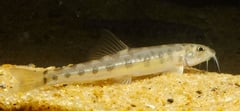
'Nemacheilus' corica
(Hamilton, 1822)
Max length45mm SL1.8in SLTank60 × 30cm24 × 12inTemp15–24°C59–75°FpH6.0–8.0Nemacheilus corica is a loach from Himalayan foothill rivers of the Ganges and Brahmaputra systems in Nepal, northern India and Bangladesh. Usually referred to Schistura in the hobby, it has been placed in Nemacheilus by most authors since the late 1970s, though its generic placement requires further study. A row of variably sized dark spots runs along the back and another along each flank, both ending in a dark blotch at the caudal-fin base.
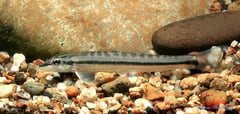
Nemacheilus longistriatusLaos Blackline Torpedo Loach
Kottelat, 1990
Max length125mm SL5in SLTank90 × 30cm36 × 12inTemp23–26°C73–79°FpH6.5–7.5The Laos blackline torpedo loach, Nemacheilus longistriatus, is a nemacheilid loach from the Mekong in Thailand and Laos. It has been collected from the main river channel and from backwaters over bedrock or sand. It is occasionally exported for the aquarium hobby and is told apart from the similar N. binotatus by the dark saddles along its back. A naturally reclusive loach, it becomes more confident alongside schools of peaceful, open water-dwelling cyprinids.
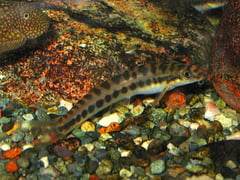
Nemacheilus masyaeArrow Loach
Smith, 1933
Max length70mm SL2.8in SLTank60 × 30cm24 × 12inTemp23–26°C73–79°FpH6.0–7.5Nemacheilus masyae is a nemacheilid loach from Thailand and Peninsular Malaysia. Its flanks carry 14-18 short dark bars and its back 12-17 saddles. It occurs in both small blackwater forest streams and turbid main river channels. It is very similar to N. pallidus but has a more slender body, and its dark bars and saddles are wider than the light interspaces between them.
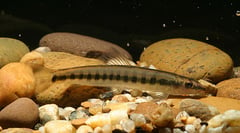
Nemacheilus ornatus
Kottelat, 1990
Max length45mm SL1.8in SLTank60 × 30cm24 × 12inTemp23–26°C73–79°FpH6.0–7.5Nemacheilus ornatus is a small nemacheilid loach known only from the Tapi river drainage in Surat Thani province, southern Thailand. It is said to occur in shallow riffles with clear, moderately-flowing water over small pebbles. Its colour pattern is a black lateral stripe with 9-16 vertical blotches extending above and below it, and the first of these blotches is ringed with lighter pigment to form an ocellus.

Nemacheilus pallidus
Kottelat, 1990
Max length60mm SL2.4in SLTank60 × 30cm24 × 12inTemp23–26°C73–79°FpH6.0–7.5Nemacheilus pallidus is a nemacheilid loach from the Mae Klong, Chao Phraya and Mekong systems in Thailand, Laos, Cambodia and Vietnam. It inhabits streams and small rivers with clear to turbid water and substrates of mud, sand or small rocks. The similar-looking N. masyae is sometimes traded under this name, but N. pallidus has a deeper body and dark bars and saddles thinner than the light interspaces between them.
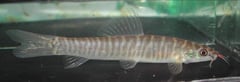
Nemacheilus platiceps
Kottelat, 1990
Max length61mm SL2.4in SLTank60 × 30cm24 × 12inTemp23–26°C73–79°FpH6.0–7.5Nemacheilus platiceps is a nemacheilid loach native to the Mekong basin in Laos, Thailand, Cambodia and Vietnam, and the Dong Nai system. It has been collected from shallow, slow-moving hill stream pools where leaf litter collects, and from faster-flowing stretches over gravel. It is only occasionally available in the aquarium trade and has 12-16 dark, irregular body bars, usually split vertically.
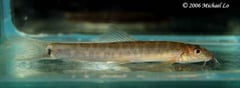
Nemacheilus saravacensis
Boulenger, 1894
Max length50mm SL2.0in SLTank60 × 30cm24 × 12inTemp23–26°C73–79°FpH4.5–7.0Nemacheilus saravacensis is a nemacheilid loach from Borneo, recorded from drainages in Sarawak (Malaysia) and West Kalimantan (Indonesia). It inhabits clear, tea-coloured forest streams with low mineral hardness and pH. Rare in the aquarium hobby, it may only have appeared as bycatch, and it carries 13-17 irregular dark blotches along the lateral line with a similar number of saddles across the back.
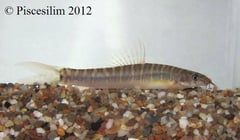
Nemacheilus selangoricus
Duncker, 1904
Max length60mm SL2.4in SLTank60 × 30cm24 × 12inTemp20–25°C68–77°FpH5.0–7.5Nemacheilus selangoricus is a nemacheilid loach ranging from southern Thailand through Peninsular Malaysia and Singapore to western Borneo and Sumatra. It is most common in shallow, flowing forest streams over sand, gravel and detritus. It belongs to the N. selangoricus group and is most similar to N. spiniferus, from which it differs in its 8-12 very regular dark bars on the flanks.
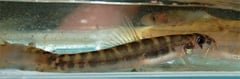
Nemacheilus spiniferus
Kottelat, 1984
Max length55mm SL2.2in SLTank60 × 30cm24 × 12inTemp23–26°C73–79°FpH5.0–7.0Nemacheilus spiniferus is a nemacheilid loach from Borneo, recorded from Sarawak, Brunei and Kalimantan, plus the Natuna and Anambas islands. It is most common in shallow, flowing forest streams with clear to slightly tannin-stained water. A member of the N. selangoricus group, it is rare in the aquarium hobby and differs from N. selangoricus in its 10-13 irregularly-shaped dark bars.
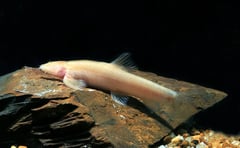
Nemacheilus troglocataractus
Kottelat & Géry, 1989
Max length68mm SL2.7in SLTanknot recordedTempnot recordedpHnot recordedNemacheilus troglocataractus is a blind cave loach known only from the Tham Sai Yok Noi cave system in Kanchanaburi Province, Thailand. Most specimens have no externally visible eyes and all are entirely depigmented. It is protected by Thai law and illegal to remove from its habitat, so the profile includes it for interest only.
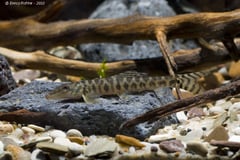
Nemachilichthys rueppelli
(Sykes, 1839)
Max length85mm SL3.3in SLTank90 × 30cm36 × 12inTemp20–25°C68–77°FpH7.0–7.5Nemachilichthys rueppelli is a nemacheilid loach from the upper Krishna River system in the Western Ghats, India. It inhabits moderate to fast-flowing streams and rivers, usually on the bed among aquatic vegetation and submerged roots. N. shimogensis was long treated as a separate species, but Keskar et al. (2015) examined topotypes of both and concluded they are conspecific.
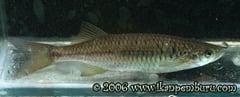
Nematabramis alestes
(Seale & Bean, 1907)
Max length105mm SL4in SLTanknot recordedTempnot recordedpHnot recordedNematabramis alestes is a cyprinid from the southern Philippines, with records from Basilan, Mindanao, Palawan and Busuanga. The only member of the genus with barbels shorter than the head, its body has a pronounced ventral keel.
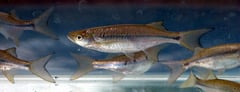
Nematabramis borneensis
Inger & Chin, 1962
Max length105mm SL4in SLTanknot recordedTempnot recordedpHnot recordedNematabramis borneensis is a cyprinid endemic to the Malaysian state of Sabah in northern Borneo. It looks particularly similar to N. alestes, sharing a dark lateral stripe, but is told apart immediately by its barbels, which are longer than the head.
Nematabramis everetti
Boulenger, 1894
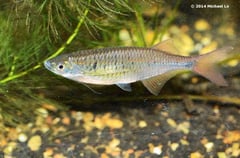
Max length105mm SL4in SLTanknot recordedTempnot recordedpHnot recordedNematabramis everetti is a cyprinid endemic to Borneo, known from Sarawak and Sabah plus East and North Kalimantan. It has a distinctive dark, vertically-elongate humeral marking, more prominent than in other Nematabramis species. Juveniles and subadults appear to favour fast-moving water, while adults are found in deeper, slower stretches of minor tributaries.
Nematabramis steindachnerii
Popta, 1905
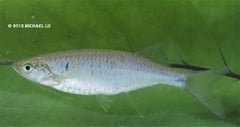
Max length112mm SL4in SLTanknot recordedTempnot recordedpHnot recordedNematabramis steindachnerii is a cyprinid endemic to northern and central Borneo, in Sarawak, Sabah, Brunei and North and East Kalimantan. It has barbels longer than the head but not reaching beyond the pectoral-fin base, and a relatively slender body with a short head.

Nematobrycon lacorteiRainbow Tetra
Weitzman & Fink, 1971
Max length36mm SL1.4in SLTank120 × 30cm48 × 12inTemp20–28°C68–82°FpH5.0–7.2The rainbow tetra, Nematobrycon lacortei, is a small characid from western Colombia, considered endemic to the Río San Juan system. All records appear to come from the Río Calima, where it is apparently restricted to small, isolated forest pools. It is very close to N. palmeri in morphology but has a highly distinctive colour pattern, and adult males are territorial to an extent.

Nematobrycon palmeriEmperor Tetra
Eigenmann, 1911
Max length42mm SL1.7in SLTank90 × 30cm36 × 12inTemp23–27°C73–81°FpH5.0–7.5The emperor tetra, Nematobrycon palmeri, is a characid endemic to the San Juan and Atrato basins in Colombia. Virtually all fish in the trade are captive bred, and it is hardy and unfussy about water chemistry. Males are told apart from N. lacortei by their blue iris, and the smaller Inpaichthys kerri, often misidentified as this species, has an adipose fin, which Nematobrycon lacks.
Neoceratodus forsteriAustralian Lungfish
authority not recorded
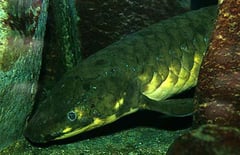
Max length1700mm SL67in SLTank180 × 90cm72 × 36inTemp22–28°C72–82°FpH6.5–8.0The Australian lungfish, Neoceratodus forsteri, is endemic to parts of Australia, where it lives in pools, swamps and other still or sluggish waters. It has a single lung and must reach atmospheric air, but it cannot survive completely dry conditions for long. It is very hardy and protected by CITES. Lungfish are unpredictable with tankmates, and it is best kept singly and alone.

Neochela dadiburjoriDadio
(Menon, 1952)
Max length30mm SL1.2in SLTank90 × 30cm36 × 12inTemp20–24°C68–75°FpH6.0–7.5The dadio, Laubuka dadiburjori, is a small cyprinid endemic to southern India, recorded from Goa, Karnataka, Kerala and Tamil Nadu. It has also been marketed as 'Burjor's brilliance', 'orange chela' and 'orange hatchetfish', and does not exceed 30 mm SL. A dark bluish stripe runs from the eye to the caudal peduncle, typically forming 2-5 round spots. There is a suggestion that it is not a direct relative of other Laubuka and may warrant its own genus.
Neoheterandria elegansTiger Teddy
Henn, 1916
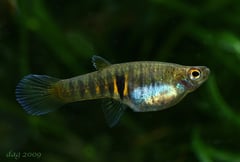
Max length25mm SL1.0in SLTank30 × 20cm12 × 8inTemp24–30°C75–86°FpH7.0–8.0The tiger teddy, Neoheterandria elegans, is a small livebearer endemic to the Río Atrato drainage in northwestern Colombia. It appears to be quite rare in the wild and in the hobby. Shy and diminutive, it is best kept alone in a small colony in a heavily-planted tank with exceptionally clean water. The fry are only 2-3 mm long and initially need infusoria-type foods.