Every species
Filters

Opsarius ardens
(Knight, Rai, d'Souza & Vijaykrishnan, 2015)
Max length105mm SL4in SLTank150 × 60cm60 × 24inTemp18–26°C64–79°FpH6.0–7.5Opsarius ardens is a fast-swimming cyprinid from the Sita and Swarna river systems of the Western Ghats in Karnataka, southwestern India. Before its description it was usually identified in the trade as O. canarensis. A row of bluish-green vertical markings along the body and broad orange margins on the dorsal and anal fins distinguish it. It lives in well-oxygenated, moderate to fast-flowing rivers and streams.

Opsarius bakeri
(Day, 1865)
Max length130mm SL5in SLTank150 × 60cm60 × 24inTemp18–26°C64–79°FpH6.0–7.5Opsarius bakeri is a fast-swimming cyprinid endemic to the Western Ghats of southwestern India, with records from many rivers in Kerala and Karnataka. It is traded as 'royal danio', 'blue-spotted hill trout' and 'blue-dotted mirror fish', and has a single row of bluish-green spots that get smaller with age. Its well-oxygenated, fast-flowing rivers are being polluted and degraded by exotic species and sand mining.

Opsarius barna
(Hamilton, 1822)
Max length130mm SL5in SLTank150 × 60cm60 × 24inTemp16–24°C61–75°FpH6.0–8.0Traded as 'striped hill trout' or 'banded hill trout', Opsarius barna is a cyprinid from the Ganges and Brahmaputra basins in northern India. It is thought to also occur in the Mahanadi and in river systems in Nepal, Bhutan, Bangladesh and Rakhine State, Myanmar, in well-oxygenated, fast-flowing rivers over gravel, cobbles and boulders. An extremely fast swimmer and vigorous feeder, it is unsuitable for the general community.

Opsarius bendelisis
(Hamilton, 1807)
Max length200mm SL8in SLTank180 × 60cm72 × 24inTemp18–26°C64–79°FpH6.0–8.0Barilius bendelisis is a large, fast-swimming cyprinid from India, Bangladesh, Nepal and probably Bhutan. Occasionally sold as 'Indian hill trout' or 'Hamilton's baril', it has 8 to 12 bluish vertical bars and, in adults, a blue-black spot on each scale. It grows to around 200 mm SL and inhabits well-oxygenated, fast-flowing rivers and streams, and its speed and vigorous feeding make it unsuitable for the general community.

Opsarius bernatziki
(Koumans, 1937)
Max length90mm SL3.5in SLTank120 × 45cm48 × 18inTemp18–26°C64–79°FpH6.0–7.5Sold as 'blue hillstream trout', Opsarius bernatziki is a cyprinid from peninsular Thailand and Tanintharyi, Myanmar, south of the Isthmus of Kra. It inhabits well-oxygenated, moderate to fast-flowing rivers and streams, usually 10-20 km or more from the sea. Six or seven bluish vertical bars on each flank and a large blotch at the caudal-fin base help identify it. Like its congeners it is too fast and vigorous a feeder for the general community.

Opsarius canarensis
Jerdon, 1849
Max length130mm SL5in SLTank150 × 60cm60 × 24inTemp18–26°C64–79°FpH6.0–7.5Opsarius canarensis is a cyprinid from southwestern India, known with certainty only from the Netravathi and Tungabhadra river systems in Karnataka. Its name has historically been applied in the trade to O. ardens and O. malabaricus, and it was redescribed in 2015. Two rows of bluish-green spots and broad white margins on the dorsal and anal fins distinguish it. It inhabits well-oxygenated, fast-flowing rivers and streams.

Opsarius caudiocellatus
(Chu, 1984)
Max length86mm SL3.4in SLTank150 × 45cm60 × 18inTemp18–24°C64–75°FpH6.5–8.0Opsarius caudiocellatus is a cyprinid known only from the Salween in southern China, Myanmar and western Thailand, and the upper Mekong in Yunnan. It is named for the black round spot at the caudal-fin base, which with its black dorsal-fin rays separates it from similar congeners. It may have appeared in the aquarium trade, though probably not under the correct name, and inhabits well-oxygenated, moderate to fast-flowing rivers and streams.

Opsarius dogarsinghiManipur Baril
(Hora, 1921)
Max length85mm SL3.3in SLTank150 × 60cm60 × 24inTemp18–24°C64–75°FpH6.0–7.5The Manipur baril, Opsarius dogarsinghi, is a cyprinid from the Chindwin river system in Manipur and Nagaland, northeastern India, and Myanmar. It occasionally appears in the trade as 'Burmese hill trout' or 'striped hill trout'. A large dark blotch at the caudal-fin base and 8-9 dark blue vertical bars help separate it from congeners, and it has been bred in aquaria.

Opsarius gatensisMalabar Baril
(Valenciennes, 1844)
Max length130mm SL5in SLTank150 × 60cm60 × 24inTemp18–26°C64–79°FpH6.0–7.5The Malabar baril, Opsarius gatensis, is a cyprinid endemic to the Western Ghats of southern India, in Karnataka, Kerala and Tamil Nadu. Occasionally seen in the trade, it has 13 to 15 dark blue vertical bars that often almost break up in adults. It inhabits well-oxygenated, fast-flowing rivers and streams, apparently favouring slower runs and pools, and its speed and vigorous feeding make it unsuitable for the general community.

Opsarius infrafasciatus
(Fowler, 1934)
Max length100mm SL3.9in SLTank120 × 45cm48 × 18inTemp18–26°C64–79°FpH6.0–8.0Opsarius infrafasciatus is a cyprinid from the Ping river in Thailand, the Ataran and Salween in Myanmar and China, and Mekong tributaries in China. Once considered synonymous with both O. ornatus and O. pulchellus, it has been treated as distinct since Tejavej (2012). It typically inhabits headwaters and minor rivers and streams with moderate to fast flow, and a small caudal spot is among the characters separating it from congeners.

Opsarius koratensis
(Smith, 1931)
Max length100mm SL3.9in SLTank150 × 45cm60 × 18inTemp22–30°C72–86°FpH6.0–8.0Opsarius koratensis is a cyprinid of the middle and lower Mekong in Thailand, Laos and Cambodia, and the Chao Phraya, Mae Klong and Dong Nai systems. It apparently inhabits larger, deeper and more turbid rivers than many congeners. Genetic evidence from Tang et al. (2010) suggests it may represent a distinct genus, and it occasionally appears in the ornamental trade.

Opsarius malabaricus
Jerdon, 1849
Max length105mm SL4in SLTank150 × 60cm60 × 24inTemp18–26°C64–79°FpH6.0–7.5Opsarius malabaricus is a cyprinid from southwestern India, known with certainty only from the Payaswini and Valapattanam river systems in Kerala. Before its revalidation in 2015 it was usually traded as O. canarensis or O. bakeri 'orange fin'. Bluish-green spots along the body and broad orange margins on the dorsal and anal fins distinguish it. It probably inhabits well-oxygenated, fast-flowing rivers and streams.
Opsarius ornatus
(Sauvage, 1883)
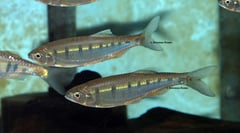
Max length110mm SL4in SLTank150 × 60cm60 × 24inTemp18–26°C64–79°FpH6.0–8.0Opsarius ornatus is a cyprinid from Thailand, possibly restricted to a few small systems in Chumphon Province, mostly in the Tha Sae basin. Kottelat (2013) disputed that view, and the species may have been described from the Chao Phraya system. Populations in the Salween, Ataran, Ping and Mekong drainages formerly considered O. ornatus are O. infrafasciatus. It may have been exported for aquaria, though probably not under the correct name.

Opsarius pulchellus
(Smith, 1931)
Max length110mm SL4in SLTank120 × 45cm48 × 18inTemp18–26°C64–79°FpH6.0–7.5Traded as 'butterfly barb' or 'mackerel barb', Opsarius pulchellus is a cyprinid from the Chao Phraya and mid-to-lower Mekong basins. It occurs in Thailand, Laos, Cambodia and Vietnam, typically in submontane headwaters and fast-flowing minor rivers and streams. Also sold as 'royal opsarius', it carries 7-10 elongate vertical bars on each flank, and like its congeners is too fast and vigorous a feeder for the general community.

Opsarius shacra
(Hamilton, 1822)
Max length130mm SL5in SLTank150 × 60cm60 × 24inTemp18–26°C64–79°FpH6.0–7.5Opsarius shacra is a cyprinid from the Himalayan foothills of Nepal and northern India, in the Ganges and Brahmaputra systems, and from Bangladesh. Poorly known in the hobby but exported on occasion, it has around 12 vertical bars on each flank and a black band in the upper third of the dorsal fin. It inhabits well-oxygenated, fast-flowing rivers with gravel, cobble and boulder substrates, and is too fast and vigorous a feeder for the general community.
Opsarius signicaudus
(Tejavej, 2012)
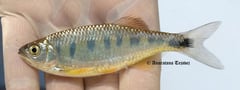
Max length100mm SL3.9in SLTank120 × 45cm48 × 18inTemp18–26°C64–79°FpH6.0–8.0Opsarius signicaudus is a cyprinid known only from headwater tributaries of the Mae Klong River in western Thailand. It inhabits well-oxygenated, moderate to fast-moving rivers and streams over gravel, cobbles and boulders, and is intolerant of organic wastes. A large, elongated blotch at the caudal-fin base helps separate it from congeners. It may have been exported for aquaria, though probably not under the correct name.

Oreichthys cosuatis
(Hamilton, 1822)
Max length43mm SL1.7in SLTank60 × 30cm24 × 12inTemp24–28°C75–82°FpH6.5–7.5Oreichthys cosuatis is a small cyprinid probably restricted to the Ganges and Brahmaputra River basins in Nepal, India and Bangladesh. Several undescribed Oreichthys spp. from India, Myanmar and Thailand continue to be traded under its name, and apparent records from those places likely represent other species. It lacks a black blotch on the caudal peduncle, and adults have a dark triangular blotch in the anal-fin.

Oreichthys crenuchoidesDrape Fin Barb
Schäfer, 2009
Max length45mm SL1.8in SLTank60 × 30cm24 × 12inTemp23–28°C73–82°FpH6.0–7.5The drape fin barb, Oreichthys crenuchoides, is a small cyprinid possibly endemic to Brahmaputra tributaries in West Bengal, eastern India. The species is sometimes traded as Oreichthys cosuatis, O. sp. 'high fin', Puntius 'arunavii' or 'neon highfin barb'. Males have a significantly enlarged dorsal-fin, and a large black marking at the caudal-fin base with no dark marking in the anal-fin separates it from congeners.

Oreichthys sp. 'Myanmar Redfin'
authority not recorded
Max length40mm SL1.6in SLTank60 × 30cm24 × 12inTemp24–28°C75–82°FpH6.5–7.5Oreichthys sp. 'Myanmar Redfin' is a small cyprinid apparently native to parts of the Irrawaddy River basin in northern Myanmar. It appears to be an undescribed species, and is one of several fish sometimes imported and sold as O. cosuatis or O. parvus. Adult males lack a dark marking in the dorsal-fin, and a large, well-defined black blotch on the caudal peduncle is the easiest way to tell it from both.

Oreochromis alcalicusSoda Cichlid
(Hilgendorf, 1905)
Max length115mm SL5in SLTanknot recordedTemp28–38°C82–100°FpH8.0–10.0The soda cichlid, Alcolapia alcalica, is endemic to Lake Natron in Tanzania, a shallow soda lake full of hot, alkaline springs. The lake runs at pH 9.5-10.5 and 32-43.5 °C, and though captive fish can be acclimatised to more normal conditions, this must happen slowly, with the pH kept above 8.0 and the temperature at 28 °C or more. Exceptionally rare in the hobby, it excretes urea where most fish excrete ammonia, and periodically gulps air at the surface.