Every species
Filters

Neolamprologus speciosus
authority not recorded
Max length65mm SL2.6in SLTanknot recordedTemp23–27°C73–81°FpH7.5–9.0Neolamprologus speciosus is a shell-brooding cichlid endemic to the south-western end of Lake Tanganyika. Very similar to N. ocellatus, it often carries the trade name 'black ocellatus', and it lives alongside N. stappersi in nature. Males are much larger than females, and it breeds quite easily in snail shells that females bury until only the entrance is visible.
Neolamprologus stappersi
authority not recorded
Max length63mm SL2.5in SLTanknot recordedTemp23–27°C73–81°FpH7.5–9.0Neolamprologus stappersi is a shell-brooding cichlid endemic to Lake Tanganyika, found on the Congo side of the lake between Moliro and Kalemie. Originally thought to be a morph of N. ocellatus, it is still occasionally offered as 'pearly ocellatus' and may be seen under the invalid name L. meleagris. It defends its shell and the small territory around it vigorously, and dried foods are sometimes refused.

Neolamprologus tretocephalusFive-barred Lamprologus
authority not recorded
Max length150mm SL6in SLTank120 × 30cm48 × 12inTemp23–27°C73–81°FpH7.5–9.0The five-barred lamprologus, Neolamprologus tretocephalus, is an aggressive cichlid endemic to Lake Tanganyika. It lives in relatively shallow water over rocky areas and intermediate zones with scattered rocks. Five vertical bars on the flanks, against six in N. sexfasciatus, separate the two species. Its aggression, particularly when breeding, rules it out of the general Tanganyikan community.
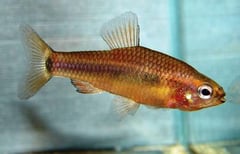
Neolebias ansorgiiAnsorge's Neolebias
authority not recorded
Max length35mm SL1.4in SLTank45 × 30cm18 × 12inTemp24–28°C75–82°FpH5.0–6.0Ansorge's neolebias, Neolebias ansorgii, is a small distichodontid from Cameroon, Democratic Republic of Congo, Nigeria, Gabon and Benin. It inhabits marshes and small, heavily vegetated ponds and creeks, and does not thrive in a brightly lit setup. Rarely offered for sale, it often looks fairly plain in dealers' tanks but colours up in the correct conditions. A very shy fish, it is ideally kept in a species setup.
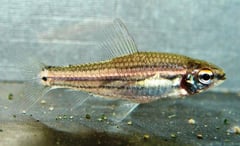
Neolebias trilineatusThree-lined Neolebias
authority not recorded
Max length35mm SL1.4in SLTank45 × 30cm18 × 12inTemp23–26°C73–79°FpH6.0–7.2The three-lined neolebias, Neolebias trilineatus, is a small distichodontid from the Democratic Republic of Congo. A very shy shoaling fish, it needs a densely planted tank with floating cover and soft, acidic, stained water. Rarely seen in the trade, it often looks quite bland in dealers' tanks but colours up in the correct environment.
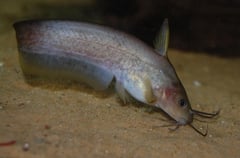
Neosilurus brevidorsalisShortfin Tandan
(Günther, 1867)
Max length200mm SL8in SLTank120 × 45cm48 × 18inTemp20–28°C68–82°FpH6.0–7.5The shortfin tandan, Neosilurus brevidorsalis, is a plotosid catfish restricted to the tips of northern Australia and southern Papua New Guinea. In Australia it is recorded only from the Jardine and Jackson river systems on the Cape York Peninsula, and in Papua New Guinea from the Fly River and some other drainages.

Nimbochromis livingstonii
(Günther, 1894)
Max length250mm SL10in SLTank120 × 45cm48 × 18inTemp24–28°C75–82°FpH7.6–8.8Nimbochromis livingstonii is a predatory cichlid endemic to Lake Malawi, where it is fairly widespread. An ambush predator, it lies motionless on the substrate and its mottled pattern makes it appear dead to the smaller fish that come to investigate. This 'playing dead' behaviour gave it the local name 'Kaligono', loosely 'sleeper'. It is not a fish for the general Malawi cichlid community.

Nimbochromis venustusVenustus
(Boulenger, 1908)
Max length250mm SL10in SLTank120 × 45cm48 × 18inTemp24–28°C75–82°FpH7.6–8.8The venustus, Nimbochromis venustus, is a predatory cichlid endemic to Lake Malawi, where it is fairly widespread. Also sold as 'giraffe hap' or 'giraffe cichlid' after its pattern of irregular dark markings, it is an ambush predator that lies motionless on the substrate to take smaller fish. It is not a fish for the general Malawi cichlid community.
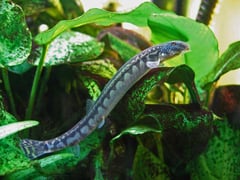
Niwaëlla delicataAjime Loach
(Niwa, 1937)
Max length110mm SL4in SLTank90 × 30cm36 × 12inTemp20–24°C68–75°FpH6.5–7.5The ajime loach, Niwaella delicata, is a 'true' loach that appears restricted to river drainages of central Honshu, Japan. It lives in shallow, fast-flowing, highly-oxygenated headwaters and minor tributaries, and retreats to streams or underflows to remain dormant between October and April. In Japan it is a prized food fish. A dark stripe or row of blotches along the lateral line separates it from its congeners.
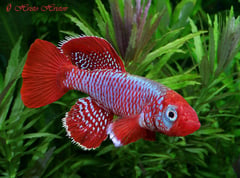
Nothobranchius eggersi
Seegers, 1982
Max length50mm SL2.0in SLTank45 × 30cm18 × 12inTemp20–24°C68–75°FpH7.0–8.2Nothobranchius eggersi is an annual killifish apparently endemic to the lower Rufiji in eastern Tanzania, including freshwater parts of the delta. It inhabits ephemeral pools and swamps on lowland floodplains that dry out for several months each year, and survives as eggs in the substrate. Many wild populations are in the hobby, labelled with collection codes to limit hybridisation, alongside aquarium strains labelled 'red' or 'blue'.
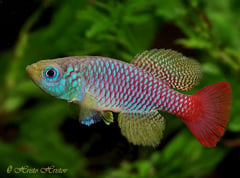
Nothobranchius foerschi
Wildekamp & Berkenkamp, 1979
Max length♂ 55 · ♀ 40mm SL♂ 2.2 · ♀ 1.6in SLTank45 × 30cm18 × 12inTemp20–24°C68–75°FpH6.5–7.5Nothobranchius foerschi is an annual killifish from eastern Tanzania that may be restricted to a small area of the Ruvu River catchment. All confirmed records come from the Ruvu and its delta, between Soga and the coast at Bagamoyo. It inhabits ephemeral pools and swamps on lowland floodplains, mostly heavily overgrown with terrestrial vegetation, and an aquarium strain appears more yellowish than the wild form.
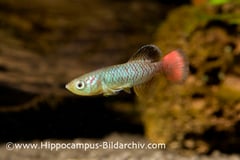
Nothobranchius guentheriGunther's Nothobranch
(Pfeffer, 1893)
Max length♂ 41 · ♀ 32mm SL♂ 1.6 · ♀ 1.3in SLTank45 × 30cm18 × 12inTemp22–25°C72–77°FpH6.5–8.0Gunther's nothobranch, Nothobranchius guentheri, is an annual killifish endemic to Unguja, the main island of Zanzibar, Tanzania. It lives in seasonal coastal pools that dry out completely, surviving the dry season as eggs in the mud. One of the easier Nothobranchius to keep and breed, it is often recommended for a first attempt at an annual killifish. The IUCN lists it as Endangered because its pools are being lost to farming.
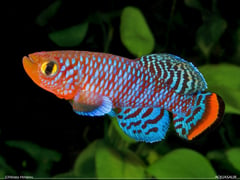
Nothobranchius rachoviiBluefin Nothobranch
Ahl, 1926
Max length55mm SL2.2in SLTank45 × 30cm18 × 12inTemp20–24°C68–75°FpH6.0–7.5The bluefin nothobranch, Nothobranchius rachovii, is a killifish of seasonal pools and swamps in eastern Mozambique. Its habitats dry out for several months each year and the adults die, while the eggs survive in the substrate and hatch when the rains return. Northern and southern populations once included in it are now described as N. krysanovi and N. pienaari, and N. rachovii sensu stricto is restricted to the lower Pungwe and Zambezi basins.

Notopterus notopterusBronze Featherback
(Pallas, 1769)
Max length600mm SL24in SLTanknot recordedTemp20–28°C68–82°FpH6.0–8.0The bronze featherback, Notopterus notopterus, is an air-breathing notopterid from the Indian subcontinent and Southeast Asia. Also called 'Asian knifefish' or 'ghost knifefish' in the trade, it grows to 600 mm and arguably has no place in the ornamental hobby given its adult size and specialised requirements. The single species in Notopterus is likely to represent a complex of closely-related species.
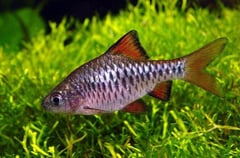
Oliotius oligolepisCheckered Barb
(Bleeker, 1853)
Max length45mm SL1.8in SLTank75 × 30cm30 × 12inTemp18–25°C64–77°FpH5.5–7.5The checkered barb, Oliotius oligolepis, is a small cyprinid apparently endemic to western central Sumatra, Indonesia. Also traded as 'checker barb', 'checkerboard barb' or 'island barb', it is farmed commercially in enormous numbers and wild examples are rarely, if ever, available. Kottelat (2013) raised the genus Oliotius for it, diagnosed partly by black crescent-shaped marks on all scales.
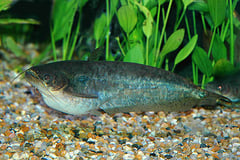
Ompok bimaculatusButter Catfish
authority not recorded
Max length450mm SL18in SLTank180 × 60cm72 × 24inTemp20–26°C68–79°FpH6.0–8.0The butter catfish, Ompok bimaculatus, is a widespread silurid catfish recorded from Afghanistan and Pakistan east to China and Indonesia. Also known as the two spot glass catfish, it very likely contains a number of separate species, given the clear morphological differences between populations. It grows to 45 cm, needs a very large tank and will eat any smaller fish it can fit in its mouth.
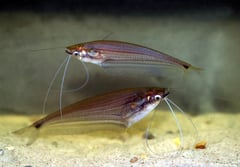
Ompok eugeneiatusBorneo Glass Catfish
authority not recorded
Max length165mm SL6in SLTank120 × 30cm48 × 12inTemp20–28°C68–82°FpH6.0–7.0The Borneo glass catfish, Ompok eugeneiatus, is a silurid catfish from flowing waters in Brunei, Thailand, Cambodia, Malaysia and Indonesia. Not often encountered in the hobby, it is a schooling catfish for a community of medium to large peaceful fish, though it will eat any smaller fish it can fit in its mouth. It needs open swimming space, some current and clean, well-oxygenated water.

Ophthalmotilapia boops
authority not recorded
Max length150mm SL6in SLTank120 × 38cm48 × 15inTemp23–27°C73–81°FpH7.5–9.0Ophthalmotilapia boops is a mouthbrooding cichlid endemic to Lake Tanganyika, found only along the southern Tanzanian coastline. It inhabits rocky drop-offs and slopes. A relatively boisterous species needing a lot of space for its size, it becomes withdrawn unless it is the dominant species in the tank, and males are aggressive towards each other. It was the first species placed in the genus Ophthalmotilapia.

Ophthalmotilapia nasuta
authority not recorded
Max length200mm SL8in SLTank150 × 45cm60 × 18inTemp23–27°C73–81°FpH7.5–9.0Ophthalmotilapia nasuta is a mouthbrooding cichlid endemic to Lake Tanganyika, found on its northwestern, southwestern and southern coasts. A fleshy, proboscis-like growth extending beyond the upper lip, more prominent in males, separates it from the rest of the genus. Several geographical morphs exist, including 'Kachese', 'Mpimbwe', 'Cape Tembwe' and 'Chamba', and these should not be mixed as they hybridise freely.

Ophthalmotilapia ventralis
authority not recorded
Max length150mm SL6in SLTank135 × 45cm53 × 18inTemp23–27°C73–81°FpH7.5–9.0Ophthalmotilapia ventralis is a mouthbrooding cichlid endemic to Lake Tanganyika, found around most of the lake's coastline. It exists in well over 20 colour morphs, which hybridise freely and should not be mixed. In nature only the largest dominant males build nests, holding territories that may measure several metres across, while subdominant males and females shoal together.