Every species
Filters
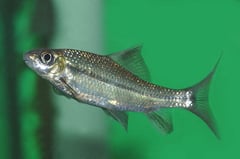
Osteochilichthys nashii
(Day, 1869)
Max length180mm SL7in SLTank120 × 45cm48 × 18inTemp22–25°C72–77°FpH6.5–7.5Osteochilichthys nashii is a cyprinid endemic to India, where it appears restricted to Karnataka and Kerala in the southwest. Predominantly a riverine fish, it lives in clear, well-oxygenated running water and hill streams over boulders, bedrock and smaller stones. Reaching around 18 cm, it is very scarce in the trade and most likely to turn up as a contaminant among imports of other Indian species.
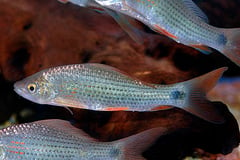
Osteochilus vittatusHard-lipped Barb
(Valenciennes, 1842)
Max length320mm SL13in SLTank180 × 60cm72 × 24inTemp22–25°C72–77°FpHnot recordedThe hard-lipped barb, Osteochilus vittatus, is a cyprinid with an enormous range from Myanmar to Vietnam and south to Borneo, Sumatra and Java. Reaching 32 cm, it inhabits slow-moving tributaries and large streams with soft substrates, and migrates into inundated forest to feed and spawn at the onset of the rainy season. A caudal spot, 15-18 dorsal-fin rays and orange flecking on the flanks help identify it. It is still often sold as Osteochilus hasseltii.
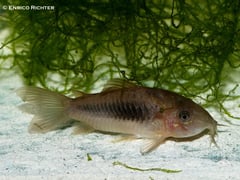
Osteogaster aeneaBronze Cory
(Gill, 1858)
Max length75mm SL3.0in SLTank80 × 30cm31 × 12inTemp21–27°C70–81°FpH6.0–8.0The bronze cory, Osteogaster aenea, long known as Corydoras aeneus, is an armoured catfish described from Trinidad and accepted to occur across much of South America. That range looks more like a complex of similar, distinct species than a single one, and fish from outside Trinidad are of uncertain identity. Aquarium fish are almost all commercially farmed, and the names C. schultzei and C. venezuelanus are routinely misapplied to them.
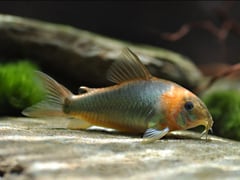
Osteogaster eques
(Steindachner, 1876)
Max length50mm SL2.0in SLTank90 × 30cm36 × 12inTemp20–26°C68–79°FpH6.0–8.0Osteogaster eques, long known as Corydoras eques, is an armoured catfish described from the Amazon at Codajás, on the rio Solimões main channel in western Brazil. Its wider range is unclear, although similar-looking fish have been exported from Peru on occasion. It is sometimes confused with C. venezuelanus, and two similar unidentified fishes from Peru carry the codes CW007 and CW043.
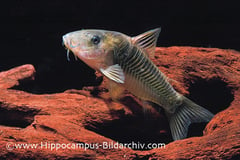
Osteogaster melanotaeniaGreen-gold Cory
authority not recorded
Max length60mm SL2.4in SLTank45 × 30cm18 × 12inTemp20–23°C68–73°FpH6.0–7.2The green-gold cory, Osteogaster melanotaenia, long known as Corydoras melanotaenia, is an armoured catfish from the Rio Meta basin in Colombia. It lives in small tributaries, creeks, flooded forest and sand banks. Also known as the 'elongate bronze cory', it resembles C. aeneus at first glance, but is more elongate and has a golden-yellow tinge to the fins.
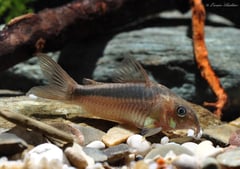
Osteogaster rabautiRusty Cory
(La Monte, 1941)
Max length65mm SL2.6in SLTank90 × 30cm36 × 12inTemp20–27°C68–81°FpH5.5–7.2The rusty cory, Osteogaster rabauti, long known as Corydoras rabauti, is an armoured catfish known mostly from the rio Javarí, which forms much of the border between Brazil and Peru. It possibly also occurs in Colombia, but the full extent of its range is somewhat unclear. Often confused with the very similar O. zygata, it can be told apart by the broad dark stripe on the upper body, which extends onto the lower part of the caudal peduncle. An albino form is available on occasion.
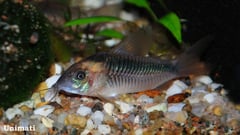
Osteogaster zygataBlack Band Cory
(Eigenmann & Allen, 1942)
Max length70mm SL2.8in SLTank90 × 30cm36 × 12inTemp20–26°C68–79°FpH5.5–7.5The black band cory, Osteogaster zygata, long known as Corydoras zygatus, is an armoured catfish from the middle Río Marañón watershed in eastern Ecuador and northern Peru. Also known in the trade as the 'zygus cory', it looks very similar to O. rabauti. In O. zygata the broad dark stripe on the upper body stops short of the lower caudal peduncle, and in O. rabauti it extends onto it.
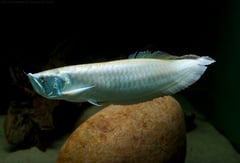
Osteoglossum bicirrhosumSilver Arowana
(Cuvier, 1829)
Max length800mm SL31in SLTanknot recordedTemp20–30°C68–86°FpH5.0–7.5The silver arowana, Osteoglossum bicirrhosum, is a large predator from the Amazon basin, plus river systems in Guyana and French Guiana. Reaching 80 cm, it is largely unsuitable for the home aquarium, and although juveniles are readily available, few private aquarists can house an adult long-term. Juveniles have a single dark lateral stripe, while in those of its only congener, O. ferreirai, most of the body and fins are dark.
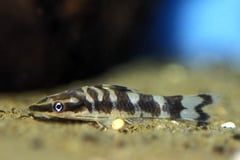
Otocinclus cocamaZebra Oto
Reis, 2004
Max length45mm SL1.8in SLTank45 × 30cm18 × 12inTemp21–25°C70–77°FpH6.0–7.5The zebra oto, Otocinclus cocama, is a miniature loricariid from Peru, thought to occur throughout the lower Ucayali and Marañon. Vertically elongated blotches from the dorsal midline to the belly distinguish it from all congeners, and it has a complete lateral line. It can be delicate when first imported and benefits from quarantine in a tank with a good biofilm to graze.
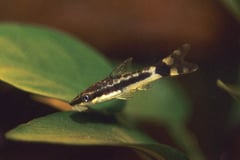
Otocinclus macrospilusOto
Eigenmann & Allen, 1942
Max length35mm SL1.4in SLTank45 × 30cm18 × 12inTemp21–26°C70–79°FpH5.5–7.5Otocinclus macrospilus, one of the commoner otos in the hobby, is a small loricariid endemic to parts of the Upper Amazon in Peru. It is frequently mislabelled as O. affinis or O. vittatus, and a large round black blotch at the base of the caudal fin separates it from O. vestitus. Imported fish can be delicate, usually through starvation in transit, and do best added to mature, planted tanks.

Otopharynx lithobatesSulphur-headed Hap
authority not recorded
Max length160mm SL6in SLTank90 × 45cm36 × 18inTemp24–28°C75–82°FpH7.6–8.8The sulphur-headed hap, Otopharynx lithobates, is a cichlid endemic to Lake Malawi, where it lives among caves and crevices in rocky areas. A true rock dweller, it is hardly ever seen in open water, even in aquaria. In breeding males the three flank spots are masked by neon blue patterning and the dorsal fin and top of the head turn deep yellow-orange. It has been sold in the trade as 'Aristochromis sp. red top'.
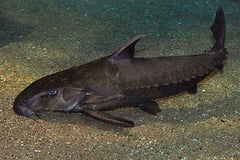
Oxydoras nigerRipsaw Catfish
authority not recorded
Max length900mm SL35in SLTank240 × 60cm96 × 24inTempnot recordedpH6.0–7.0The ripsaw catfish, Oxydoras niger, is a large doradid catfish from many of the major river systems of northern South America. Reaching 90 cm, it is only for the experienced fishkeeper and best suited to public aquaria. Much more peaceful than its common name suggests, it takes that name from the spines along the lateral line. It was previously referred to Pseudodoras niger.
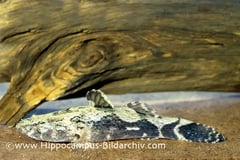
Oxyeleotris marmorataMarbled Goby
authority not recorded
Max length650mm SL26in SLTank150 × 60cm60 × 24inTemp22–28°C72–82°FpH6.5–7.5The marbled goby, Oxyeleotris marmorata, is one of the largest gobies in the world, found in Southeast Asia from Thailand to the Philippines. It lives in rivers, ponds, swamps and flooded forests, mainly in fresh water but also in brackish environments, and grows to 65 cm. A nocturnal ambush predator, it is territorial with its own kind and will eat any fish it can fit in its mouth, so it is best kept alone. It is also a popular food fish in some of its native countries.
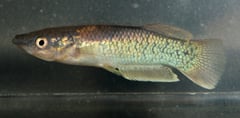
Pachypanchax arnoulti
Loiselle, 2006
Max length80mm SL3.1in SLTank90 × 30cm36 × 12inTemp20–28°C68–82°FpH6.0–7.5Pachypanchax arnoulti is a killifish endemic to western Madagascar, where it occurs in the Mahavavy du Sud and Betsiboka river systems. It was in the hobby for many years as the congener P. omalonotus and appears under that name in most older aquarium literature, so a degree of hybridisation has undoubtedly occurred. The absence of metallic gold spots on the flanks separates it from that species. Its populations have declined dramatically since the 1950s.
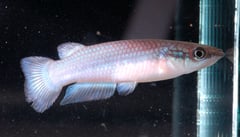
Pachypanchax omalonotusPowder-blue Panchax
(Duméril, 1861)
Max length90mm SL3.5in SLTank90 × 30cm36 × 12inTemp20–28°C68–82°FpH6.0–7.5The powder-blue panchax, Pachypanchax omalonotus, is a killifish from Nosy Be and the adjacent Sambirano River system in northwestern Madagascar. Many fish in the hobby identified as P. omalonotus are in fact P. arnoulti, as are those in much older aquarium literature, and a degree of hybridisation has undoubtedly occurred. Metallic gold spots on the flanks separate it from that species, and males are polymorphic, with yellow, red and blue morphs in different populations.
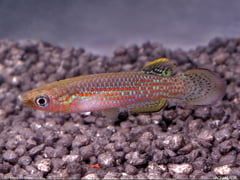
Pachypanchax playfairiiPlayfair's Panchax
(Günther, 1866)
Max length100mm SL3.9in SLTanknot recordedTemp18–24°C64–75°FpH6.0–8.0Playfair's panchax, Pachypanchax playfairii, is a killifish from forest streams in the granitic Seychelles, and has been translocated to Zanzibar. The only purely freshwater fish native to the Seychelles, it is known there from Mahé, Praslin, Silhouette and La Digue. Raised scales on the back of most adult males and a black ocellus in the dorsal-fin of females tell it apart from all congeners.
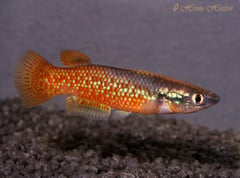
Pachypanchax sakaramyiMadagascar Panchax
(Holly, 1928)
Max length90mm SL3.5in SLTank90 × 30cm36 × 12inTemp20–24°C68–75°FpH6.5–7.5The Madagascar panchax, Pachypanchax sakaramyi, is a killifish from high-gradient forest streams around the Ambohitra Massif in northern Madagascar. The only remaining riverine populations are in a short stretch of the Sakaramy River and the upper Antongombato River, most of the original populations having been lost to invasive species, deforestation and the diversion of the Sakaramy's source. Despite its conservation status it is relatively well-established in the aquarium hobby.
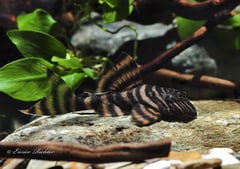
Panaqolus sp.L403
authority not recorded
Max length120mm SL5in SLTank120 × 30cm48 × 12inTemp24–30°C75–86°FpH6.0–7.0L403 is an undescribed wood-eating suckermouth catfish in the genus Panaqolus, known only from the rio Anapu in Pará state, Brazil. The species is xylophagous, feeding primarily on wood, so driftwood must be provided. It should be given a mainly vegetarian diet, with meaty foods kept to a minimum. It has been bred in aquaria.
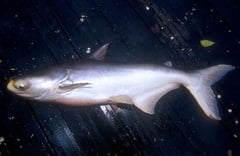
Pangasianodon gigasGiant Mekong Catfish
authority not recorded
Max length3000mm SL118in SLTanknot recordedTemp20–28°C68–82°FpH6.5–7.5The giant Mekong catfish, Pangasianodon gigas, is a pelagic shark catfish from the lower Mekong in China, Thailand, Laos, Cambodia and Vietnam. Perhaps the biggest freshwater fish in the world, it has been listed as critically endangered by the IUCN since 2003, after wild stocks fell by over 80% from 1990, and international trade is banned under CITES Appendix I. It should not be considered an aquarium subject under any circumstance.
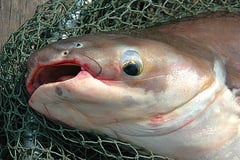
Pangasianodon hypophthalmusIridescent Shark Catfish
authority not recorded
Max length1300mm SL51in SLTanknot recordedTemp22–26°C72–79°FpH6.5–7.5The iridescent shark catfish, Pangasionodon hypophthalmus, is a pangasiid catfish from the lower Mekong in Thailand, Laos, Cambodia and Vietnam. It also occurs in the Chao Phraya. The commonest pangasiid in the trade, it is usually sold as a small silvery-blue juvenile with little said about its eventual size. It rarely reaches 130 cm in captivity but easily tops 90 cm and can live for 20 years or more, so it is debatable whether it should be considered an aquarium subject at all.