Every species
Filters
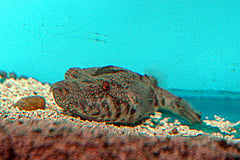
Pao suvattiiArrowhead Puffer
(Sontirat & Soonthornsatit, 1985)
Max length150mm SL6in SLTanknot recordedTemp22–26°C72–79°FpH6.5–7.5The arrowhead puffer, Pao suvattii, is a predatory puffer from Thailand and Laos, found over rocky or muddy substrates in main river channels. A true ambush predator, it spends most of its time buried in the substrate and will mimic rocks if it cannot dig in. It will eat any fish that fits in its mouth and takes chunks from larger ones, so it is best kept on its own.
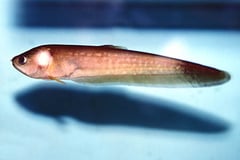
Papyrocranus aferArowana Knifefish
authority not recorded
Max length800mm SL31in SLTank210 × 90cm84 × 36inTemp24–28°C75–82°FpH6.5–7.5The arowana knifefish, Papyrocranus afer, is a notopterid knifefish widespread over much of western and central Africa, from Senegal to Sudan. Its anal and caudal fins are fused into one long, undulating fin. Infrequently imported, it grows to 80 cm and becomes increasingly territorial as it matures, so it is recommended only to the experienced fishkeeper and best kept as a single specimen.
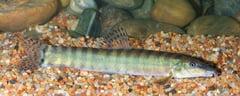
Parabotia bimaculatus
Chen, 1980
Max length140mm SL6in SLTank120 × 45cm48 × 18inTemp20–24°C68–75°FpH6.0–7.5Parabotia bimaculatus is a riverine botiid loach from the upper Yangtze basin in Sichuan, southwest China, described from the Laixi River at Luxian. It looks similar to P. fasciatus but has two dark markings at the caudal-fin base (vs. one) and 12-15 dark bars on the body. Like other Parabotia it favours clear, well-oxygenated running water over rocks and gravel, and needs spotless water in the aquarium.
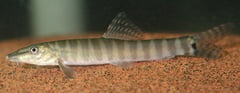
Parabotia fasciatus
Dabry de Thiersant, 1872
Max length150mm SL6in SLTank120 × 45cm48 × 18inTemp20–24°C68–75°FpH6.0–7.5Parabotia fasciatus is a botiid loach from China, described from the Yangtze and also recorded from much of the Pearl River watershed. It is rarely seen in the trade and usually arrives only as bycatch among shipments of Sinibotia, particularly S. robusta. A single dark spot at the caudal-fin base separates it from the similar P. bimaculatus, and numerous species from several genera are considered synonymous with it.
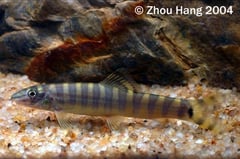
Parabotia lijiangensis
Chen, 1980
Max length83mm SL3.3in SLTank120 × 30cm48 × 12inTemp20–24°C68–75°FpH6.0–7.5Parabotia lijiangensis is a botiid loach described from the Li River drainage near Guilin, in the Pearl River system of southern China. It has 10-13 dark vertical bars on the body and a dark, ocellated spot in the centre of the caudal-fin base. It probably inhabits clear, well-oxygenated running water, and the occasional specimen may turn up among shipments of similar-looking Sinibotia.
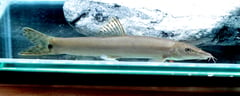
Parabotia sp. 'PB01'
authority not recorded
Max length100mm SL3.9in SLTank120 × 45cm48 × 18inTemp20–24°C68–75°FpH6.0–7.5Parabotia sp. 'PB01' is an unidentified botiid loach imported into Singapore in 2012 from Sichuan province, southwestern China. Its name is unclear, and identification is harder still because diagnoses for several members of the genus do not appear to exist in English. It is not common in the aquarium trade and presumably needs clear, well-oxygenated running water like its congeners.
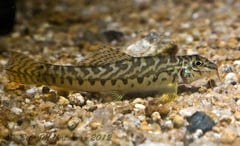
Paracanthocobitis botiaZipper Loach
(Hamilton, 1822)
Max length152mm SL6in SLTank75 × 30cm30 × 12inTemp21–26°C70–79°FpH6.0–7.5The zipper loach, Paracanthocobitis botia, is a nemacheilid loach from the Brahmaputra River in Assam, northeastern India. It was long thought to range from Pakistan to western Thailand, and several populations once included under the name are now treated as separate species. Relatively hardy and peaceful, it is one of the better choices for those new to nemacheilids, and its dark, eye-like ocellus at the top of the caudal peduncle is normally more intense in younger fish.
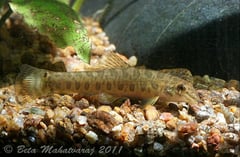
Paracanthocobitis mooreh
(Sykes, 1839)
Max length75mm SL3.0in SLTank75 × 30cm30 × 12inTemp20–26°C68–79°FpH6.0–7.5Paracanthocobitis mooreh is a nemacheilid loach known only from the Godavari, Krishna and Kaveri (Cauvery) systems in western and southern India. An incomplete lateral line ending near the pelvic-fin origin, with small, mostly vertical blotches along it connected to the dorsal saddles, separates it from congeners. It favours stretches of streams and small rivers where leaf litter collects over sand, cobbles and boulders, and is generally non-aggressive.
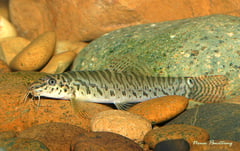
Paracanthocobitis pictilisCherry-fin Loach
(Kottelat, 2012)
Max length91mm SL3.6in SLTank90 × 30cm36 × 12inTemp21–26°C70–79°FpH6.5–7.5The cherry-fin loach, Paracanthocobitis pictilis, is a nemacheilid loach from the Ataran River, a Salween tributary on the Thailand-Myanmar border. Before its description it was traded as P. rubidipinnis, a species apparently endemic to the lower Irrawaddy. Bolder and less peaceful than other members of the genus, it inhabits shady, fast-flowing riffles, and some males become aggressive unless kept in a mixed-sex group of at least six.
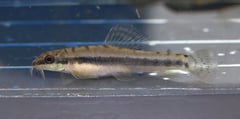
Paracanthocobitis zonalternans
(Blyth, 1860)
Max length78mm SL3.1in SLTank60 × 30cm24 × 12inTemp20–25°C68–77°FpH6.0–7.5Paracanthocobitis zonalternans is a nemacheilid loach ranging from Manipur in India through Myanmar into western and peninsular Thailand. Several species are thought to be confused under the name, and Singer and Page (2015) consider it likely to be a species complex. Among the more peaceful members of the genus, it does best in a mixed-sex group of at least half a dozen, and it has been bred in aquaria, first by UK aquarist Mick Wright.
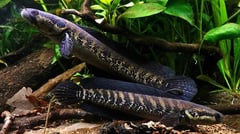
Parachanna africana
(Steindachner, 1879)
Max length300mm SL12in SLTank120 × 60cm48 × 24inTemp22–28°C72–82°FpH5.0–7.5Parachanna africana is an African snakehead found from Benin to Nigeria, in lowland coastal rivers draining into the Gulf of Guinea. Sometimes called the 'Niger snakehead', it is uncommon in the trade, and its name is sometimes misapplied to P. obscura. A series of 8-11 dark chevrons along the body identifies it, though these may not show depending on mood. It is best kept in a species-specific aquarium with a tight-fitting hood.
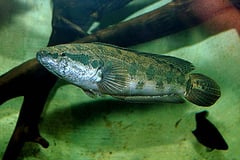
Parachanna obscuraAfrican snakehead
authority not recorded
Max length406mm SL16in SLTank38 × 38cm15 × 15inTemp26–30°C79–86°FpH6.0–7.5The African snakehead, Parachanna obscura, is widespread in West Africa from Senegal to Cameroon and ranges inland across the continent to Sudan. The most commonly seen African Parachanna, it is hard to tell apart from the rarely imported P. insignis. It will eat any fish less than two thirds its size and is best kept alone. Both parents guard the eggs among surface vegetation, and the female is said to feed the fry with infertile eggs.

Paracheirodon axelrodiCardinal Tetra
(Schultz, 1956)
Max length35mm SL1.4in SLTank60 × 30cm24 × 12inTemp23–29°C73–84°FpH3.5–7.5The cardinal tetra, Paracheirodon axelrodi, is a small characid from the rio Negro and Orinoco drainages of Brazil, Colombia and Venezuela. Immensely popular in the hobby, it is now commercially bred on a large scale, but a significant proportion of trade fish are still wild caught or come from community-led projects such as Project Piaba. Rio Negro and Orinoco populations differ in colour pattern, and wild fish are less tolerant of deteriorating water conditions than commercially-produced ones.

Paracheirodon innesiNeon Tetra
(Myers, 1936)
Max length30mm SL1.2in SLTank60 × 30cm24 × 12inTemp21–25°C70–77°FpH4.0–7.5The neon tetra, Paracheirodon innesi, is a small characid from the Amazon basin in Colombia, Brazil and Peru, found in acidic forest streams. Years of commercial breeding have weakened the ornamental strain, and defects and ill-health are widespread, so stock needs choosing with care. Neons are also susceptible to 'neon tetra disease', a microsporidian infection that is virtually untreatable once advanced.

Paracheirodon simulansGreen Neon Tetra
(Géry, 1963)
Max length25mm SL1.0in SLTank45 × 30cm18 × 12inTemp24–27°C75–81°FpH3.0–6.5The green neon tetra, Paracheirodon simulans, is a small characid from the rio Negro and Orinoco drainages of Brazil, Colombia and Venezuela. An exclusive inhabitant of blackwater, it lives only in the upper, terra firme reaches of tributaries and is sometimes traded as 'false neon tetra' or 'blue neon tetra'. A greener lateral stripe that extends to the caudal-fin base and duller red flanks separate it from P. innesi and P. axelrodi.

Parachromis managuensisJaguar Cichlid
authority not recorded
Max length610mm SL24in SLTank120 × 38cm48 × 15inTemp24–30°C75–86°FpH6.0–8.0The jaguar cichlid, Parachromis managuensis, is a large predatory cichlid from eastern Central America, from Honduras through Nicaragua to Costa Rica. Almost exclusively carnivorous, it will see smaller fish as food and is always territorial. A large aquarium is required, and a single spawn from large adults can produce 3000 fry.
Parachromis motaguensisFalse Yellowjacket Cichlid
authority not recorded
Max length305mm SL12in SLTank120 × 38cm48 × 15inTemp20–30°C68–86°FpH6.0–8.0The false yellowjacket cichlid, Parachromis motaguensis, is a large predatory cichlid from Guatemala, El Salvador and Honduras. It occurs in lakes and larger streams, most often in the central flowing parts of rivers. Aggressive towards its own and other species, it treats anything that fits in its mouth as food, and a breeding pair will hurt any other fish in the tank, even significantly bigger ones.

Paracyprichromis brieni
authority not recorded
Max length110mm SL4in SLTank120 × 45cm48 × 18inTemp24–27°C75–81°FpH7.5–9.0Paracyprichromis brieni is a deep-water cichlid endemic to Lake Tanganyika, where it is quite widespread. Males hold territories under rocky overhangs and are often seen hanging upside down beneath them, while females stay in open water above the rocks. It is easily confused with P. nigripinnis, its only congener, but has smaller eyes and a slimmer, more elongate body, and it quickly loses its best colouration under bright lighting or with boisterous tankmates.

Paracyprichromis nigripinnis
(Boulenger, 1901)
Max length110mm SL4in SLTank120 × 45cm48 × 18inTemp24–27°C75–81°FpH7.5–9.0A deep-water cichlid endemic to Lake Tanganyika, Paracyprichromis nigripinnis is easily confused with P. brieni, its only congener. It has larger eyes and a slightly rounder, stockier body than that species. Males hold territories under rocky overhangs and can often be seen hanging upside down beneath them. Several colour morphs exist that hybridise if mixed, and the fish loses its best colouration under bright lighting or with boisterous tankmates.
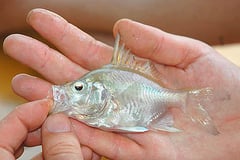
Parambassis wolffiiDuskyfin Glass Fish
authority not recorded
Max length200mm SL8in SLTank120 × 30cm48 × 12inTemp18–25°C64–77°FpH6.5–8.0The duskyfin glass fish, Parambassis wolffii, is a large, predatory ambassid from Thailand, Laos, Cambodia, Vietnam and Indonesia. It inhabits slow-moving and standing waters, including floodplains, and is very common in its native countries, where it is used as a food fish. It grows to around 20 cm, though not usually in aquaria, and eats any small tankmates.