Every species
Filters
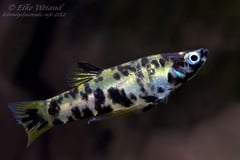
Phalloceros caudimaculatusDusky Millions Fish
(Hensel, 1868)
Max length70mm SL2.8in SLTanknot recordedTemp16–22°C61–72°FpH7.0–8.0The dusky millions fish, Phalloceros caudimaculatus, is a small livebearer native to Brazil, Paraguay, Uruguay and Argentina. Feral populations in Australia, New Zealand, Ethiopia and Malawi were purportedly introduced for mosquito control and are now considered invasive. Highly variable in colour pattern, it is known in the hobby in spotted and golden ornamental forms. P. caudimaculatus is the type species of a genus that was monotypic until 21 new species were described in 2008.

Phenacogaster tegatus
(Eigenmann, 1911)
Max length45mm SL1.8in SLTank60 × 30cm24 × 12inTemp20–28°C68–82°FpH6.0–7.5Phenacogaster tegatus is a small characid from the upper rio Paraguay basin in Brazil and Paraguay and the Río Paraná in northeastern Argentina. It has been traded as 'six-eyed tetra', in reference to the two dark spots on each flank plus the eye. Peaceful but somewhat unsuitable for the general community aquarium, it is best kept in a group of at least 8-10 alongside similarly-sized characids and other small, non-predatory fishes.
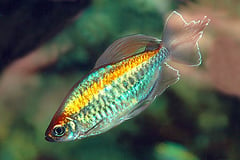
Phenacogrammus interruptusCongo Tetra
authority not recorded
Max length80mm SL3.1in SLTank120 × 30cm48 × 12inTemp23–28°C73–82°FpH6.0–7.5The Congo tetra, Phenacogrammus interruptus, is a tetra from parts of the River Congo drainage in the Democratic Republic of Congo. Wild populations are endemic there, but most fish in the trade are bred commercially in the Far East and Eastern Europe. Usually sold as a drab, greyish juvenile, it colours up as it matures, and males develop extended caudal filaments and a greatly extended dorsal fin. It is sensitive to water quality and easily frightened when not kept in numbers.
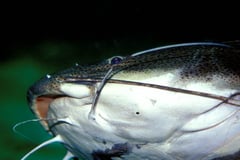
Phractocephalus hemioliopterusRed-tail Catfish
authority not recorded
Max length1340mm SL53in SLTanknot recordedTemp21–26°C70–79°FpH6.0–7.5The red-tail catfish, Phractocephalus hemioliopterus, is a giant pimelodid catfish from much of the Amazon and Rio Orinoco basins in South America. The largest specimen recorded by science measured 134 cm and weighed more than 40 kg, and keeping one at home is not recommended without the facilities to house it for life. Juveniles are sold cheaply, and fish dumped when they outgrow their tanks have established populations in the USA and several other countries.
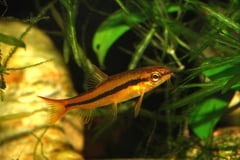
Physoschistura mangoRosy Loach
Conway & Kottelat, 2023
Max length30mm SL1.2in SLTank60 × 30cm24 × 12inTemp20–26°C68–79°FpH6.5–8.0The rosy loach, Physoschistura mango, is a miniature nemacheilid loach from waters around Hopong in Shan State, eastern Myanmar, where it is collected alongside Danio margaritatus. It was sold for years as an undescribed Yunnanilus or Petruichthys, as Y. sp. 'orange' or 'Burmese pink loach', and under the fictitious name 'Tuberoschistura arakensis', until Conway and Kottelat described it in 2023. Peaceful and highly gregarious, it reaches 25-30 mm and should be kept in a group of at least 8-10. Often only the colourful males are exported.

Piabucus dentatusPiabuco Tetra
authority not recorded
Max length130mm SL5in SLTank120 × 30cm48 × 12inTemp20–25°C68–77°FpH6.0–7.5The piabuco tetra, Piabucus dentatus, is a large tetra from coastal waters of northern South America, from Venezuela to the mouth of the Amazon. A pelagic species of estuaries and floodplain streams, it is often found in turbid, silt-laden water and sometimes in brackish conditions, and reaches 13 cm SL. Oddly for a tetra it will also eat red, filamentous 'black brush' algae. All three species in the genus are rarely seen in the hobby.
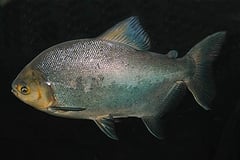
Piaractus brachypomusRed-bellied Pacu
authority not recorded
Max length880mm SL35in SLTank300 × 90cm118 × 36inTemp23–28°C73–82°FpH4.8–7.5The red-bellied pacu, Piaractus brachypomus, is a serrasalmid from the Orinoco and Amazon basins in Colombia, Venezuela, Peru, Bolivia and Brazil. Known as the pirapitinga in its native countries, it is one of the largest scaled fishes in the Amazon basin, with wild fish recorded to 88 cm. Juveniles mimic the red-bellied piranha and are sold small as 'vegetarian piranha', and releases by aquarists have left populations in the USA and elsewhere.
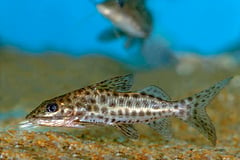
Pimelodus maculatusSpotted Pim
authority not recorded
Max length180mm SL7in SLTank120 × 60cm48 × 24inTemp20–24°C68–75°FpH6.4–7.4The spotted pim, Pimelodus maculatus, is a pimelodid catfish from the Rio Paraná and Rio São Francisco basins in Brazil and Argentina. Active and shoaling, it grows to 18 cm and is a predator that will eat smaller fish, so it suits only roomy tanks with tough, active tankmates. Like other pims it is scaleless and sensitive to many medications, and the mucus on its rigid fin spines can cause a painful sting.
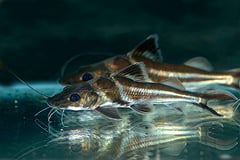
Pimelodus ornatusOrnate Pim
authority not recorded
Max length280mm SL11in SLTank150 × 60cm60 × 24inTemp24–25°C75–77°FpH6.0–7.2The ornate pim, Pimelodus ornatus, is a pimelodid catfish recorded in major river systems from Colombia and Venezuela south to Paraguay and Argentina. One of the more sought-after pims imported with any regularity, it grows to 28 cm and is a predator that will eat smaller fish. It is scaleless, sensitive to many medications and often in poor shape when first imported, and its rigid fin spines can cause a painful sting.
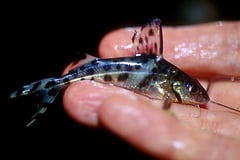
Pimelodus pictusPictus Cat
authority not recorded
Max length120mm SL5in SLTank120 × 45cm48 × 18inTemp22–25°C72–77°FpH5.8–6.8The pictus cat, Pimelodus pictus, is a small pimelodid catfish from the Rio Orinoco and Amazon basins in Colombia, Venezuela, Peru and Brazil. The most popular member of the genus in the hobby, it is often sold as a bottom dweller for communities of small fish, though it is a predator that will eat neons, guppies and similarly-sized species. Colombian fish are peppered with tiny dark spots, while the Peruvian form has much larger spots on the body.

Placidochromis electraDeepwater Hap
authority not recorded
Max length200mm SL8in SLTank120 × 45cm48 × 18inTemp24–28°C75–82°FpH7.6–8.8The deepwater hap, Placidochromis electra, is a cichlid endemic to Lake Malawi, living over sandy bottoms usually below 7 metres. In nature it feeds on invertebrates stirred up by digging substrate feeders such as Taeniolethrinops praeorbitalis. The common name dates from when it was thought to live only in much deeper water. A very gentle species, it is unsuited to a mbuna community, and its colour forms should not be kept together as they may hybridise.

Placidochromis milomoSuper VC 10 Hap
authority not recorded
Max length250mm SL10in SLTank120 × 45cm48 × 18inTemp24–28°C75–82°FpH7.6–8.8The Super VC 10 hap, Placidochromis milomo, is a cichlid endemic to Lake Malawi, found in the southern part of the lake and at Nkhata Bay. Wild fish have massively enlarged lips for scraping algae and invertebrates from rocks, but these usually recede in the aquarium and do not develop at all in tank-bred fish. Relatively peaceful, it does well with larger Malawians but not mbuna, and only one male should be kept unless the tank is very large.
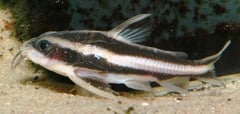
Platydoras armatulusHumbug Catfish
(Valenciennes, 1840)
Max length240mm SL9in SLTank120 × 30cm48 × 12inTemp24–30°C75–86°FpH5.8–7.5The humbug catfish, Platydoras armatulus, is a doradid catfish from the Paraná and Paraguay basins in Argentina, Bolivia, Brazil and Paraguay. Most fish in the trade come from the Amazon and Orinoco, and those are now treated as P. costatus or P. hancockii, so a fish sold under this name may be one of those. Also sold as the striped dora, striped raphael or striped talking catfish, it is hardy, but its secretive nature, adult size and habit of eating smaller tankmates suit it only to communities of larger fish. It produces audible sounds by grinding its pectoral spines in their sockets or by resonating the swimbladder.
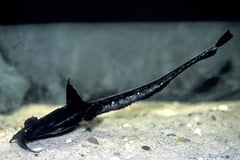
Platystacus cotylephorusBanded Banjo Catfish
authority not recorded
Max length320mm SL13in SLTank120 × 30cm48 × 12inTemp22–25°C72–77°FpH6.0–8.2The banded banjo catfish, Platystacus cotylephorus, is an aspredinid catfish from estuarine and coastal waters of northern South America and Trinidad. Largely inactive and secretive, it is camouflaged to resemble a dead leaf and emerges only after dark, often lying buried in muddy substrates of fresh or brackish mangroves. During the spawning season females develop fleshy stalks called cotylephores on the belly, to which the eggs are attached until they hatch.
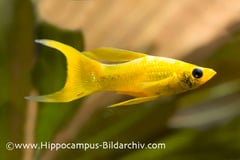
Poecilia latipinnaSailfin Molly
(Lesueur, 1821)
Max length125mm SL5in SLTank76 × 38cm30 × 15inTemp21–26°C70–79°FpH7.0–8.5The sailfin molly, Poecilia latipinna, is a livebearer native to southern North America and Mexico, from Carolina to Veracruz. Bred into many colour morphs and crossed with P. sphenops, it can live perfectly well in fresh water provided it is not soft or acidic. Dark rectangular spots in the dorsal fin separate it from the similar P. velifera, and introduced populations in many countries often outcompete native species.
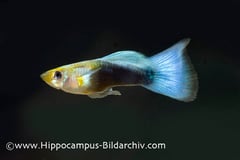
Poecilia reticulataGuppy
Peters, 1859
Max length60mm SL2.4in SLTank45 × 30cm18 × 12inTemp17–28°C63–82°FpH7.0–8.5The guppy, Poecilia reticulata, is a livebearer native to northeastern South America and the southern Caribbean, including Venezuela and Trinidad. One of the most popular aquarium fish in the world, it is available in many aquarium-bred varieties with elongated finnage, while the wild form is seldom seen for sale. Many commercially bred guppies are weakened by inbreeding and over-production, and introduced or feral populations exist in around fifty other countries.
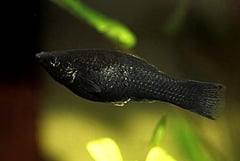
Poecilia sphenopsShort-finned Molly/Black Molly
Valenciennes, 1846
Max length80mm SL3.1in SLTank90 × 30cm36 × 12inTemp21–28°C70–82°FpH7.0–8.5The short-finned molly, Poecilia sphenops, is a livebearer whose native range runs north from Venezuela and Colombia to Mexico. Many colour morphs exist, including the black molly, and years of inbreeding and over-production have left many of them weak and prone to disease. All the morphs do better in slightly brackish conditions and are much more prone to disease in fresh water that is not hard and alkaline.
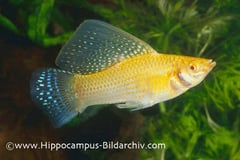
Poecilia veliferaGiant Sailfin Molly
(Regan, 1914)
Max length150mm SL6in SLTank91 × 38cm36 × 15inTemp22–28°C72–82°FpH7.0–8.5The giant sailfin molly, Poecilia velifera, is a livebearer endemic to southeastern Mexico, with introduced populations in several other countries. Young fish are hard to tell from P. latipinna, and the only reliable method is to count the dorsal-fin rays: 18-19 in this species against 14. More difficult to maintain than others in the genus, it needs hard, alkaline water of high quality for males to develop the full sail-like dorsal fin.
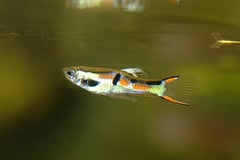
Poecilia wingeiEndler's Livebearer
Poeser, Kempkes & Isbrucker, 2005
Max length25mm SL1.0in SLTank45 × 30cm18 × 12inTemp24–30°C75–86°FpH7.0–8.5Endler's livebearer, Poecilia wingei, is a small livebearer from the Campoma and Buena Vista lagoons in northeastern Venezuela. It hybridises with the guppy, P. reticulata, to produce fertile offspring, but Schories et al. (2009) confirmed it as a valid species. The fish are thought to be extinct at Laguna de Patos, the type locality, after the lake became polluted, and much of the species' natural variability has been lost through inbreeding in the hobby.
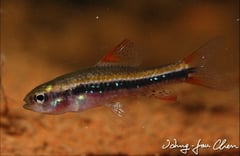
Poecilocharax weitzmaniBlack Darter Tetra
Géry, 1965
Max length50mm SL2.0in SLTank45 × 30cm18 × 12inTemp21–28°C70–82°FpH3.0–6.5The black darter tetra, Poecilocharax weitzmani, is a crenuchid recorded from Brazil, Colombia, Peru and Venezuela. It has been collected from the upper Río Negro, Río Orinoco and Río Solimões drainages. Also traded as 'Black Morpho' tetra, it requires specialist care and is notoriously reluctant to accept dried foods. Unlike most small characids it does not form schools, and males are aggressively territorial towards one another. The Peruvian populations may apparently represent an undescribed species.