Every species
Filters
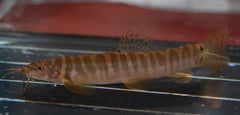
Pogonoschistura kohchangensisOrnate Tiger Sand Loach
(Smith, 1933)
Max length75mm SL3.0in SLTank90 × 30cm36 × 12inTemp20–26°C68–79°FpH6.0–7.5The ornate tiger sand loach, Pogonoschistura kohchangensis, is a nemacheilid loach from southeastern Thailand and southwestern Cambodia. Described from a waterfall stream on Koh Chang island, it appears in the trade from time to time but is not well known in the hobby. It has 10-12 dark brown vertical bars, usually split vertically, and inhabits shallow, often high-gradient streams with moderate to fast flow, surviving the dry months in isolated pools at some localities.
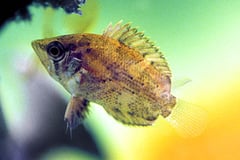
Polycentropsis abbreviataAfrican Leaf Fish
authority not recorded
Max length80mm SL3.1in SLTank60 × 38cm24 × 15inTemp26–31°C79–88°FpH6.0–6.5The African leaf fish, Polycentropsis abbreviata, is a predatory leaf fish from Nigeria, Benin, Cameroon and Gabon. Camouflaged to mimic a dead leaf, it stalks prey in a head-down stance and can swallow prey almost as big as itself. It is flighty and very sensitive to deteriorations in water quality, needs soft, acidic water and often accepts only live food. It is not recommended for the beginner.
Polypterus bichirNile Bichir
Lacepède, 1803
Max length720mm SL28in SLTank180 × 60cm72 × 24inTemp22–28°C72–82°FpH6.0–8.0The Nile bichir, Polypterus bichir, is a large bichir recorded from Egypt, Kenya, Ethiopia and Chad west to Nigeria, Ghana and Guinea-Bissau. It grows to 72 cm, though rarely that large in aquaria, and belongs to the 'lower-jawed' group of Polypterus. It will eat any tankmate it can fit in its mouth, and needs a tight-fitting cover as an excellent escape artist.
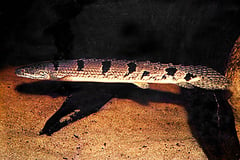
Polypterus delheziArmoured Bichir
authority not recorded
Max length350mm SL14in SLTank120 × 45cm48 × 18inTemp24–30°C75–86°FpH6.0–8.0The armoured bichir, Polypterus delhezi, is a bichir from the Democratic Republic of Congo, found in lakes, streams and flooded areas. Also known as the banded bichir, it is hardy and nocturnal with very poor vision, and relies on its sense of smell to find food. Like other bichirs it can drown if denied access to atmospheric air, and it will eat any tankmate small enough to fit in its mouth.
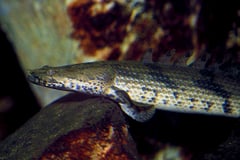
Polypterus endlicheriiSaddled Bichir
Heckel, 1847
Max length750mm SL30in SLTank210 × 120cm84 × 48inTemp22–27°C72–81°FpH6.0–8.0The saddled bichir, Polypterus endlicherii, is a nocturnal bichir recorded from ten African countries including Cameroon, Nigeria and Sudan. It lives in rivers and marshy areas and is occasionally found in brackish water around mangroves. One of the 'lower-jawed' tribe of Polypterus, it can reach 75 cm, though rarely in captivity, and a fully grown fish needs a very large aquarium. Like other bichirs it breathes atmospheric air and can drown if denied access to it.
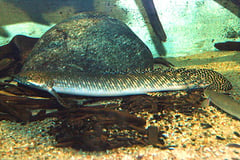
Polypterus ornatipinnisOrnate Bichir
Boulenger, 1902
Max length600mm SL24in SLTank180 × 60cm72 × 24inTemp25–28°C77–82°FpH6.0–8.0The ornate bichir, Polypterus ornatipinnis, is a nocturnal bichir from Cameroon, the Democratic Republic of Congo, Burundi, Angola and Tanzania. It is found in rivers, ponds, marshes and lakes, including Tanganyika. The largest of the 'upper-jawed' polypterids, it reaches 60 cm, though usually less in aquaria, and will eat any tankmate small enough to fit in its mouth.
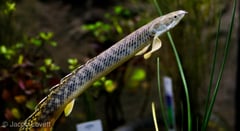
Polypterus palmasMarbled Bichir
Ayres, 1850
Max length325mm SL13in SLTank120 × 45cm48 × 18inTemp25–28°C77–82°FpH6.0–7.0The marbled bichir, Polypterus palmas, is a small bichir from Ghana, Cameroon, the Democratic Republic of Congo and four other countries. One of the more peaceful and active Polypterus, it reaches 32.5 cm and is recommended as a beginner's bichir. Most fish sold as P. palmas are in fact P. polli, though aquarium care for the two is identical.
Polypterus retropinnisWest African Bichir
authority not recorded
Max length350mm SL14in SLTank120 × 45cm48 × 18inTemp25–28°C77–82°FpH6.0–8.0The West African bichir, Polypterus retropinnis, is a nocturnal bichir widely distributed throughout Western Africa. It inhabits marshes, swamps, flooded areas and small rivers, and is also known as the speckled bichir. Imported infrequently, it has an unsettled classification: its former subspecies P. retropinnis lowei is now a synonym of P. palmas palmas, and there is some discussion as to whether P. retropinnis belongs in the P. palmas complex too.
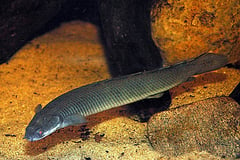
Polypterus senegalusSenegal Bichir
Cuvier, 1829
Max length500mm SL20in SLTank150 × 60cm60 × 24inTemp24–28°C75–82°FpH6.2–7.8The Senegal bichir, Polypterus senegalus, is the most widespread bichir, found in 26 African countries including Egypt and Senegal. It is usually found in shallow, slow-moving swamps, marshes and freshwater lagoons. One of the more peaceful and active Polypterus, it reaches 50 cm, is recommended for beginners with these fish, and has lived for over 30 years in aquaria.
Polypterus teugelsi
Britz, 2004
Max length400mm SL16in SLTank150 × 60cm60 × 24inTemp25–28°C77–82°FpH7.0–7.5Polypterus teugelsi is a bichir probably endemic to the River Cross drainage in Cameroon, where it lives in shady, slow-moving rainforest streams. Its colour pattern differs from every other member of the genus: a network of black marks over the upper half of the body, an orange belly and jet black pectoral fins. It is also more slender than other Polypterus. Discovered in 1988 and described in 2004, it stands apart from every other known bichir, all described before 1911.
Polypterus weeksiiMottled Bichir
authority not recorded
Max length550mm SL22in SLTank150 × 60cm60 × 24inTempnot recordedpHnot recordedThe mottled bichir, Polypterus weeksii, is a nocturnal bichir from the Congo basin in the Republic of Congo and Democratic Republic of Congo. One of the 'upper-jawed' polypterids and one of the rarer bichirs in the hobby, it reaches 55 cm. Like its congeners it finds food by smell, breathes atmospheric air, and will eat any tankmate it can fit in its mouth.
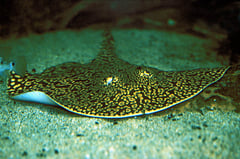
Potamotrygon falkneriLarge Spot Stingray
authority not recorded
Max length518mm DW20in DWTank180 × 60cm72 × 24inTemp23.9–28.9°C75–84°FpH6.0–7.5The large spot stingray (P53), Potamotrygon falkneri, is a freshwater stingray from the Paraná and Paraguay basins in Brazil, Paraguay and Argentina. A large female can reach about 52 cm across the disc. It is imported irregularly and is usually expensive when available. Like all rays it carries a venomous sting on the tail, and the venom causes intense pain and tissue necrosis.
Potamotrygon henleiBlack Stingray
authority not recorded
Max length600mm DW24in DWTank240 × 120cm96 × 48inTemp23–28°C73–82°FpHnot recordedThe black stingray (P12), Potamotrygon henlei, is a freshwater stingray probably endemic to the Rio Tocantins basin in Brazil. It reaches 60 cm across the disc and occurs in several colour forms, with white or yellow spots on a black to dark brown background. It is often confused with P. leopoldi and P14, and is told apart by spots on the underside of the disc, although some P. leopoldi have shown this patterning too.
Potamotrygon histrixPorcupine Stingray
(Müller & Henle, 1839)
Max length375mm DW15in DWTank180 × 60cm72 × 24inTemp24–26°C75–79°FpH6.0–7.5The porcupine stingray (P06), Potamotrygon histrix, is a freshwater stingray from the Rio Paraná and Rio Paraguay basins in Argentina and Brazil. Usually around 35 cm across the disc, it is recommended as a good beginners' ray. Fish sold as hystrix are almost always Peruvian and mislabelled: P. humerosa, P. yepezi and a P. motoro variant known as P. sp. 'Peru' have all been sold under the name, and all grow considerably larger.
Potamotrygon jabutiPearl Ray
Carvalho, 2016
Max length600mm DW24in DWTank240 × 90cm96 × 36inTemp23–29°C73–84°FpHnot recordedThe pearl ray, Potamotrygon jabuti, is a freshwater stingray from the Rio Tapajos in Brazil. It can exceed 60 cm across the disc, and its patterning is highly variable: some fish have golden markings, others almost white, and the darker pigmentation varies in both shade and coverage. Under the newer R-number system it is known as R080.
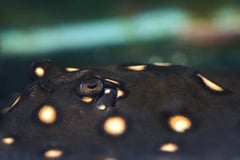
Potamotrygon leopoldiPolka Dot Stingray
Castex & Castello, 1970
Max length700mm DW28in DWTank240 × 90cm96 × 36inTemp20–29°C68–84°FpH6.0–7.5The polka dot stingray, Potamotrygon leopoldi, is a freshwater stingray known only from the Rio Xingu basin and Rio Fresco in central Brazil. A large female reaches 70 cm across the disc, and males tend to be smaller. A rare form with ring-shaped spots is known as 'eclipse'. P. henlei is very similar and is told apart by spots on the underside of the disc that P. leopoldi is supposed to lack.
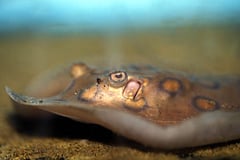
Potamotrygon motoroMotoro Stingray
authority not recorded
Max length500mm DW20in DWTank240 × 90cm96 × 36inTemp24–26°C75–79°FpH6.0–7.5The motoro stingray, Potamotrygon motoro, is a freshwater stingray ranging across Colombia, Peru, Bolivia, Brazil, Paraguay, Uruguay and Argentina. It reaches about 50 cm across the disc. The patterning is highly variable, with some variants given P-numbers and others sold as 'blue', 'orange', 'black' or 'marbled'. Males are among the most violent when spawning and can seriously injure females.
Potamotrygon orbignyiSmooth-back Stingray
authority not recorded
Max length375mm DW15in DWTank180 × 60cm72 × 24inTemp24–26°C75–79°FpH6.0–7.5The smooth-back stingray (P11), Potamotrygon orbignyi, is a freshwater stingray from Venezuela, Guyana, Suriname, French Guiana, Brazil and Bolivia. Often labelled 'teacup ray' by dealers, it is tricky to identify when young and most resembles P. humerosa. The skin tells them apart: rough in P. humerosa and noticeably smooth in P. orbignyi. Most reach 35 to 37.5 cm across the disc, but females from the Amazon basin grow larger and do not mature until about 44 cm.
Potamotrygon schroederiFlower Ray
authority not recorded
Max length540mm DW21in DWTank240 × 90cm96 × 36inTemp20–29°C68–84°FpH6.0–7.5The flower ray, Potamotrygon schroederi, is a freshwater stingray from the Orinoco (Rio Apure) and Amazon (Rio Negro) basins in Brazil and Venezuela. A large female can exceed 50 cm across the disc, and the long caudal fin takes it well over 90 cm nose to tail. Another fish sold as 'flower ray' is a potentially undescribed species from Peru, known to ray enthusiasts as 'Peru flower' or P40.
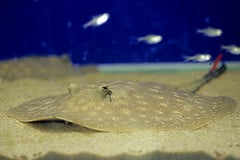
Potamotrygon scobinaMosaic Stingray
authority not recorded
Max length660mm DW26in DWTank180 × 75cm72 × 30inTemp24–26°C75–79°FpH6.0–7.5The mosaic stingray, Potamotrygon scobina, is a freshwater stingray found only in the middle and lower Amazon drainage in Brazil. Most captive fish stay below 35 cm across the disc, and it is usually recommended as a good beginners' ray. Other rays, almost always Peruvian, are often mislabelled as scobina. Apparently only the real P. scobina has five rows of spines on the tail.