Polypterus endlicherii
Saddled Bichir
Formerly Polypterus endlicheri endlicheri
Last revised 2026Edit this page
On this page11 sections
Quick factsEdit
Difficulty4 of 8 measures
Rated difficult because it needs a tank at least 2 m long.
- Space
- very large tank
- Water
- flexible
- Temp
- flexible
- Diet
- unknown
- Temperament
- unknown
- Social
- unknown
- Compatibility
- unknown
Other demands
Each of these can raise the rating on its own, whatever the measures above say.
- Hardiness
- hardy
- Needs a tank at least 2 m long
Before you buy
Needs a tight-fitting lid as this species is known to jump
The aquarium should have a tight-fitting cover as it is an excellent escape artist.
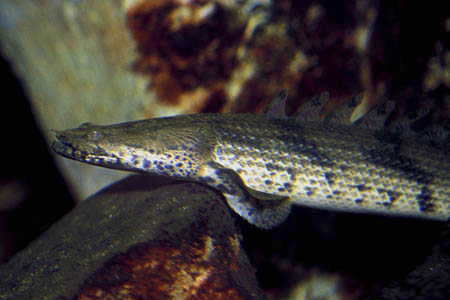
The saddled bichir, Polypterus endlicheri endlicheri, is a nocturnal bichir recorded from ten African countries including Cameroon, Nigeria and Sudan. It lives in rivers and marshy areas and is occasionally found in brackish water around mangroves. One of the 'lower-jawed' tribe of Polypterus, it can reach 75 cm, though rarely in captivity, and a fully grown fish needs a very large aquarium. Like other bichirs it breathes atmospheric air and can drown if denied access to it.
Distribution
EditA widespread species, it has been recorded in Cameroon, Nigeria, Burkina Faso, Ghana, Chad, The Ivory Coast, Mali, Sudan, Benin and the Central African Republic. It inhabits rivers and marshy areas and is occasionally found in brackish conditions, particularly in areas of mangrove.
Habitat
Write a noteEditA widespread species, it has been recorded in Cameroon, Nigeria, Burkina Faso, Ghana, Chad, The Ivory Coast, Mali, Sudan, Benin and the Central African Republic. It inhabits rivers and marshy areas and is occasionally found in brackish conditions, particularly in areas of mangrove.
Aquarium size
Write a noteEdit210 ∗ 120 ∗ 90 cm84 ∗ 48 ∗ 36 in - ~2268 litres~599 US gal for a fully grown adult specimen. Juveniles can be grown on in smaller tanks.
Maintenance
Write a noteEditFloor space is more important than depth with this species. A soft substrate with pieces of driftwood and smooth rocks arranged to form hiding places is ideal. Plants are not essential. The aquarium should have a tight-fitting cover as it is an excellent escape artist.
Water conditions
EditTemperature: 22 – 27 °C72 – 81 °F
pH: 6.0-8.0
Hardness: 5-25°H
Diet
Write a noteEditP. endlicherii is carnivorous by nature and will not usually accept dried foods in aquaria, though some specimens have been known to take pelleted varieties. The most suitable options are meaty live or frozen foods such as prawns, earthworms, mussel, lancefish etc.
Behaviour and compatibility
Write a noteEditNot to be trusted with tankmates it can fit in its mouth but is relatively peaceful otherwise. Suitable tankmates include other Arowana, Synodontis, Datnoides, Knife Fish, large characins and some cichlids.
Sexual dimorphism
Write a noteEditThe anal fin of the male is thicker than that of the female.
Reproduction
Write a noteEditHas been achieved in aquaria but details are very scarce. As this species breeds during the rainy season in nature, changes in the temperature and chemistry of the water are likely to induce spawning behaviour. A large tank is required and should contain soft, slightly acidic water. It is an egg scatterer and therefore areas of dense planting and/or spawning mops should be provided. During spawning itself, the male receives the eggs from the female by cupping his anal and caudal fins around her genitals. He then fertilises the eggs before scattering them amongst vegetation. At this point the adult fish should be removed, as they may predate upon the eggs. The eggs hatch in 3-4 days, with the fry becoming free swimming around 3 days later. First foods should be brine shrimp nauplii or microworm. Apparently the fry are not particularly mobile, so care should be exercised to ensure they are well fed.
Notes
EditAn incredibly hardy, nocturnal species with very poor vision, P. endlicherii relies on its excellent sense of smell to locate food. This species, along with others of its genus, are some of the last surviving relatives of very ancient species. Fossils of earlier relatives have been found that date back to the Triassic Period, which occured during the early development of the dinosaurs more than 200 million years ago.They have several interesting adaptations. The swim bladder is divided into 2 parts, of which the right hand section is considerably larger. This functions as an accessory breathing organ and means the fish can survive out of water for some time, provided it is kept moist. Like Ananbantoid species, this fish may actually drown if it is denied access to atmospheric air.Young bichirs have amphibian-like external gills which are lost as the fish matures. This, coupled with their nocturnal mode of hunting, in which they emerge from their daytime refuges to hunt invertebrates and small fish in shallow water clearly exhibit the link these species form between fish and amphibians. This is one of the "lower-jawed" tribe of Polypterus, so called as the lower jaw protrudes in these species. P. congicus, once treated as a subspecies of this fish, is now a species in its own right and grows even larger than P. endlicherii. Wild specimens of up to 39" in length have been recorded.It should be noted that most Polypterus offered for sale are wild caught and as such, may come in carrying infections or parasites. We suggest keeping a close eye on new fish for the first few weeks after purchase.
Species images · 1
These photographs are used with each photographer's permission.
Send a photographHow the name has changed
Renamed from Polypterus endlicheri endlicheri to Polypterus endlicherii.
2026Eschmeyer's Catalog of Fishes: genera, species, references
Distribution
Profile completeness19 of 24
79% complete
Also missing: etymology.
Community
Questions about Polypterus endlicherii?
Ask on Discord