Every species
Filters

Pseudotropheus sp. 'acei'
authority not recorded
Max length125mm SL5in SLTanknot recordedTemp24–28°C75–82°FpH7.6–8.8Pseudotropheus sp. 'acei' is an undescribed mbuna endemic to the western side of Lake Malawi, around Nkhata Bay, Senga Bay and Karonga. In nature it feeds on algae and other organisms growing on submerged wood, the only known mbuna to do so exclusively, and gathers in schools around branches and logs. Relatively peaceful and easily bred, it is sometimes sold as Gephyrochromis acei, and colour forms such as 'yellow tail' and 'white tail' should not be kept together.

Pterophyllum "scalare"Angelfish
authority not recorded
Max length150mm SL6in SLTank100 × 40cm39 × 16inTemp24–30°C75–86°FpH6.0–7.4The angelfish, Pterophyllum scalare, is a cichlid from the Amazon, Essequibo, Oyapock and other rivers of northern South America. Adults reach 15 cm in body length and 20 cm or more in height, so it needs a tall tank. Almost all fish on sale are mass-produced, in black, gold and koi strains as well as the standard silver, and while generally peaceful it may eat small fish such as tetras.

Pterophyllum altumAltum Angel
authority not recorded
Max length178mm TL7in TLTanknot recordedTemp28–32°C82–90°FpH4.8–6.2The altum angel, Pterophyllum altum, is a cichlid from Colombia and Venezuela, native to the upper Rio Negro and tributaries of the upper Rio Orinoco. Far less common in the trade than its relative P. scalare, the common angelfish, it is a challenge to keep. It needs very acidic, soft water and high temperatures, most fish are wild-caught and can be difficult to feed, and spawning in captivity is hard to achieve.

Pterophyllum leopoldiRoman Nose Angelfish
(Gosse, 1963)
Max length100mm SL3.9in SLTank90 × 30cm36 × 12inTemp22–29°C72–84°FpH5.0–7.0The roman nose angelfish, Pterophyllum leopoldi, is a cichlid from the lower Rio Negro in Brazil and the Rupununi and Essequibo basins of Guyana. It can be told from other members of the genus by up to 11 vertical stripes, a dark patch over the operculum and the roman nose that gives it its name. Reportedly one of the more aggressive species in the genus towards conspecifics, it should be kept in a group of four or more to prevent bullying.

Pundamilia nyererei
(Witte-Maas & Witte, 1985)
Max length80mm SL3.1in SLTank120 × 45cm48 × 18inTemp23–27°C73–81°FpH7.0–8.5Pundamilia nyererei is a maternally mouthbrooding cichlid endemic to Lake Victoria, recorded only from the southern part of the lake in Tanzania. It is mostly restricted to rocky, littoral habitats around islands. At least 11 populations are known and male colour varies with locality, so fish are labelled with collection details to avoid hybridisation in aquaria. Males are aggressive and can kill other males if the tank lacks cover.

Pungu maclareni
authority not recorded
Max length100mm SL3.9in SLTank75 × 30cm30 × 12inTemp28–30°C82–86°FpH7.5–8.5Pungu maclareni is a maternally mouthbrooding cichlid endemic to Lake Barombi Mbo, a small volcanic crater lake in Cameroon. Enlarged jaw muscles and small teeth allow it to tear chunks from freshwater sponges, its characteristic diet. It is considered critically endangered because of its tiny range, habitat destruction, introduced species and overfishing, and is correspondingly rare in the hobby.
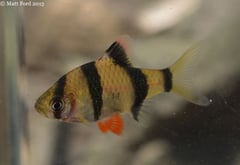
Puntigrus anchisporus
(Vaillant, 1902)
Max length60mm SL2.4in SLTank80 × 30cm31 × 12inTemp20–26°C68–79°FpH5.5–7.0Puntigrus anchisporus is a small cyprinid endemic to Borneo, recorded from Kalimantan in Indonesia and much of Sarawak in Malaysia. One of the four-barred species once called the 'Puntius tetrazona group', it has a complete lateral line, a black dorsal fin with a red outer band and red pelvic fins. It occasionally appears in the hobby, but the trade relies largely on commercially-produced 'tiger barbs' of questionable origin.
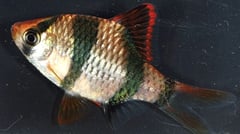
Puntigrus navjotsodhii
(Tan, 2012)
Max length48mm SL1.9in SLTanknot recordedTempnot recordedpHnot recordedPuntigrus navjotsodhii is a small cyprinid known only from the upper Katingan and Barito river basins in Central Kalimantan, Indonesian Borneo. The type series came from a small clear-water hill stream of riffles and deeper pools over sand, gravel and rocks. Among the four-barred Puntigrus species it has broad black bars up to five scales wide, black lips and almost entirely red pelvic fins in life.

Puntigrus partipentazona
(Fowler, 1934)
Max length40mm SL1.6in SLTank80 × 30cm31 × 12inTemp20–26°C68–79°FpH5.0–7.0Puntigrus partipentazona is a small cyprinid recorded from numerous river basins in Vietnam, Cambodia, Laos, Thailand and Peninsular Malaysia. It is easily told from congeners because the dark blotch on its dorsal fin extends onto the body. Typically found in heavily vegetated parts of rivers and sluggish streams, it is generally peaceful, though rival males continually battle for position within the group.
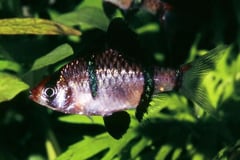
Puntigrus pulcher
(Rendahl, 1922)
Max length60mm SL2.4in SLTank80 × 30cm31 × 12inTemp20–26°C68–79°FpH5.0–7.5Puntigrus pulcher is a small cyprinid endemic to the Indonesian part of eastern Borneo, with records from the Kayan and Mahakam rivers. Considered a synonym of P. anchisporus for decades following Alfred (1963), it was revalidated by Kottelat and Tan (2011). It has an incomplete lateral line, an entirely black dorsal fin and black pelvic fins, and occasionally appears in the hobby, though the trade relies largely on commercially-produced 'tiger barbs'.
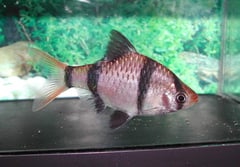
Puntigrus tetrazonaTiger Barb
(Bleeker, 1855)
Max length60mm SL2.4in SLTank80 × 30cm31 × 12inTemp20–26°C68–79°FpH5.0–8.0The tiger barb, Puntigrus tetrazona, is a small cyprinid probably endemic to central and southern Sumatra, Indonesia. Among the most ubiquitous species in the aquarium trade, it is seen mostly as commercially-produced fish and ornamental strains, and wild examples are rarely traded. The identity of the 'aquarium' tiger barb is the subject of ongoing confusion, and many farmed fish are weak or deformed through inbreeding.

Puntius bimaculatusTwo-spotted Barb
(Bleeker, 1863)
Max length50mm SL2.0in SLTank60 × 30cm24 × 12inTemp18–24°C64–75°FpH6.0–7.5The two-spotted barb, Puntius bimaculatus, is a small cyprinid from Sri Lanka and southern India. It lives in flowing hill streams and quieter stretches in the middle reaches of rivers, but tends to be absent from lowland environments. Also called the 'redside barb', it has 7 branched dorsal-fin rays and round dark spots at the base of the dorsal and caudal fins. Generally very peaceful, it is a schooling species and at least 6-10 should be kept.

Puntius cholaSwamp Barb
(Hamilton, 1822)
Max length130mm SL5in SLTank120 × 45cm48 × 18inTemp18–26°C64–79°FpH5.5–8.0The swamp barb, Puntius chola, is a cyprinid from much of Pakistan, India, Nepal, Bhutan, Bangladesh, Sri Lanka, Myanmar and western Thailand. Sometimes called the 'chola' or 'green' barb, it has a single pair of barbels and dark blotches behind the operculum and near the caudal-fin base. It apparently prefers stiller waters over mud or silt, and makes an ideal addition to a peaceful community of riverine fishes.

Puntius kamalikaKami's Barb
Silva, Maduwage & Pethiyagoda, 2008
Max length72mm SL2.8in SLTank120 × 30cm48 × 12inTemp20–27°C68–81°FpHnot recordedKami's barb, Puntius kamalika, is a cyprinid endemic to Sri Lanka, widespread in the southwestern 'wet zone' between the Kelani and Gin basins. Common throughout its range, it has been collected from rivers, streams and marshland. Before its description it was referred to as P. amphibius, a putatively valid species probably restricted to western India, and it lacks prominent markings on the body and fins.

Puntius mahecola
(Valenciennes, 1844)
Max length75mm SL3.0in SLTank90 × 30cm36 × 12inTemp18–24°C64–75°FpH6.0–7.5Puntius mahecola is a cyprinid from rivers draining much of the Western Ghats mountains in Kerala, Karnataka and Tamil Nadu states, southern India. The name was misapplied to members of Dawkinsia for over a century, while the fish itself was widely misidentified as P. amphibius. A relatively plain fish, it has a single dark blotch on the caudal peduncle behind the anal fin. D. assimilis and other Dawkinsia species appear on trade lists as 'mahecola barb'.

Puntius sahyadriensisMaharaja Barb
Silas, 1953
Max length65mm SL2.6in SLTank80 × 30cm31 × 12inTemp18–24°C64–75°FpH6.0–7.8The maharaja barb, Puntius sahyadriensis, is a cyprinid endemic to the northern and central Western Ghats mountains of India. It lives in hill streams shaded by the forest canopy and dense marginal vegetation, over boulders, stones, sand or gravel. The angular body, colour pattern and enlarged male dorsal fin make it difficult to confuse with any other member of the genus, and it is occasionally traded as the 'Khavli' barb.

'Puntius' snyderi
Oshima, 1919
Max length75mm SL3.0in SLTank90 × 30cm36 × 12inTemp18–24°C64–75°FpH6.0–8.0'Puntius' snyderi is a cyprinid from central and northern Taiwan, found in shallow margins of slow streams, irrigation canals and ponds. Almost identical to the wild form of 'P.' semifasciolatus, the 'golden barb' of the hobby, it is reliably told apart externally only by its tiny, indistinct barbels. It is also a deeper-bodied fish with 4-5 main dark markings on the flank, and the two differ genetically.

Puntius terioOnespot Barb
(Hamilton, 1822)
Max length90mm SL3.5in SLTank80 × 30cm31 × 12inTemp18–26°C64–79°FpH6.5–7.5The onespot barb, Puntius terio, is a cyprinid widely distributed from Pakistan through northern India, Nepal and Bangladesh. Its range covers parts of the Indus, Ganges and Brahmaputra drainages, where it apparently prefers stiller waters over mud or silt. Populations vary in colour pattern to an extent, but all share a diffuse yellow-golden marking on the operculum and a dark spot on the caudal peduncle.

Puntius titteyaCherry Barb
Deraniyagala, 1929
Max length50mm SL2.0in SLTank60 × 30cm24 × 12inTemp20–27°C68–81°FpH6.0–8.0The cherry barb, Puntius titteya, is a small cyprinid endemic to the Kelani and Nilwala river basins in the southwestern 'wet zone' of Sri Lanka. Among the most ubiquitous small cyprinids in the hobby and an unreserved choice for beginners, it is sold mostly as commercially farmed stock, including albino and 'super red' strains. Generally very peaceful, it is a schooling species and at least 6-10 should be kept.

Puntius vittatusGreenstripe Barb
Day, 1865
Max length45mm SL1.8in SLTank75 × 30cm30 × 12inTemp18–26°C64–79°FpH6.0–7.5The greenstripe barb, Puntius vittatus, is a small cyprinid widely distributed in India, with further populations in Pakistan and Sri Lanka. Sometimes called the 'kooli barb', it lacks barbels and has a vertical black streak and an orange-marked black tip on the dorsal fin. It most commonly occurs in lowland streams, pools, irrigation channels and rice paddies over mud or silt, and is not an especially popular aquarium fish despite its wide range.