Every species
Filters
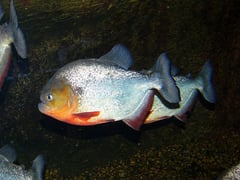
Pygocentrus caribaBlack Spot Piranha
(Humboldt, 1821)
Max length350mm SL14in SLTank240 × 90cm96 × 36inTemp20–28°C68–82°FpH4.0–7.0The black spot piranha, Pygocentrus cariba, is restricted to the Río Orinoco basin in Colombia and Venezuela. Many of its habitats lie within the llanos, and it has been recorded from river channels, tributaries and floodplain lakes, many of them acidic blackwater environments. Specimens over 100 mm SL have a large humeral spot and few spots on the body, which separates it from P. nattereri. It is best maintained alone.
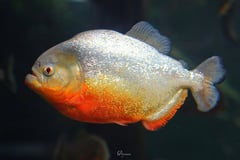
Pygocentrus nattereriRed Bellied Piranha
Kner, 1858
Max length350mm SL14in SLTank240 × 90cm96 × 36inTemp24–28°C75–82°FpH5.5–7.5The red bellied piranha, Pygocentrus nattereri, occurs through much of the Amazon basin and south into the Paraná and Uruguay river systems. Famed as a rapacious predator, it is among the most notorious freshwater fishes in the world. According to Herbert Axelrod (1976), the myth began with a feeding frenzy staged for Theodore Roosevelt in Brazil in 1913. Usually only juveniles form aggregations, and the species is relatively easy to breed in the aquarium.
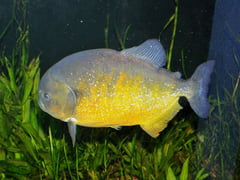
Pygocentrus pirayaPiraya
(Cuvier, 1819)
Max length350mm SL14in SLTanknot recordedTemp20–28°C68–82°FpH6.0–8.0The piraya, Pygocentrus piraya, is a piranha restricted to the rio São Francisco watershed in eastern Brazil. It can be identified by bright yellow-orange pigmentation on the lower jaw, opercle and flanks in life, and larger specimens have rays in the adipose fin. It is best maintained alone because mature individuals are reported to be extremely aggressive towards one another when space is limited.
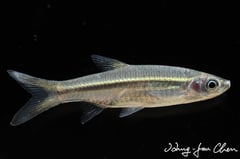
Rasbora argyrotaeniaSilver Rasbora
(Bleeker, 1849)
Max length140mm TL6in TLTank120 × 45cm48 × 18inTemp20–26°C68–79°FpH6.0–7.5The silver rasbora, Rasbora argyrotaenia, is a cyprinid from Peninsular Malaysia, Singapore, Sumatra, Java, Borneo and the Palawan islands. One of the larger rasboras at up to 140 mm TL, it is a plain, silvery fish with a faint dark stripe, and fish pictured under this name with a bold black stripe are probably a regional variant of R. daniconius. A DNA barcode study found two mitochondrial lineages under the name, and the species as currently recognised is likely to be split.
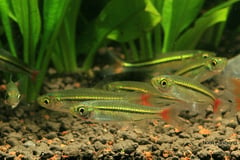
Rasbora borapetensisRed-tailed Rasbora
authority not recorded
Max length50mm SL2.0in SLTank60 × 38cm24 × 15inTemp22–26°C72–79°FpHnot recordedThe red-tailed rasbora, Rasbora borapetensis, is a small cyprinid from the Mekong and Chao Phraya drainages and the Mae Klong in western Thailand. One of the more commonly encountered rasboras in stores, it is also sold as the black-line or magnificent rasbora. The similar R. rubrodorsalis has a bright red blotch in the dorsal fin, whereas in R. borapetensis the dorsal is colourless and only the base of the caudal fin is red. Very peaceful, it often schools quite closely.
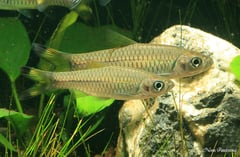
Rasbora caudimaculataGreater Scissortail Rasbora
authority not recorded
Max length150mm SL6in SLTank150 × 45cm60 × 18inTemp20–26°C68–79°FpHnot recordedThe greater scissortail rasbora, Rasbora caudimaculata, is a cyprinid probably restricted to Peninsular Malaysia, Borneo and Sumatra. Also sold as the 'red scissortail', it is told from the similar R. trilineata by orange-red colour in the caudal fin, with black tips to the lobes. It has been collected from swift forest streams and sluggish peat swamp blackwaters, and its size, to 150 mm SL, suits it only to larger tanks with sufficiently bold companions.
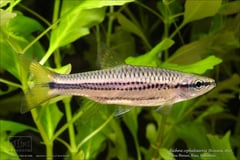
Rasbora cephalotaeniaPorthole Rasbora
authority not recorded
Max length130mm SL5in SLTank120 × 45cm48 × 18inTemp22–25°C72–77°FpHnot recordedThe porthole rasbora, Rasbora cephalotaenia, is a cyprinid from Peninsular Malaysia, Borneo, Sumatra and southern Thailand. It inhabits black water streams and rivers in ancient peat swamp forest, where the water is very soft and acidic. The dark lateral stripe is broken into a series of spots, while in the similar R. einthovenii and R. jacobsoni it forms a solid line. Not often exported, it makes an elegant, peaceful resident of the larger community tank.
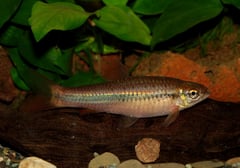
Rasbora cf. dandia
authority not recorded
Max length99mm SL3.9in SLTank120 × 45cm48 × 18inTemp22–25°C72–77°FpHnot recordedRasbora cf. dandia is a cyprinid from Sri Lanka and southern India that may well be a form of R. dandia itself. It appears to be widely available in the trade but is often misidentified as R. wilpita, a species confirmed as endemic to a small number of Sri Lankan streams and probably much rarer in the hobby than previously thought. It inhabits virtually all kinds of lowland freshwater habitat, from rivers and streams to rice paddies and reservoirs.
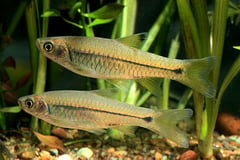
Rasbora dorsinotata
Kottelat, 1987
Max length43mm SL1.7in SLTank90 × 30cm36 × 12inTemp20–25°C68–77°FpH6.0–7.5Rasbora dorsinotata is a small rasbora from the Mekong and upper Chao Phraya river basins in northern Thailand and northern Laos. It shows a preference for smaller tributaries containing clear, flowing water and is apparently abundant in such habitats. Poorly documented in the aquarium literature, it can be told from similar species by the black tip to its dorsal fin and a black lateral stripe ending in a rounded spot on the caudal peduncle.
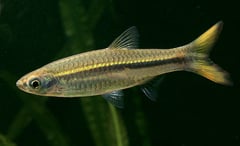
Rasbora dusonensis
(Bleeker, 1850)
Max length162mm SL6in SLTank120 × 30cm48 × 12inTemp20–26°C68–79°FpH4.0–7.5Rasbora dusonensis is a cyprinid from Sumatra, Peninsular Malaysia and Borneo, found in larger river channels and peat swamp blackwaters. Its identity was unclear for decades before its redescription by Ng and Kottelat (2013). It is very similar to R. tornieri, which shares the Musi river with it, but has a bright yellow caudal fin with a broad dark margin, against carmine red in R. tornieri. One specimen measured 162 mm SL, although 95 to 105 mm is a more commonly reported adult size.
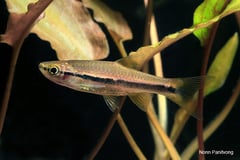
Rasbora einthoveniiBrilliant Rasbora
authority not recorded
Max length90mm SL3.5in SLTank120 × 30cm48 × 12inTemp22–26°C72–79°FpHnot recordedThe brilliant rasbora, Rasbora einthovenii, is a cyprinid from southern Thailand, Peninsular Malaysia, Singapore, Borneo and Sumatra. It mostly inhabits black water streams and rivers associated with peat swamp forest. One of the more commonly seen rasboras in the hobby, it resembles R. jacobsoni but lacks dark reticulated scales above the lateral stripe, and the stripe itself has noticeably uneven or 'crinkly' edges. Most fish in the trade are captive-bred.
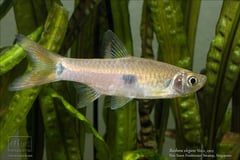
Rasbora elegansElegant Rasbora
authority not recorded
Max length200mm SL8in SLTank120 × 45cm48 × 18inTemp22–25°C72–77°FpHnot recordedThe elegant rasbora, Rasbora elegans, is a cyprinid from Peninsular Malaysia, Singapore and the Greater Sunda Islands of Borneo and Sumatra. It lacks the dark lateral stripe of similar members of the genus and carries two spot-like markings on each flank, one below the dorsal-fin origin and one at the caudal peduncle. It has been collected from swift forest streams and peat swamp blackwaters alike, and it needs space to swim: it can act nervously in smaller quarters.
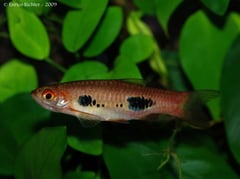
Rasbora kalochromaClown Rasbora
authority not recorded
Max length100mm SL3.9in SLTank120 × 45cm48 × 18inTemp23–28°C73–82°FpHnot recordedThe clown rasbora, Rasbora kalochroma, is a cyprinid from the peat swamp blackwaters of Peninsular Malaysia, Borneo and Sumatra. Its patterning varies with locality. Adults are sometimes confused with R. elegans, a silver fish, while this one is pinkish to reddish. The only congener it may genuinely be mistaken for is the almost identical R. kottelati of northern Sarawak and Brunei, which has an additional dark blotch on the caudal peduncle.
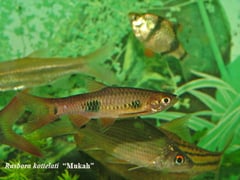
Rasbora kottelati
authority not recorded
Max length70mm SL2.8in SLTank120 × 30cm48 × 12inTemp23–28°C73–82°FpHnot recordedRasbora kottelati is a blackwater rasbora endemic to Borneo, restricted to Brunei Darussalam and northern parts of the Malaysian state of Sarawak. It is almost identical to its closest relative R. kalochroma but has an additional oval-shaped dark blotch on the caudal peduncle and lacks the stripe in the middle of the caudal fin. Collections from its native waters occur only sporadically, and its care is largely based on experience with R. kalochroma.
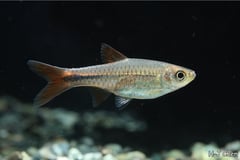
Rasbora lacrimulaRed Cherry Rasbora
authority not recorded
Max length31mm SL1.2in SLTank45 × 30cm18 × 12inTemp22.2–25.6°C72–78°FpHnot recordedThe red cherry rasbora, Rasbora lacrimula, is a small cyprinid confirmed only from the Belayan drainage in east Kalimantan, Indonesian Borneo. Also traded as 'Bornean redfin rasbora', 'sunshine rasbora' and 'dwarf volcano rasbora', it first appeared in the hobby in late 2010. Larger fish carry small tubercules on the back behind the dorsal fin, and a faint dark midlateral stripe ends in a teardrop-shaped blotch at the caudal peduncle.
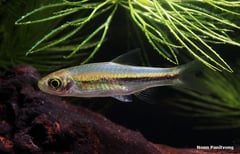
Rasbora paucisqualis
authority not recorded
Max length40mm SL1.6in SLTank60 × 30cm24 × 12inTemp22.2–25.6°C72–78°FpH6.0–7.5Rasbora paucisqualis is a small rasbora from Peninsular Malaysia, recorded from the states of Johor, Pahang, Selangor, Kelantan and Terengganu. It was described from a single specimen from the aquarium trade, supposedly imported from the Malay Peninsula. Despite reports to the contrary it does not occur in the Mekong drainage, and the fish from there once thought to be conspecific was described as R. amplistriga by Kottelat (2000).
Rasbora paviana
authority not recorded
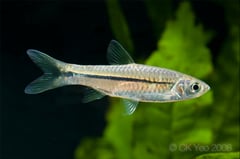
Max length90mm SL3.5in SLTank120 × 30cm48 × 12inTemp22–26°C72–79°FpHnot recordedRasbora paviana is a striped rasbora from the Mekong, Chao Phraya and Mae Klong basins in Thailand, Laos, Cambodia and Vietnam. Much of the literature pictures it under the invalid name R. paviei. It can be hard to separate from R. sumatrana, R. hobelmani and R. laticlavia, but it is the only one of the group found in Indochina, so a known collection locality makes identification easier. It has been collected from hill streams and sluggish lowland waters alike.
Rasbora rasboraGangetic Scissortail Rasbora
authority not recorded
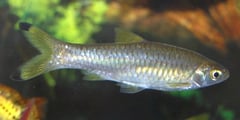
Max length130mm SL5in SLTank120 × 45cm48 × 18inTemp20–25°C68–77°FpHnot recordedThe Gangetic scissortail rasbora, Rasbora rasbora, is a cyprinid apparently native to Pakistan, India, Bangladesh, Myanmar and Thailand. Many older records are probably cases of mistaken identity, and recent ones come mostly from the Brahmaputra basin and Myanmar, while records from the Ganges basin are conspicuously absent. The species is rarely seen in the trade and little has been written about its captive care.
Rasbora rubrodorsalis
authority not recorded
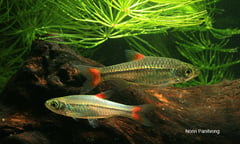
Max length30mm SL1.2in SLTank45 × 30cm18 × 12inTemp24–28°C75–82°FpHnot recordedRasbora rubrodorsalis is a small rasbora from Thailand, found most abundantly in the lower Mekong river basin in the northeast of the country. It lives in the shallow margins of still or gently flowing waters such as swamps, marshes and floodplains. The bright red blotch in its dorsal fin separates it from R. borapetensis, a similar fish that shares part of its range and is much commoner in the hobby. It is sometimes sold as R. beauforti or R. sp. cf. beauforti.
Rasbora sarawakensis
authority not recorded
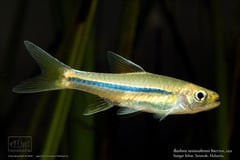
Max length50mm SL2.0in SLTank60 × 38cm24 × 15inTemp22–26°C72–79°FpH6.0–7.5Rasbora sarawakensis is a small rasbora endemic to Borneo, found in Sarawak and the neighbouring Indonesian province of West Kalimantan. It mostly inhabits slow-moving forest streams with thick marginal vegetation, where the water is clear but weakly stained by tannins. Poorly documented in the aquarium literature, it is a very peaceful little fish and apparently quite common across its natural range.