Every species
Filters
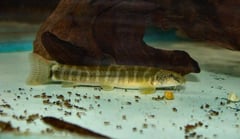
Schistura sp. 2Laos Redtail Loach
authority not recorded
Max length45mm SL1.8in SLTank80 × 30cm31 × 12inTemp20–26°C68–79°FpH6.0–7.5The Laos redtail loach, Schistura sp. 2, is a nemacheilid loach supposedly exported from Laos. Its identity is unclear, and it has been traded as S. sp. 'Laos redtail'. Expect it to reach at least 40-45 mm.
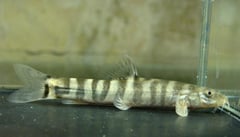
Schistura sp. 3
authority not recorded
Max length50mm SL2.0in SLTank80 × 30cm31 × 12inTemp20–26°C68–79°FpH6.0–7.5Schistura sp. 3 is an unidentified nemacheilid loach thought to have been exported from northern India. It has been traded as Schistura scaturigina but does not appear to be that species, since it has 9 regular vertical bars extending the full depth of the body and a dark marking at the anterior dorsal-fin base. Several vertically-barred Schistura from northern India have confused identities.
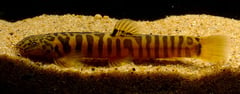
Schistura sp. 4Grizzled Loach
authority not recorded
Max length100mm SL3.9in SLTank120 × 30cm48 × 12inTemp12–20°C54–68°FpH7.0–8.5The grizzled loach, Schistura sp. 4, is a nemacheilid loach from a hill stream in the Siwalik hills around Darjeeling, West Bengal, northern India. Its identity is unclear, and though collected close to the type locality of S. multifasciata it does not match the description of that species. The stream is small, shallow and clear, well over 1000 m AMSL, and the fish is likely to attain 90-100 mm.
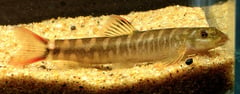
Schistura sp. 6
authority not recorded
Max length50mm SL2.0in SLTank80 × 30cm31 × 12inTemp18–24°C64–75°FpHnot recordedSchistura sp. 6 is an unidentified nemacheilid loach from the south Garo Hills in Meghalaya state, northeastern India. It was collected for the aquarium trade during 2012. The body apparently becomes suffused with red once the fish is settled, and its colour pattern recalls the Schistura multifasciata group, in which the anterior flank bars are divided.
Schistura sp. 7
authority not recorded
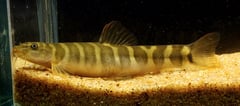
Max length50mm SL2.0in SLTanknot recordedTempnot recordedpHnot recordedSchistura sp. 7 is an unidentified nemacheilid loach from the south Garo Hills in Meghalaya state, northeastern India. It was collected for the aquarium hobby during 2012 and may have been traded as 'green loach'.
Schistura spilota
(Fowler, 1934)
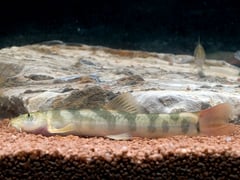
Max length100mm SL3.9in SLTank120 × 30cm48 × 12inTemp20–26°C68–79°FpH6.0–7.5Schistura spilota is a nemacheilid loach known only from tributaries of the upper Ping River basin in Chiang Mai Province, northern Thailand. The species turns up sporadically in shipments of wild fishes from Thailand. Its body bars tend to form roundish blotches along the flanks, and the caudal-fin is reddish with two vertical rows of dark spots. Feisty and reaching 90-100 mm, it is largely unsuitable for the general community aquarium.
Schistura vinciguerrae
(Hora, 1935)
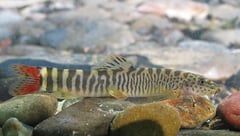
Max length75mm SL3.0in SLTank90 × 30cm36 × 12inTemp20–26°C68–79°FpH6.0–7.5Schistura vinciguerrae is a nemacheilid loach from the Irrawaddy, Salween and Chindwin river basins in Myanmar and northeastern India. Traded fairly regularly, it belongs to the Schistura multifasciata group, in which the anterior flank bars are divided and thinner than those behind. Males lack a suborbital flap, and this separates it from S. bella, S. mahnerti, S. reticulata and S. udomritthiruji. It inhabits clear, well-oxygenated forest streams over coarse sand, gravel, rocks and boulders.
Schistura yingjiangensis
(Zhu, 1982)
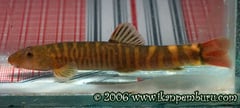
Max lengthnot recordedTank80 × 30cm31 × 12inTemp20–24°C68–75°FpH6.0–7.5Schistura yingjiangensis is a nemacheilid loach known only from the Daying River, an Irrawaddy tributary in Yingjiang County, Yunnan, China. It appears never to have been exported for the aquarium hobby. Normally listed in Nemacheilus, it appears under Schistura in Kottelat (2012), as it does in Chen & Neely (2012) and Endruweit (2014).

Sciaenochromis fryeriElectric Blue Hap
authority not recorded
Max length200mm SL8in SLTank150 × 45cm60 × 18inTemp24–28°C75–82°FpH7.6–8.8The electric blue hap, Sciaenochromis fryeri, is a non-mbuna cichlid endemic to Lake Malawi, found along rocky shorelines and the sandy zones beyond. It was previously imported and classified as Sciaenochromis ahli, and is still named as such in much of the literature. Males of every morph are blue and differ only in the fins, and the morphs should not be mixed because they will hybridise. Highly piscivorous in nature, it should not be kept with mbuna.
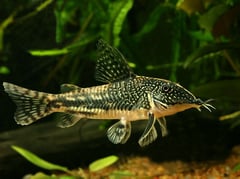
Scleromystax barbatusBanded 'Cory'
(Quoy & Gaimard, 1824)
Max length100mm SL3.9in SLTank120 × 45cm48 × 18inTemp16–24°C61–75°FpH5.5–7.5The banded 'cory', Scleromystax barbatus, is an armoured catfish from coastal rivers in south-east Brazil, between Rio de Janeiro and Santa Catarina. At 90-100 mm it is the largest of the Corydoradinae, and it was formerly included in Corydoras. The hobby also knows it as 'bearded cory', 'checkerboard cory' and 'filigree cory'. Males are aggressively territorial towards one another and cannot be kept together in smaller aquaria.
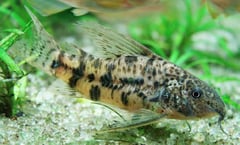
Scleromystax macropterusSailfin 'Cory'
(Regan, 1913)
Max length90mm SL3.5in SLTank120 × 45cm48 × 18inTemp14–20°C57–68°FpH5.0–7.0The sailfin 'cory', Scleromystax macropterus, is an armoured catfish from coastal rivers of southern Brazil and the rio Paraná basin in Paraguay. Most have been collected from small blackwater streams draining directly into the Atlantic, but it also inhabits roadside ditches. Males are somewhat territorial towards one another and should not be kept together in smaller aquaria, and its stiffened pectoral-fin spines can give a painful 'sting'.
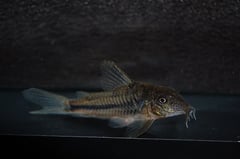
Scleromystax prionotos
(Nijssen & Isbrücker, 1980)
Max length65mm SL2.6in SLTank120 × 30cm48 × 12inTemp16–24°C61–75°FpHnot recordedScleromystax prionotos is an armoured catfish known only from coastal rivers in Minas Gerais, Espírito Santo, Rio de Janeiro and São Paulo, Brazil. Like its congeners it is a facultative air breather and occasionally rises to gulp air at the surface. Its stiffened pectoral-fin spines can pierce human skin, so care is needed when handling it.
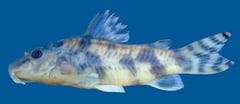
Scleromystax salmacis
Britto & Reis, 2005
Max length48mm SL1.9in SLTanknot recordedTempnot recordedpHnot recordedScleromystax salmacis is a small armoured catfish known only from the rios Mampituba and Araranguá in Santa Catarina state, southern Brazil. It is most similar to S. macropterus but lacks a black spot at the base of the median caudal-fin rays and has more irregular transverse blotches. The dorsal and pectoral fins are equal in length in both sexes, and the type locality was a small, clear, slow-moving pool over mud-covered rock.
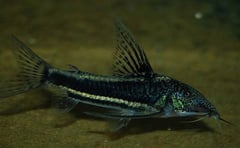
Scleromystax sp. C113
authority not recorded
Max length65mm SL2.6in SLTank120 × 30cm48 × 12inTemp16–24°C61–75°FpH5.0–7.5Scleromystax sp. C113 is an unidentified armoured catfish apparently collected in Bahia state, eastern Brazil, south of Salvador da Bahia. Like its congeners it is a facultative air breather and occasionally rises to gulp air at the surface, and its stiffened pectoral-fin spines can give a very painful 'sting'. Males are aggressively territorial towards one another and cannot be kept together in smaller aquaria.

Scleropages formosusAsian Arowana
(Müller & Schlegel, 1840)
Max length900mm SL35in SLTanknot recordedTemp22–28°C72–82°FpH5.0–8.0The Asian arowana, Scleropages formosus, is an osteoglossid from the Mekong system, eastern Thailand, Peninsular Malaysia, Sumatra and Borneo. Highly valued in the aquarium trade since the 1970s and listed on Appendix I of CITES since 1975, it is now extirpated across much of its range. It occurs in several colour forms, such as the 'super red' of the upper Kapuas, and three were described as species in 2003, though the majority view treats all of them as S. formosus pending review.

Scleropages inscriptus
Roberts, 2012
Max length600mm SL24in SLTanknot recordedTempnot recordedpHnot recordedScleropages inscriptus is an osteoglossid said to come from the Tenasserim river basin in Tananthayi Region, southern Myanmar. Its distribution is unclear, and the type specimens were obtained dead from an aquarium fish vendor. Distinctive angulated linear markings on the head and flanks separate it from other members of the genus. The largest of the type series measured 385 mm, but it can apparently attain about 600 mm.
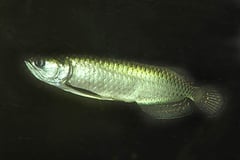
Scleropages jardiniiAustralian Arowana
authority not recorded
Max length900mm SL35in SLTank180 × 60cm72 × 24inTemp24–29°C75–84°FpH6.8–7.5The Australian arowana, Scleropages jardinii, is an osteoglossid from still and slow-moving waters in Australia, Papua New Guinea and Indonesia. Known in Australia as the gulf saratoga or northern-spotted barramundi, it has smaller scales, a bronze base colour and duller patterning than the Asian species. It is widely considered the most aggressive arowana in aquaria, and some individuals will not tolerate any tankmates.
Scleropages leichardtiSpotted Australian Arowana
authority not recorded
Max length900mm SL35in SLTank180 × 60cm72 × 24inTempnot recordedpH6.8–7.5The spotted Australian arowana, Scleropages leichardti, is an osteoglossid endemic to the Fitzroy River system of north-eastern Queensland, Australia. Known there as the spotted or southern saratoga, it differs from S. jardinii in its spotted scales, forward-pointing barbels, unpatterned gill covers and silver base colour. Indonesia classes it as protected even though it has never been recorded there, probably through misidentified S. jardinii. The species is rare in the hobby.
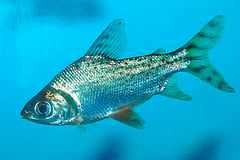
Semaprochilodus insignisFlagtail Prochilodus
authority not recorded
Max length350mm SL14in SLTank150 × 60cm60 × 24inTemp23–29°C73–84°FpH5.5–7.2The flagtail prochilodus, Semaprochilodus insignis, is a large shoaling characin from Ecuador, Peru, Colombia, Guyana and Brazil. Known with some congeners as the jaraqui in Brazil, it migrates over large distances in huge shoals and feeds on organic detritus, using one of its two stomachs, filled with mud, to aid digestion. It is aggressive towards its own kind in small numbers but can be kept in groups of six or more in larger tanks.
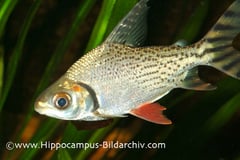
Semaprochilodus taeniurusFlagtail Characin
authority not recorded
Max length300mm SL12in SLTank150 × 60cm60 × 24inTemp23–29°C73–84°FpH5.5–7.5The flagtail characin, Semaprochilodus taeniurus, is a large shoaling fish from the central Amazon basin in Brazil, growing to around 30 cm. Also sold as the silver prochilodus or fei feng, it migrates twice a year in huge shoals, moving into white waters to spawn at the start of the wet season and feeding mostly in the floodplains. It is aggressive towards its own kind in small numbers but can be kept in groups of six or more in larger tanks.