Every species
Filters
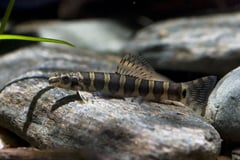
Serpenticobitis octozona
Roberts, 1997
Max length55mm SL2.2in SLTank75 × 30cm30 × 12inTemp23–26°C73–79°FpH6.0–7.0Serpenticobitis octozona is a small loach apparently endemic to the Sekong River basin in southern Laos, part of the lower Mekong system. Sometimes sold as 'serpent loach', it shows a degree of social interaction and can cling to vertical or overhanging surfaces. The type species of its genus, it has 7-8 dark bars on each flank, much wider than the pale interspaces. It lives in shallow, fast-flowing, highly-oxygenated headwaters and minor tributaries.
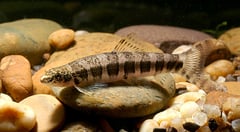
Serpenticobitis zonata
Kottelat, 1998
Max length50mm SL2.0in SLTank75 × 30cm30 × 12inTemp26°C79°FpH6.0–7.0Serpenticobitis zonata is a small loach from the Xe Bangfai and Xe Bang Hiang drainages in Laos, and Chanthaburi province in south-eastern Thailand. Fish sold under this name are sporadically available, but the majority appear to be the congener S. octozona. S. zonata has a pale body with 7-8 regular dark vertical bars, sometimes with thin dark bars on the interspaces. It inhabits shallow, fast-flowing, highly-oxygenated headwaters and minor tributaries.
Serrasalmus altuveiAltuvei
authority not recorded
Max length173mm SL7in SLTank120 × 45cm48 × 18inTempnot recordedpHnot recordedSerrasalmus altuvei is a piranha from the Venezuelan section of the Rio Orinoco basin, where it lives in the clear, sunlit waters of the Llanos. Very scarce in the hobby, it turns up mostly among imports of juvenile S. rhombeus and is also known as 'caribe azul' or 'blue caribe'. It belongs to the 'compressed group' and can be very tricky to tell from S. compressus, though juveniles supposedly differ in having speckling only on the upper half of the body.
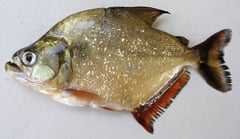
Serrasalmus brandtiiWhite Piranha
Lütken, 1875
Max length250mm SL10in SLTank150 × 60cm60 × 24inTemp20–26°C68–79°FpH5.0–8.0The white piranha, Serrasalmus brandtii, may be restricted to the rio São Francisco watershed in eastern Brazil. Also known as 'green piranha' or 'Brandt's pirambeba', it appears infrequently in the trade, and its name is sometimes misapplied to the distantly related Pygopristis denticulata. Adults are uniformly golden-bronze with dark fin margins and a concave head profile above the eye. It is best kept alone as a single specimen.
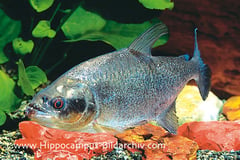
Serrasalmus elongatusPike Piranha
authority not recorded
Max length300mm SL12in SLTank120 × 60cm48 × 24inTemp24–28°C75–82°FpHnot recordedThe pike piranha, Serrasalmus elongatus, is a streamlined piranha from the Amazon and Orinoco basins in Venezuela, Ecuador, Peru, Bolivia and Brazil. Its elongate shape is unique among serrasalmids and makes it possibly the easiest Serrasalmus to identify, although large adults fill out into a more diamond-shaped figure. Known as 'caribe pinche' in its native countries, it is a rare find in the trade and suits only the enthusiast as a specimen fish.
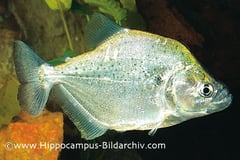
Serrasalmus geryiGéry's Pirambeba
authority not recorded
Max length181mm SL7in SLTank120 × 60cm48 × 24inTemp22–29°C72–84°FpHnot recordedGéry's pirambeba, Serrasalmus geryi, is a piranha from the Rio Araguaia and Rio Tocantins drainages in Brazil. Sometimes sold as the 'violet-line piranha', it is one of the easiest Serrasalmus to identify because the purple stripe from the lower jaw over the top of the body is unique to it. S. compressus has been sold as S. geryi, and reports of it living in groups are considered tenuous, so it is kept as a specimen fish.
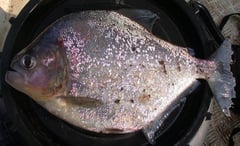
Serrasalmus gouldingiGoulding's Piranha
Fink & Machado-Allison, 1992
Max length280mm SL11in SLTank150 × 60cm60 × 24inTemp24–28°C75–82°FpH4.0–7.0Goulding's piranha, Serrasalmus gouldingi, is a deep-bodied piranha from the rio Negro drainage in Brazil and the Casiquiare system in Venezuela. It occasionally appears in the ornamental trade, sometimes as 'blue tiger piranha'. The eye is bluish or coppery, the body carries vertically-elongate dark spots and the caudal-fin has a blackish basal band. Its native rivers are acidic, mineral-poor blackwater, and it is best kept alone.
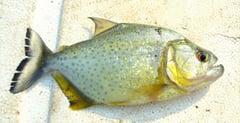
Serrasalmus maculatusMac
authority not recorded
Max length210mm SL8in SLTank120 × 45cm48 × 18inTemp21.1–30°C70–86°FpHnot recordedSerrasalmus maculatus, the mac, is a piranha from the Amazon, Paraguay and Paraná river systems, described from the rio Guaporé in western Brazil. It grows to a manageable size, is relatively hardy and is sometimes called the 'gold piranha' or 'golden mac' in the hobby. It has often been confused with S. spilopleura, and it should be considered a specimen fish that does not make a good tankmate for anything else.
Serrasalmus manueliManny
authority not recorded
Max length435mm SL17in SLTank210 × 75cm84 × 30inTempnot recordedpHnot recordedSerrasalmus manueli, sometimes sold as the 'green tiger piranha', is a piranha from parts of the Amazon and Orinoco basins in Brazil and Venezuela. Adults are caught in deep, flowing sections of major river channels and grow to 435 mm SL. Imported fish are notoriously sensitive travellers with high mortality, and this is a species for the specialist that must be kept alone, since adults fight until only one remains.
Serrasalmus marginatus
authority not recorded
Max length221mm SL9in SLTank120 × 38cm48 × 15inTemp22–25°C72–77°FpHnot recordedSerrasalmus marginatus is a piranha from the Rio Paraguay and Rio Paraná drainages in Brazil, Paraguay, Uruguay and Argentina. Its main distinguishing feature is the thick, black, v-shaped marking in the anterior portion of the caudal fin, and it is rarely seen in the hobby. Individuals defend feeding territories in the wild, and conspecifics are liable to fight until only one remains, so it is kept singly as a specimen fish.

Serrasalmus rhombeusBlack Piranha/Rhom
authority not recorded
Max length450mm SL18in SLTank210 × 45cm84 × 18inTemp22.2–27.8°C72–82°FpHnot recordedSerrasalmus rhombeus, known as the black piranha or rhom, is a large piranha recorded from much of northern South America. It occurs in numerous geographical forms that vary in size, body form and colour, linked by the deep red eye of mature fish, and a species complex has been suggested. Juveniles lack the red eye and are easily mislabelled. Conspecifics fight until only one remains, so it is kept alone.
Serrasalmus sancheziSanchez's Piranha
authority not recorded
Max length114mm SL4in SLTank120 × 30cm48 × 12inTemp24–28°C75–82°FpHnot recordedSanchez's piranha, Serrasalmus sanchezi, is a small piranha endemic to Peru, collected from rivers including the Ucayali, Itayi and Pacaya. It is sometimes still sold as 'Spilo cf' or 'Ruby-red Spilo', and its red throat has led to confusion with S. medinai and even Pygocentrus nattereri. The serrae on the underside are arranged irregularly, unlike other Serrasalmus. Whether it can be kept in groups remains hotly debated.
Serrasalmus serrulatus
authority not recorded
Max length190mm SL7in SLTank120 × 45cm48 × 18inTemp24–28°C75–82°FpHnot recordedSerrasalmus serrulatus is a piranha reported from Peru, western Brazil and Argentina. The validity of that range is unclear, since the name may have been applied to more than one species. It also occupies a particularly confusing taxonomic position within the 'humeralis group' and is very close in appearance to S. eigenmanni, S. hollandi, S. humeralis and S. nalseni. Its habitat is unknown. Conspecifics are liable to fight until only one remains, so it is a specimen fish for the enthusiast.
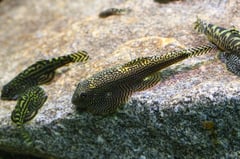
Sewellia albisuera
Freyhof, 2003
Max length70mm SL2.8in SLTank90 × 30cm36 × 12inTemp18–24°C64–75°FpH6.0–7.5Sewellia albisuera is a hillstream loach known only from a handful of localities in the Thu Bon river system, Quang Nam province, central Vietnam. It is very rarely traded but resembles S. sp. 'SEW01', from which it differs in its network of irregular dark reticulations (many small light spots in SEW01). It inhabits shallow, fast-flowing, highly-oxygenated headwaters and tributaries, and the type locality is apparently suffering from pollution.
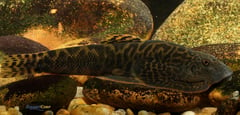
Sewellia elongata
Roberts, 1998
Max length75mm SL3.0in SLTank90 × 30cm36 × 12inTemp20–24°C68–75°FpH6.0–7.5Sewellia elongata is a hillstream loach from the Bolovens plateau in southern Laos, also recorded in the upper Se Kong drainage in central Vietnam. The largest described Sewellia, growing to at least 73 mm SL, it is most similar to S. diardi but has a relatively slender, elongate body. It appeared in the aquarium trade during 2010 and inhabits shallow, fast-flowing, highly-oxygenated headwaters with riffles and runs.
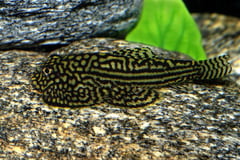
Sewellia lineolataTiger Hillstream Loach
(Valenciennes, 1846)
Max length65mm SL2.6in SLTank75 × 30cm30 × 12inTemp20–24°C68–75°FpH6.0–7.5The tiger hillstream loach, Sewellia lineolata, is a gastromyzontid loach from fast-flowing headwaters in Vietnam and on the Mekong in Laos. Three to five dark stripes on the body make it difficult to confuse with any other member of the genus. The water must be clean, fast-flowing and well-oxygenated, and Sewellia species are arguably the easiest of all loaches to breed in aquaria.
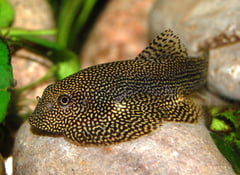
Sewellia sp. 'SEW01'Spotted Butterfly Loach
authority not recorded
Max length80mm SL3.1in SLTank90 × 30cm36 × 12inTemp20–24°C68–75°FpH6.0–7.5The spotted butterfly loach, Sewellia sp. 'SEW01', is a hillstream loach from Quang Nam province in central Vietnam. One of the more readily available members of the genus, it is also called S. sp. 'spotted' or S. sp. 'special' and has many small, light spots on a dark background. It resembles S. albisuera, and it has been suggested the two are the same species, but this does not appear to be the case.
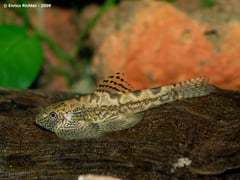
Sewellia sp. 'SEW02'
authority not recorded
Max length65mm SL2.6in SLTank75 × 30cm30 × 12inTemp18–24°C64–75°FpH6.0–7.5Sewellia sp. 'SEW02' is an undescribed hillstream loach whose trade specimens are thought to originate in Hue province, central Vietnam. It first became available in early 2009 and was initially identified as S. breviventralis, but it does not fully match that species or S. elongata and remains in need of identification. It is sometimes sold as 'butterfly loach', a generic name used for several balitorids.
Sewellia sp. 'SEW03'
authority not recorded
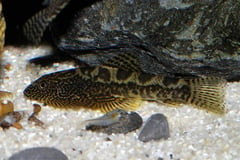
Max length60mm SL2.4in SLTank75 × 30cm30 × 12inTemp20–24°C68–75°FpH6.0–7.5Sewellia sp. 'SEW03' is an unidentified hillstream loach thought to originate in Hue province, central Vietnam. First available in early 2009 as S. breviventralis, it cannot be that species because there is no discernible gap between the pelvic and anal fins. It is often imported in mixed batches with S. sp. 'SEW02', which it resembles closely, and needs shallow, fast-flowing, highly-oxygenated water.
Sewellia sp. 'SEW04'
authority not recorded
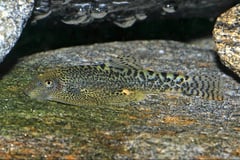
Max length60mm SL2.4in SLTank75 × 30cm30 × 12inTemp20–24°C68–75°FpH6.0–7.5Sewellia sp. 'SEW04' is a hillstream loach thought to originate in Hue province, central Vietnam, and may be undescribed. It has been imported among shipments of S. sp. 'SEW02' and S. sp. 'SEW03' and does not appear to correspond to any known member of the genus.