Every species
Filters
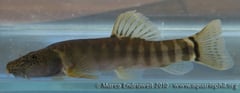
Schistura callichroma
(Zhu & Wang, 1985)
Max length90mm SL3.5in SLTank120 × 45cm48 × 18inTemp10–22°C50–72°FpH7.0–9.0Schistura callichromus is a nemacheilid loach recorded only from the Babianjiang River in the Red River basin, Yunnan Province, China. It is expected to occur in Vietnamese waters as well, and Kottelat (2012) amended the spelling of its name to 'callichroma'. Wild specimens have been observed living in social aggregations of up to six in clear, well-oxygenated headwater streams.
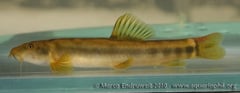
Schistura caudofurca
(Mai, 1978)
Max length80mm SL3.1in SLTank120 × 30cm48 × 12inTemp10–22°C50–72°FpH7.0–9.0Schistura caudofurca is a nemacheilid loach from northern Vietnam, Laos and southern China, described from the Mã River in Vietnam. S. laterivittata, described from the Babianjiang River in the Red River basin of Yunnan, has been treated as a synonym by most authors since Kottelat (2001).
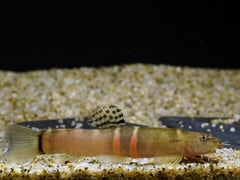
Schistura cf. balteataSumo Loach II
authority not recorded
Max length80mm SL3.1in SLTank90 × 30cm36 × 12inTemp22–26°C72–79°FpH6.5–7.5The sumo loach II, Schistura cf. balteata, is an apparently undescribed nemacheilid loach from the Ataran River drainage in Myanmar and Thailand. Both it and the real S. balteata have been traded as 'sumo loach', but this fish has brighter colouration, a smaller adult size and seems more peaceful. The colour pattern is highly variable, with the rear half of the body bright pink in some specimens and yellow in others.
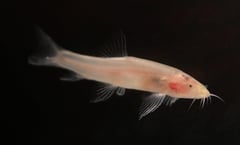
Schistura deansmarti
Vidthayanon & Kottelat, 2003
Max length105mm SL4in SLTanknot recordedTempnot recordedpHnot recordedSchistura deansmarti is a troglomorphic nemacheilid loach endemic to the Tham Phra Sai Ngam cave system in Phitsanulok Province, Thailand. All individuals are entirely depigmented, and some have no externally visible eyes. The species is protected by Thai national law and illegal to remove from its habitat, so it is included here for interest only and is not suitable as an aquarium fish.
Schistura denisoni
(Day, 1867)
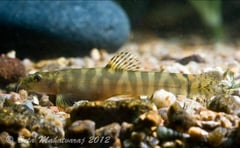
Max length52mm SL2.0in SLTank75 × 30cm30 × 12inTemp18–24°C64–75°FpH6.0–7.5Schistura denisoni is a nemacheilid loach from the Western Ghats of southern India, described from the Bhavani River in the Cauvery system. Widely referred to Nemacheilus, it matches the diagnostic characters of Schistura. The number and arrangement of its vertical body bars vary greatly, and whether it represents a complex of species or a single taxon remains unclear. Feisty, it is largely unsuitable for the general community aquarium.
Schistura devdeviSaddleback Loach
(Hora, 1935)
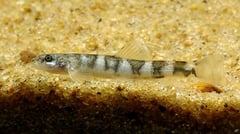
Max lengthnot recordedTanknot recordedTemp15–22°C59–72°FpH6.5–8.0The saddleback loach, Schistura devdevi, is a nemacheilid loach from upland parts of Assam, Sikkim, Arunachal Pradesh and West Bengal, northern India. It has been collected for the aquarium trade in limited quantities and is sometimes called 'firefly loach'. Records from Nepal apparently require confirmation. It is unlikely to prove aggressive and should suit a community aquarium provided tankmates are selected with care.
Schistura disparizona
Zhou & Kottelat, 2005
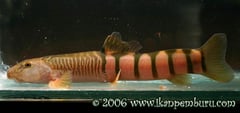
Max length96mm SL3.8in SLTank120 × 30cm48 × 12inTemp18–25°C64–77°FpH6.0–8.0Schistura disparizona is a nemacheilid loach known only from its type locality on the Nangun River, a Salween tributary in Yunnan Province, China. Its colour pattern of 8-11 closely-set, narrow dark bars at the front of the body and 5 wider bars behind separates it from congeners, and it has prominent adipose crests on the caudal peduncle. It inhabits shallow, narrow branches of streams over gravel or stone.
Schistura geisleri
Kottelat, 1990
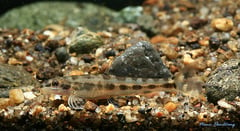
Max length35mm SL1.4in SLTank60 × 30cm24 × 12inTemp21–26°C70–79°FpH6.0–7.5Schistura geisleri is a small nemacheilid loach widespread in the Chao Phraya river system of western Thailand. It differs from most congeners in its small adult size, sociable behaviour and tendency to bury itself in the substrate when threatened. Peaceful with conspecifics, it is best kept in a group of four or more. It is available in the trade from time to time but is by no means common.
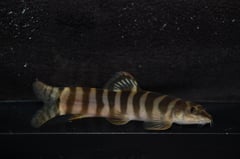
Schistura hypsiuraSuper Convict Loach
Bohlen, Ŝlechtová & Udomritthiruj, 2014
Max length73mm SL2.9in SLTank80 × 30cm31 × 12inTemp18–24°C64–75°FpH6.0–7.5The super convict loach, Schistura hypsiura, is a nemacheilid loach known only from a short coastal river in southern Rakhine State, western Myanmar. Traded as S. sp. 'super convict', it has a deep caudal peduncle, a deeply forked caudal-fin and 6-8 very regular bars along the flank. Not among the more aggressive members of the genus, it can be kept in a community aquarium provided tankmates are selected with care.
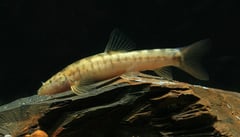
Schistura jarutanini
Kottelat, 1990
Max length67mm SL2.6in SLTanknot recordedTempnot recordedpHnot recordedSchistura jarutanini is a troglomorphic nemacheilid loach that appears to be endemic to the Ba Dan cave in Kanchanaburi Province, western Thailand. The eyes are reduced or absent but the body retains a degree of pigmentation, and it is found in deeper parts of the cave's subterranean stream. Protected by Thai national law and illegal to remove from its habitat, it is included here for interest only.
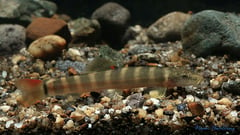
Schistura kengtungensis
(Fowler, 1936)
Max length65mm SL2.6in SLTank90 × 30cm36 × 12inTemp18–24°C64–75°FpH6.0–7.5Schistura kengtungensis is a nemacheilid loach from the middle Mekong basin in Thailand, Myanmar, Laos and Yunnan Province, southern China. It has 9-13 vertical bars as wide as or wider than the interspaces, and specimens from China differ from those in Thailand and Myanmar in several morphological characters. It inhabits shallow, narrow branches of streams over gravel or stone.
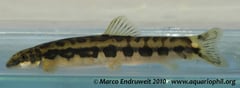
Schistura kloetzliae
Kottelat, 2000
Max length47mm SL1.9in SLTank75 × 30cm30 × 12inTemp18–22°C64–72°FpH7.0–8.5Schistura kloetzliae is a nemacheilid loach known only from the Mengla River system in Yunnan, China, and Luang Namtha province, northern Laos. It appears restricted to highly-oxygenated, fast-flowing riffles of small to medium streams with clear water and no aquatic plants. A series of large black blotches along the lateral line, each connected with blotches on the dorsal midline, separates it from congeners.
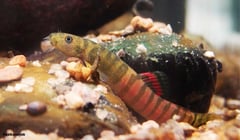
Schistura kodaguensis
(Menon, 1987)
Max length36mm SL1.4in SLTank60 × 30cm24 × 12inTemp20–25°C68–77°FpH6.0–7.5Schistura kodaguensis is a small nemacheilid loach from the Western Ghats of Karnataka, India, confirmed only from a tributary of the Cauvery. It is not a well-known aquarium fish but is maintained by a number of Indian enthusiasts. The very similar S. nilgiriensis, also from the Western Ghats, has a black spot at the base of the dorsal-fin and lacks the rows of spots on the caudal-fin.
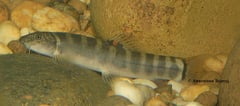
Schistura nicholsi
(Smith, 1933)
Max length74mm SL2.9in SLTank120 × 30cm48 × 12inTemp20–26°C68–79°FpH6.0–7.5Schistura nicholsi is a nemacheilid loach widespread in the Mekong basin in Laos and Thailand, and it may also occur in Cambodia. It is sometimes traded for aquaria, but its name also appears to have been widely misapplied to other fishes. It has 8-10 quite regular dark bars wider than the light interspaces. It has been bred in an aquarium, although the adults seem to consume both eggs and fry.
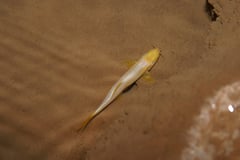
Schistura oedipus
(Kottelat, 1988)
Max length80mm SL3.1in SLTanknot recordedTempnot recordedpHnot recordedSchistura oedipus is a troglomorphic nemacheilid loach restricted to five caves in the Pang Mapha karst, Mae Hong Son province, northwest Thailand. The eyes are reduced to vestigial pits beneath the skin and the body is unpigmented. It inhabits flowing subterranean streams, often interrupted by cascades, that drain to the Salween system. Protected by Thai national law, it is included here for interest only.
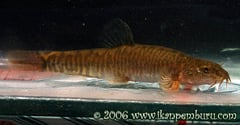
Schistura polytaenia
(Zhu, 1982)
Max length50mm SL2.0in SLTank60 × 30cm24 × 12inTemp20–24°C68–75°FpH6.0–7.5Schistura polytaenia is a nemacheilid loach known only from its type locality, an Irrawaddy tributary in Tengchong County, Yunnan, China. It appears never to have been exported for the aquarium hobby. Normally listed in Nemacheilus, it appears under Schistura in Kottelat (2012), and the specimens shown on the profile were identified on the basis of collection locality.
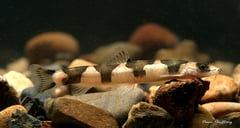
Schistura pridiiMini Dragon Loach
Vidthayanon, 2003
Max length40mm SL1.6in SLTank60 × 30cm24 × 12inTemp18–24°C64–75°FpH7.0–8.5The mini dragon loach, Schistura pridii, is a small nemacheilid loach endemic to tributary streams of the upper Chao Phraya in northern Thailand. Only a handful of populations are known, most inside the Doi Chiang Dao Wildlife Sanctuary, in swift, shallow forest hill streams at around 950-1250 m. Despite its endangered status it is available in the trade sporadically. Four black bars on a yellow base, usually forming saddles, identify it.
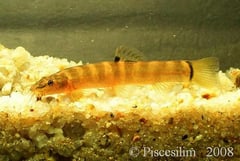
Schistura robertsi
Kottelat, 1990
Max length56mm SL2.2in SLTank80 × 30cm31 × 12inTemp18–30°C64–86°FpH6.0–8.0Schistura robertsi is a small nemacheilid loach from the western slope of the Malay Peninsula in southern Thailand and Malaysia. It inhabits shallow, narrow branches of streams over sand, gravel or stone, and adults carry 8-10 regular dark body bars wider than the pale interspaces. It may have been exported alongside similar-looking relatives such as S. cf. balteata, and like many fishes from running water it is intolerant of organic pollutants.
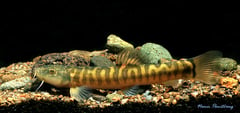
Schistura schultzi
(Smith, 1945)
Max length93mm SL3.7in SLTank120 × 30cm48 × 12inTemp16–24°C61–75°FpH6.0–8.0Schistura schultzi is a nemacheilid loach from Mekong tributaries in northern Thailand, and probably also Bokeo province in Laos. The full extent of its range is unclear. It grows to at least 93 mm and has 13-18 relatively thin dark body bars. Its aquarium behaviour is unknown, but slow-moving, long-finned or very placid tankmates are not recommended.
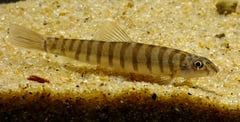
Schistura sp. 1Ring Loach
authority not recorded
Max lengthnot recordedTank75 × 30cm30 × 12inTemp18–24°C64–75°FpH6.0–7.5The ring loach, Schistura sp. 1, is a nemacheilid loach collected for the trade in the Torsa river, a Brahmaputra tributary in West Bengal, India. Its identity is unclear: it has been considered to represent S. beavani, S. montana and S. himachalensis, but its bar count and plain fins argue against each. Unlike many congeners it is peaceful with conspecifics, and it has a propensity to bury itself when startled.