Every species
Filters
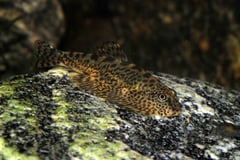
Sewellia speciosa
Roberts, 1998
Max length55mm SL2.2in SLTank75 × 30cm30 × 12inTemp20–24°C68–75°FpH6.0–7.5Sewellia speciosa is a hillstream loach that appears endemic to the Xe Kong river drainage in central Vietnam and southern Laos. It first became available in early 2010 and sometimes appears on trade lists as 'Laos sucker' or 'Laos Sakura sucker'. The spotted body without stripes separates it from the morphologically similar S. lineolata, which is striped, and it inhabits shallow, fast-flowing, highly-oxygenated headwaters.
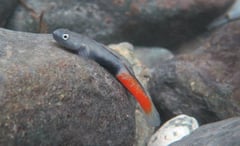
Sicyopus cebuensis
Chen & Shao, 1998
Max length45mm SL1.8in SLTank60 × 30cm24 × 12inTemp22–28°C72–82°FpH6.5–7.5Sicyopus cebuensis is a stream goby known from the Uling brook in the upper Naga River basin on Cebu, the Philippines. It appears rare in nature, and the type series consisted of a single adult pair. Males have a creamy-yellow front half with a dark midbody blotch and bright orange-red behind. Its complex amphidromous breeding strategy means fry are not raised in aquaria.
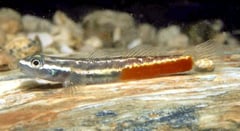
Sicyopus discordipinnis
Watson, 1995
Max length30mm SL1.2in SLTank60 × 30cm24 × 12inTemp22–26°C72–79°FpH6.0–7.5Sicyopus discordipinnis is a small stream goby from northern New Guinea and the islands of Normanby, New Hanover and Bougainville, Papua New Guinea. Members of the genus inhabit short coastal streams on tropical islands, typically above waterfalls or cataracts, and have a complex amphidromous breeding strategy.
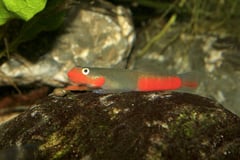
Sicyopus exallisquamulus
Watson & Kottelat, 2006
Max length52mm SL2.0in SLTank60 × 30cm24 × 12inTemp22–28°C72–82°FpH6.5–7.5Sicyopus exallisquamulus is a stream goby described from the island of Halmahera in the Maluku Islands, Indonesia. It is normally misidentified and traded as the Sri Lankan endemic Sicyopus jonklaasi. Members of the genus inhabit short coastal streams on tropical islands, typically above waterfalls or cataracts, and males have filamentous third and/or fourth dorsal-fin rays.
Sicyopus zosterophorus
(Bleeker, 1856)
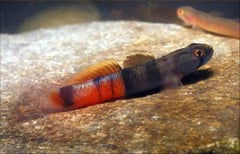
Max length45mm SL1.8in SLTank60 × 30cm24 × 12inTemp22–26°C72–79°FpH6.0–7.5Sicyopus zosterophorus is a stream goby with a patchy but wide range from the Marquesas Islands westwards to Indonesia, Japan and southern China. It is occasionally available in the hobby as the 'flaming arrow goby', 'belted rockclimbing goby' or 'ornate goby', often under the invalid name Sicyopus zosterophorum. It inhabits short coastal streams on tropical islands, typically above waterfalls or cataracts.
Silurus glanisWels catfish
authority not recorded
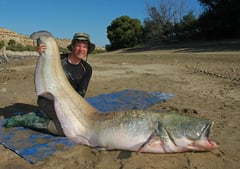
Max length5000mm SL197in SLTanknot recordedTemp3.9–20°C39–68°FpHnot recordedThe wels catfish, Silurus glanis, is a sheatfish native to rivers draining into the North, Baltic, Black, Caspian and Aral seas. It has been introduced across western and southern Europe, where populations in Italy and Spain grow very large. Juveniles are occasionally available in the aquarium trade, but this species is clearly not a viable subject for the vast majority of private aquarists.
Sinibotia pulchraGolden Zebra Loach
(Wu, 1939)
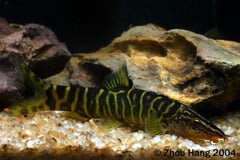
Max length110mm SL4in SLTank120 × 30cm48 × 12inTemp20–25.5°C68–78°FpH6.5–8.0The golden zebra loach, Sinibotia pulchra, is a botiid loach from the Zhu Jiang (Pearl River) system in southern China. It is also sold as the 'golden Chinese loach' or '12-banded Chinese loach' and, with S. robusta, is the most commonly traded Sinibotia, the two often imported in mixed batches. It is reclusive but very peaceful, and the gregarious nature of the genus means 3-4 should be the minimum purchase.
Sinibotia reevesae
(Chang, 1944)
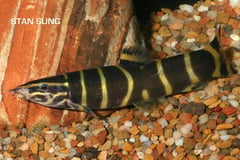
Max length95mm SL3.7in SLTank120 × 30cm48 × 12inTemp20–25.5°C68–78°FpH6.5–8.0Sinibotia reevesae is a botiid loach described from the middle Yangtze in Luxian County, Sichuan Province, and still known only from that area. It is apparently rare in nature and seldom seen in the trade, arriving occasionally as bycatch in shipments of S. pulchra or S. robusta. It has 7-8 dark vertical bars, and the head lacks the brown vermiform markings of S. pulchra.
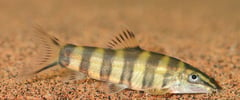
Sinibotia robustaKansu Loach
(Wu, 1939)
Max length100mm SL3.9in SLTank120 × 30cm48 × 12inTemp20–25.5°C68–78°FpH6.5–8.0The Kansu loach, Sinibotia robusta, is a botiid loach from the Zhu Jiang (Pearl River) system in Guangxi, southern China. Its deeper, stockier body separates it from other Sinibotia. With S. pulchra it is the most commonly traded member of the genus, and the two are often imported in mixed batches. Young fish have around 6 dark bars that usually bifurcate as they mature.
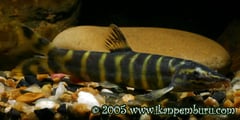
Sinibotia superciliaris
(Günther, 1892)
Max length110mm SL4in SLTank120 × 30cm48 × 12inTemp20–25.5°C68–78°FpH6.5–8.0Sinibotia superciliaris is a botiid loach from the middle Yangtze River drainage in Sichuan and Guizhou provinces, western China. It is rarely seen in the trade, with exports sporadic. It looks very similar to S. pulchra but lacks the brownish markings and spots on the side of the head, and in the wild it was collected from swiftly-flowing stretches with rocky substrates.
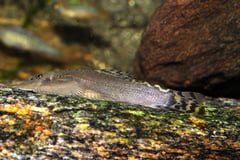
Sinogastromyzon puliensis
Liang, 1974
Max length80mm SL3.1in SLTank75 × 30cm30 × 12inTemp20–24°C68–75°FpH6.0–8.0Sinogastromyzon puliensis is a hillstream loach endemic to western river drainages of central and southern Taiwan. It is considered endangered across some of its range and has been protected by the Wildlife Conservation Act of Taiwan since 1989, and those in the trade appear to be collected and exported illegally. It lives in riffles and rapids with swift currents.
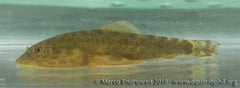
Sinogastromyzon tonkinensis
Pellegrin & Chevey, 1935
Max length65mm SL2.6in SLTank75 × 30cm30 × 12inTemp15–22°C59–72°FpH7.0–9.0Sinogastromyzon tonkinensis is a hillstream loach that appears endemic to the lower Red River drainage in southern China and northern Vietnam. It is poorly known in the hobby but appears to have been exported on a handful of occasions. It occurs alongside three congeners, which are most easily separated by the barbels and mouth width, and it dwells in swiftly-flowing streams and headwaters.
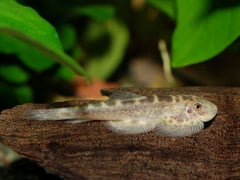
Sinogastromyzon wui
Fang, 1930
Max length110mm SL4in SLTank75 × 30cm30 × 12inTemp20–24°C68–75°FpH6.5–8.0Sinogastromyzon wui is a hillstream loach known only from parts of the Xi Jiang (West River) watershed in Guangxi and Guangdong, southern China. Probably the most common member of the genus in the aquarium trade, it is still not often exported in numbers and more often arrives in mixed shipments with Beaufortia or Pseudogastromyzon. It lives in shallow riffles and rapids with swift currents.
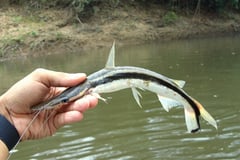
Sorubim limaDuckbill Catfish
authority not recorded
Max length501mm SL20in SLTank200 × 75cm79 × 30inTemp23.3–30°C74–86°FpHnot recordedThe duckbill catfish, Sorubim lima, is a pimelodid catfish recorded from rivers across South America, including the Amazon, Orinoco and Paraná. It is also known as the 'hockey stick catfish' and 'lima shovelnose', and S. elongatus is sometimes sold as it. Sorubim spp. often swim head-down among plants and roots as camouflage. It is quite peaceful but eats anything that fits in its mouth.
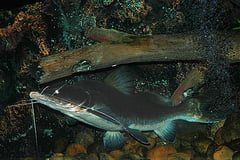
Sperata aorIndian Shovelnose Catfish
authority not recorded
Max length1800mm SL71in SLTank720 × 180cm283 × 72inTemp20–25°C68–77°FpH6.0–7.0The Indian shovelnose catfish, Sperata aor, is a large bagrid catfish from India, Pakistan, Nepal, Bangladesh and Myanmar. Named for its flattened, extended head, it is sometimes seen in dealers' tanks, but its enormous adult size makes it totally unsuited to aquarium life. It will eat any fish it can fit in its mouth and is territorial with its own kind.

Sphaerichthys acrostomaGiant Chocolate Gourami
Vierke, 1979
Max length70mm SL2.8in SLTank80 × 30cm31 × 12inTemp21–25°C70–77°FpH3.5–6.5The giant chocolate gourami, Sphaerichthys acrostoma, is a small gourami known only from the Mentaya River drainage in Indonesian Borneo. It is far from common in the hobby and is traded under several other names, including 'sharp-nosed gourami'. Its colour pattern sets it apart from the other members of the genus. A paternal mouthbrooder, it chiefly inhabits peat swamps and associated black water streams.

Sphaerichthys osphromenoidesChocolate Gourami
Canestrini, 1860
Max length50mm SL2.0in SLTank60 × 30cm24 × 12inTemp26–31°C79–88°FpH4.0–6.5The chocolate gourami, Sphaerichthys osphromenoides, is a small gourami from Peninsular Malaysia, Sumatra and Borneo. By far the best known member of the genus, it mostly inhabits peat swamps and black water streams where the pH can drop to 3.0 or 4.0. A maternal mouthbrooder, it is slow-moving and easily outcompeted for food by more boisterous tankmates.

Sphaerichthys selatanensisCrossband Chocolate Gourami
Vierke, 1979
Max length45mm SL1.8in SLTank60 × 30cm24 × 12inTemp26–31°C79–88°FpH4.0–6.5The crossband chocolate gourami, Sphaerichthys selatanensis, is a small labyrinth fish from southern Borneo, Indonesia. It probably inhabits peat swamps and associated black water streams, and is only occasionally seen in the hobby, sometimes sold as 'cherry chocolate gourami'. Originally described as a subspecies of S. osphromenoides, it differs in fin-ray counts and an additional light vertical bar on each flank.

Sphaerichthys vaillantiVaillant's Chocolate Gourami
Pellegrin, 1930
Max length55mm SL2.2in SLTank60 × 30cm24 × 12inTemp21–25°C70–77°FpH3.5–6.5Vaillant's chocolate gourami, Sphaerichthys vaillanti, is a labyrinth fish that appears to be endemic to the Kapuas drainage in Indonesian Borneo. It is also traded as the 'samurai gourami', a misleading name since the fish is neither especially combative nor from Japan. Unlike S. osphromenoides and S. selatanensis it is a paternal mouthbrooder, and females carry alternating red and green vertical bars.

Steatocranus casuariusBlockhead Cichlid
authority not recorded
Max length120mm SL5in SLTank75 × 30cm30 × 12inTemp24–28°C75–82°FpH6.0–7.5The blockhead cichlid, Steatocranus casuarius, is a rheophilic cichlid from the Lower Congo River and its tributaries, Democratic Republic of Congo. Its swimbladder is modified to reduce buoyancy, and in the aquarium it spends most of its time resting on the substrate or in caves, moving with short 'hopping' motions. A monogamous cave spawner, it should be kept in pairs, and both parents guard the fry for up to three months.