Every species
Filters

Steatocranus tinanti
(Poll, 1939)
Max length130mm SL5in SLTanknot recordedTemp25–28°C77–82°FpH6.0–7.5Steatocranus tinanti is a rheophilic cichlid from around Malebo Pool in the River Congo, Democratic Republic of Congo. It has a confused taxonomic history, having been classified in Gobiochromis and then Leptotilapia, and further revision is likely since it differs in behaviour and morphology from other Steatocranus. It inhabits rapids and turbulent water, digs shallow pits along the shorelines and moves by 'hopping' around the aquarium floor.
Stigmatogobius sadanundioKnight Goby
authority not recorded
Max length90mm SL3.5in SLTank75 × 30cm30 × 12inTemp20–26°C68–79°FpH7.0–8.5The knight goby, Stigmatogobius sadanundio, is a widely distributed goby recorded from Pakistan and India through to Indonesia and Fiji. It inhabits estuarine zones but is more often found in fresh than brackish water, and is by far the most common Stigmatogobius in the hobby. It will eat anything that fits in its mouth and is territorial towards conspecifics, so tankmates are medium-sized hardwater or brackish species using other levels of the aquarium.
Stiphodon alcedo
Maeda, Mukai & Tachihara, 2011
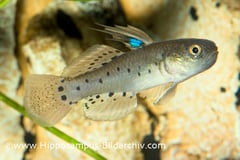
Max length50mm SL2.0in SLTanknot recordedTemp22–28°C72–82°FpH6.5–7.5Stiphodon alcedo is a small stream-dwelling goby known only from the Ryukyu Islands, Japan, in streams on Okinawa and Iriomote. Nuptial males are blackish or sometimes orange with metallic turquoise on the head, and the male's first dorsal fin is pointed but not filamentous. Like other Stiphodon it is a specialised algal grazer with an amphidromous life cycle.
Stiphodon atratus
Watson, 1996
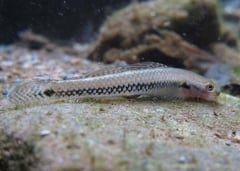
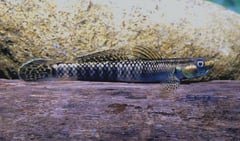
Max length60mm SL2.4in SLTank60 × 30cm24 × 12inTemp22–28°C72–82°FpH6.5–7.5Stiphodon atratus is a stream-dwelling goby from Indonesia, northern New Guinea and islands east to Vanuatu and New Caledonia. Males are blackish, especially on the unpaired fins, and large males appear entirely black between the second dorsal and anal fins. It has been maintained by a few private collectors. Like other Stiphodon it is a specialised algal grazer with an amphidromous life cycle.
Stiphodon atropurpureusBlue Neon Goby
(Herre, 1927)
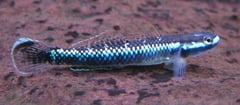
Max length50mm SL2.0in SLTank60 × 30cm24 × 12inTemp22–26°C72–79°FpH6.5–7.5The blue neon goby, Stiphodon atropurpureus, is a stream-dwelling goby from southern Japan, Taiwan, southern China, the Philippines and Malaysia. It is available occasionally but often under the wrong name, including S. elegans and 'Sumatran blue neon goby', though it is not found on Sumatra. In males the bright blue-green lateral stripe combined with a reddish outer edge to the first dorsal fin is unique within the genus.
Stiphodon birdsong
Watson, 1996
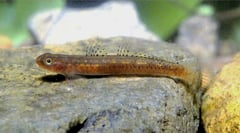
Max length23mm SL0.9in SLTank60 × 30cm24 × 12inTemp22–28°C72–82°FpH6.5–7.5Stiphodon birdsong is a tiny stream-dwelling goby from Halmahera Island east along the northern coast of Papua New Guinea to Fergusson Island. The largest officially recorded specimen measured just 22.9 mm. It is most similar to S. surrufus and S. mele and differs from them only in meristics, such as tooth and scale counts. Like other Stiphodon it is a specialised algal grazer with an amphidromous life cycle.
Stiphodon maculidorsalisOrange-fin Stiphodon
Maeda & Tan, 2013
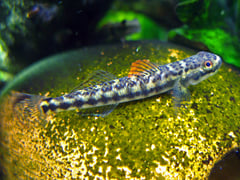
Max length80mm SL3.1in SLTank80 × 30cm31 × 12inTemp20–28°C68–82°FpH6.5–7.5The orange-fin stiphodon, Stiphodon maculidorsalis, is a stream-dwelling goby known only from western Sumatra, Indonesia. Formerly referred to as S. sp. 'orange fin' or 'ST01', it is one of the more commonly traded members of the genus, often in single-sex batches, mixed with other species or misidentified as S. zebrinus. Small black spots on the top of the head and trunk, present in both sexes, are unique within the genus.
Stiphodon ornatusRainbow Stiphodon
Meinken, 1974
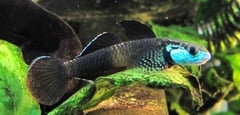
Max length70mm SL2.8in SLTank80 × 30cm31 × 12inTemp20–28°C68–82°FpH6.5–7.5The rainbow stiphodon, Stiphodon ornatus, is a stream-dwelling goby known only from Aceh and West Sumatra provinces, Sumatra, Indonesia. Traded as S. sp. 'rainbow', 'gold fin' or 'gold cheek', it is among the more widely available members of the genus. More than one species may be sold under these names, and males vary a great deal in colour with mood, so identification can be tricky. All Stiphodon in the trade are wild-collected.
Stiphodon pelewensis
Herre, 1936
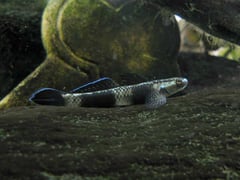
Max length45mm SL1.8in SLTank60 × 30cm24 × 12inTemp22–28°C72–82°FpH6.5–7.5Stiphodon pelewensis is a stream-dwelling goby described from Palau and thought to occur through the Mariana Islands and as far as Pohnpei. Its range needs confirmation, since a number of similarly patterned fishes occur across much of Micronesia. It resembles S. weberi, and the two are most easily told apart by the belly, fully scaled in S. pelewensis and unscaled in S. weberi.
Stiphodon percnopterygionus
Watson & Chen, 1998
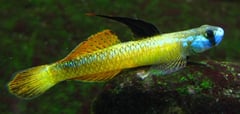
Max length35mm SL1.4in SLTank60 × 30cm24 × 12inTemp22–28°C72–82°FpH6.5–7.5Stiphodon percnopterygionus is a small stream-dwelling goby ranging from southern Taiwan through the Ryukyu and Bonin islands to Guam and Palau. Rare in the aquarium trade, it is among the most easily identified in the genus. Males have highly extended fourth and fifth spines in the first dorsal fin, and adults reach only 30-35 mm SL. Like other Stiphodon it is a specialised algal grazer with an amphidromous life cycle.
Stiphodon rutilaureus
Watson, 1996
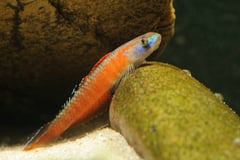
Max length35mm SL1.4in SLTank60 × 30cm24 × 12inTemp22–28°C72–82°FpH6.5–7.5Stiphodon rutilaureus is a small rock-climbing goby from fast island streams, from northern Papua New Guinea east to Vanuatu and Fiji. Males are bright orange-red with 9 to 11 vertical bars and a blue upper lip, cheek and opercle. An algal grazer, it needs clean, well-oxygenated, flowing water.
Stiphodon semoniCobalt Blue Goby
Weber, 1895
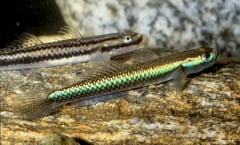
Max length50mm SL2.0in SLTank60 × 30cm24 × 12inTemp22–28°C72–82°FpH6.5–7.5The cobalt blue goby, Stiphodon semoni, is a stream-dwelling goby ranging from western Sumatra east to northern New Guinea and the Solomon Islands. It has been traded for a number of years but often under the wrong name, including S. elegans and S. atropurpureus. Males have a bright blue metallic stripe from snout to caudal peduncle and rounded, almost hyaline dorsal fins, while those of S. atropurpureus are dusky to black.
Stiphodon surrufus
Watson & Kottelat, 1995
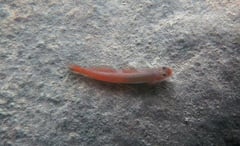
Max length35mm SL1.4in SLTank60 × 30cm24 × 12inTemp22–28°C72–82°FpH6.5–7.5Stiphodon surrufus is a small stream-dwelling goby described from Leyte in the Philippines and also reported from Okinawa and Yakushima, Japan. Males are reddish in life and lack elongate spines in the first dorsal fin. It was possibly carried north by the Kuroshio Current, and is less abundant there than congeners such as S. percnopterygionus. Like other Stiphodon it is a specialised algal grazer with an amphidromous life cycle.

Stomatepia pindu
authority not recorded
Max length90mm SL3.5in SLTank75 × 30cm30 × 12inTemp25–27°C77–81°FpH7.5–8.5Stomatepia pindu is a cichlid endemic to Lake Barombi Mbo, a small volcanic crater lake in Cameroon. Its tiny range, water removal for the nearby town of Kumba, deforestation, introduced species and overfishing mean it is considered critically endangered, and it is correspondingly rare in the hobby. It can change colour rapidly, turning pure black when in good condition and particularly when spawning.
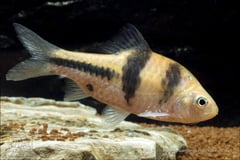
Striuntius lateristrigaSpanner Barb
(Valenciennes, 1842)
Max length150mm SL6in SLTank150 × 45cm60 × 18inTemp20–28°C68–82°FpH6.0–8.0The spanner barb or 'T-barb', Striuntius lateristriga, is a cyprinid from peninsular Thailand, Peninsular Malaysia, Singapore, Sumatra and Java. Its colour pattern varies with locality, and the form most commonly seen in the trade corresponds most closely to fish from Johor. The species may prove to be a complex of closely-related taxa. Quite boisterous, it can intimidate more timid species with its size and activity, especially at feeding times. It is still often sold as Puntius lateristriga.

Striuntius lineatusLined Barb
(Duncker, 1904)
Max length55mm SL2.2in SLTank80 × 30cm31 × 12inTemp20–26°C68–79°FpH4.0–7.0The lined barb, Striuntius lineatus, is a laterally-striped cyprinid from Peninsular Malaysia, Sumatra and Borneo, found mostly in peat swamps. It is most often confused with Desmopuntius johorensis, the two being the most common of the striped species in the trade, but it has no more than one pair of barbels, lacks vertical bars as a juvenile and grows smaller. Its habitats include black water streams stained brown with humic acids, with pH as low as 3.0 or 4.0.
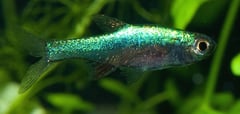
Sundadanio axelrodi
authority not recorded
Max length22mm SL0.9in SLTank30 × 20cm12 × 8inTemp23–26°C73–79°FpHnot recordedSundadanio axelrodi is a miniature cyprinid from Borneo, where it inhabits black water streams and pools associated with forest peat swamps. Originally described as Rasbora axelrodi, it is the only member of its genus. Several colour forms exist depending on locality, normally labelled 'red', 'green' or 'blue', and they are best not mixed. Very peaceful but timid, it does best alone or with similarly sized species, in a group of at least 20-30.

Sundasalanx microps
Roberts, 1981
Max length20mm SL0.8in SLTank45 × 30cm18 × 12inTemp22–26°C72–79°FpHnot recordedSundasalanx microps is a miniature clupeiform from Borneo, in Indonesia and Malaysia, described from the Kapuas River. Adults are sexually mature at less than 20 mm SL and resemble the larval form of their larger ancestors. It has a small eye, less than 4% of SL. Sundasalanx species inhabit turbid, slow to moderately flowing water over silt, sand or mud in the lower parts of river basins, and little else is known of their ecology.

Symphysodon aequifasciatusDiscus
Pellegrin, 1904
Max length140mm SL6in SLTanknot recordedTemp26–30°C79–86°FpH5.0–7.0The discus, Symphysodon aequifasciatus, is a cichlid from the Amazon in Colombia, Peru and Brazil. It ranges down the Rio Solimões and the main Amazon from the Rio Putumayo to the Tocantins drainage, keeping to slow-moving tributaries and forest pools where it schools in deep, sheltered water around tree roots and rocks. Wild fish reach around 14 cm, and discus are very shy, skittish fish that need plenty of cover.
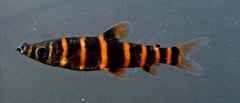
Synaptolaemus latofasciatus
(Steindachner, 1910)
Max length110mm SL4in SLTank120 × 45cm48 × 18inTemp20–28°C68–82°FpH5.0–7.5Synaptolaemus latofasciatus is a headstander from the upper Orinoco, the Casiquiare Canal and the middle-to-lower Amazon in Venezuela and Brazil. Described from a single specimen and placed in Leporinus until 2011, it was then recognised as the fish described as Synaptolaemus cingulatus. Alternating transverse bands of orange or yellow and dark brown or black run along the entire body, and snout shape and colour pattern vary with locality.