Basin
Irrawaddy basin
Only species with a profile on Seriously Fish are counted.
- Species
- 71
- Rivers
- 6
- Photographed
- 71 of 71
- Difficulty rated
- 71 of 71
Rivers in this basinspecies recorded from each
Runs through
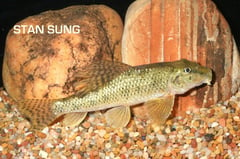
Abbottina rivularisChinese False Gudgeon
Cyprinidae · Basilewsky, 1855
The Chinese false gudgeon, Abbottina rivularis, is a small bottom-dwelling cyprinid native to China, the Korean peninsula and southern Japan. It has been widely introduced elsewhere, including the Mekong and Salween basins, Taiwan, Turkmenistan and Kyrgyzstan, and is considered invasive. It has started to appear in the aquarium trade and should never be released into natural waters outside its native range.
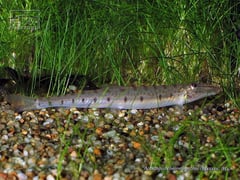
Acantopsis dialuzonaHorseface Loach
Cobitidae · van Hasselt, 1823
The horseface loach, Acantopsis dialuzona, is a cobitid loach from Sumatra, Borneo, Java and Peninsular Malaysia, and possibly Thailand. Most literature lists it as A. choirorhynchos, which Kottelat treats as a junior synonym, and few if any fish in the trade come from near the type locality, so they may represent an unidentified species. Juveniles are exported in large numbers but adults are uncommon in the hobby, and it needs soft sand to bury in.

Akysis prashadiIndawgyi Stream Catfish
Akysidae · Hora, 1936
The Indawgyi stream catfish, Akysis prashadi, is an akysid catfish from Lake Indawgyi and the upper Ayeyarwady drainage in northern Myanmar. It has also been recorded from the Lokchao river in Manipur, India. At up to 62 mm SL it ranks among the largest in the genus, and though it has been exported for the hobby it is by no means common.

Badis corycaeus
Badidae · Kullander & Britz, 2002
Badis corycaeus is a badid known only from the upper Ayeyarwady River basin in northern Myanmar, including nearby Lake Indawgyi. Its closest relative is B. pyema, but it is much the deeper, darker-bodied fish. At the type locality it lives in running water towards the margins of a clear stream, alongside B. kyar and Dario hysginon, which occupy different niches. Rare in the hobby, it is best kept alone with the emphasis on captive reproduction, and rival males can be very aggressive.

Badis ferrarisi
Badidae · Kullander & Britz, 2002
Badis ferrarisi is a badid endemic to the Ayeyarwady River drainage in Myanmar, although the full extent of its range remains unclear. It is difficult to confuse with any congener because of its body patterning of usually 11 short dark bars running along the flank from just behind the gill plate. Poorly documented and rare in the hobby, it is best kept alone with the emphasis on captive reproduction, and rival males can be aggressive towards one another.

Badis kyar
Badidae · Kullander & Britz, 2002
Badis kyar is a slender badid from the upper Ayeyarwady River basin in northern Myanmar, recorded near Myitkyina and in the lower Shweli River. It shares its body shape with B. pyema, but has solid, uniform dark bars on the flanks and a solid bar on the caudal peduncle where B. pyema has rows of irregular spots and a blotch. At the type locality it occupies the faster flow towards the centre of the stream, and it needs more current than most other Badis in the aquarium.

Badis pyema
Badidae · Kullander & Britz, 2002
Badis pyema is a slender badid known only from the remote, mountainous Putao area of Kachin state, northern Myanmar, in the Ayeyarwady system. It resembles B. kyar in shape, but its flank 'bars' are rows of irregular dark spots and it has a dark blotch on each side of the caudal peduncle. The type series came from a narrow, shallow, fast-moving forest stream with clear water over rocks, gravel and sand, and it needs more flow than most other Badis in the aquarium.

Badis ruberBurmese Badis
Badidae · Schreitmüller, 1923
The Burmese badis, Badis ruber, is a badid common throughout much of lowland Myanmar, from the Ayeyarwady and Sittaung south to the Tenasserim. Among the better known Badis in the hobby, it is also traded as 'red badis' and appears in older literature as Badis badis burmicanus. It differs from B. khwae and B. siamensis in its rows of vertically arranged dark flank markings and relatively large caudal peduncle blotch. It tends to inhabit lentic biotopes such as roadside ditches and small, well-vegetated creeks.

Barbodes binotatusSpotted Barb
Cyprinidae · Valenciennes, 1842
The spotted barb, Barbodes binotatus, is a cyprinid ranging from Myanmar and Thailand through the Greater Sunda Islands to the Philippines. So ubiquitous across its range that it's often called simply 'common barb', it occurs from sea level to at least 2000 m in habitats from fast-flowing hill streams to irrigation canals and floodplain ponds. The basic pattern of a dark spot at the dorsal-fin origin and another on the caudal peduncle varies with origin.

Barilius vagra
Cyprinidae · Hamilton, 1822
Barilius vagra is a cyprinid widely distributed in the Ganges and Brahmaputra river systems of northern India, Nepal and Bangladesh. Poorly known in the hobby but exported on occasion, it has 10 to 14 vertical bars on each flank that do not extend below the lateral line. It inhabits well-oxygenated, fast-flowing rivers and tributaries with gravel, cobble and boulder substrates, and its speed and vigorous feeding make it unsuitable for the general community.
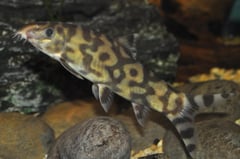
Botia histrionica
Botiidae · Blyth, 1860
Known in the trade as the 'Burmese loach', Botia histrionica is a botiid loach from Myanmar, Manipur in India and Yunnan, China. Young fish all carry five solid dark bars on each flank and are often confused with B. kubotai, but in B. histrionica the bars stay solid for longer and the central bar usually forms a 'y' shape. Adult patterning varies considerably between the Ayeyarwady, Salween, Manipur and Ataran forms, and there has been speculation that some represent distinct species.

Channa burmanica
Channidae · Chaudhuri, 1919
Channa burmanica is a snakehead that appears endemic to the headwaters of the Ayeyarwady in northern Myanmar, known only from the Mali Hka drainage. It is exceptionally rare in the aquarium trade, and its name has been applied to other snakeheads, including an unidentified fish known as C. sp. 'fire and ice'. It lacks pelvic fins, and aquarium specimens suggest orangey-brown patches between the eye and upper lip are typical.

Channa gachuaDwarf Snakehead
Channidae · Hamilton, 1822
The dwarf snakehead, Channa gachua, is a snakehead recorded across an enormous range from Iran to Taiwan and Bali. There is significant evidence that C. gachua as currently understood is a complex of similar-looking species in need of taxonomic review. A mouthbrooder bred regularly in captivity, it can share a well-chosen community with peaceful fishes too large to be prey, but populations should not be mixed as some may hybridise.

Danio albolineatusPearl Danio
Cyprinidae · (Blyth, 1860)
The pearl danio, Danio albolineatus, is a small cyprinid recorded from Myanmar and Indochina south to Peninsular Malaysia and Sumatra. Colour and patterning differ between localities, and doubts remain whether it is a single species or a group of closely related fish. Wild examples are rare in the trade, with most produced commercially in South East Asia or eastern Europe, and some of the fish traded are likely to be hybrids with D. roseus.

Danio chopraeGlowlight Danio
Cyprinidae · Hora, 1928
The glowlight danio, Danio choprae, is a small cyprinid from northern Myanmar, apparently restricted to the Mogaung Chaung system. Available in the trade since around 2003, it quickly became one of the most popular small danionins in the hobby, and commercial breeding means wild fish are hard to come by. It closely resembles D. flagrans, and the spelling 'choprai' seen in some sources is not the accepted one.

Danio flagransNorthern Glowlight Danio
Cyprinidae · Kullander, 2012
The northern glowlight danio, Danio flagrans, is a small cyprinid known only from a handful of streams near Putao in far northern Myanmar. It has reached the hobby in limited numbers, also traded as 'Danio sp. Putao', 'D. putaoensis' or 'D. cf. choprae'. It looks very similar to D. choprae and is told apart by its more slender body, longer barbels and an almost always present lateral line.

Danio kyathitOrange-Finned Danio
Cyprinidae · Fang, 1998
The orange-finned danio, Danio kyathit, is a small cyprinid from the upper Irrawaddy (Ayeyarwady) River drainage in northern Myanmar. Its body patterning varies, with the lateral stripes solid in some specimens and wavy or broken into spots in others, and the striped form was recovered as genetically distinct from the spotted one. Striped fish resemble D. rerio but have much longer barbels and red to orange fins. Very peaceful, it seems most comfortable at 16 to 26 °C.

Danio nigrofasciatusDwarf Spotted Danio
Cyprinidae · (Day, 1870)
The dwarf spotted danio, Danio nigrofasciatus, is a small cyprinid endemic to central Myanmar, on both sides of the Bago Yoma range. It inhabits streams, minor rivers, ponds, ditches and rice paddies, many of them seasonal. A spotted anal-fin separates it most easily from similar species such as D. rerio and D. kyathit. Very peaceful but rather timid, it does best alone or with similarly sized species that enjoy similar conditions.

Danio tinwiniGold Ring Danio
Cyprinidae · Kullander & Fang, 2009
The gold ring danio, Danio tinwini, is a tiny cyprinid from the Mogaung Chaung, an Irrawaddy tributary in Kachin State, northern Myanmar. Seen in the trade since 2003, it has been sold as 'Danio sp. TW02', 'D. sp. fire ring', 'D. sp. gold ring' and 'D. sp. spotted', among other names. Smaller than the similar D. kyathit and D. nigrofasciatus, it has spotted unpaired fins and much shorter barbels. Adults measure just 20 to 30 mm, so tankmates need choosing with that in mind.

Danionella dracula
Cyprinidae · Conway & Rüber, 2009
Danionella dracula is a miniature cyprinid known only from the Mogaung Chaung, a tributary of the Ayeyarwady in Kachin State, northern Myanmar. Males carry a row of tooth-like processes in the jaws ending in a large fang-like pair, a structure unique among cypriniform fishes according to current knowledge. It grows to around 17 mm SL, has been sold as Danionella sp. 'neon green', and is best kept alone in a school of a dozen or more.
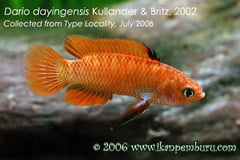
Dario dayingensis
Badidae · Kullander & Britz, 2002
Dario dayingensis is a small badid from a tributary of the Daying River in the Irrawaddy drainage of Yunnan Province, China. Known for some years before its description, it was identified as Badis dario but is much closer to D. hysginon. It has been maintained by a handful of private collectors, and given its rarity the emphasis should be on captive reproduction, with the fish kept alone.

Dario hysginon
Badidae · Kullander & Britz, 2002
Dario hysginon is a tiny badid endemic to Myanmar, known from streams near Myitkyina in Kachin State and from nearby Lake Indawgyi. Traded as 'red melon Dario' or 'flame red Dario', it reaches around 20 mm in males and 15 mm in females. The barred form sold as Dario sp. 'Myanmar' is officially a colour form of this species, but it grows larger and the two will not hybridise in aquaria.

Dario tigrisBlack Tiger Dario
Badidae · Britz, Kullander & Rüber, 2022
The black tiger Dario, Dario tigris, is a small badid from mountain streams south of Mogaung in Kachin State, northern Myanmar. First available to hobbyists in 2005, it was sold as Dario sp. 'Myanmar', D. sp. 'pyjamas' or 'fire red tiger badis' until Britz, Kullander and Rüber described it in 2022. It had been treated as a colour form of D. hysginon, but it grows appreciably larger, its females are distinguishable, and the two will not hybridise in aquaria.

Devario acuticephala
Cyprinidae · (Hora, 1921)
Devario acuticephalus is a small devario from Manipur state in northeastern India, also known from neighbouring Nagaland. It is rare in the hobby but traded on occasion. D. apogon from Yunnan, China, is very similar but has dark vertical bars on the front of the flanks. During a 2010 IUCN assessment it was recorded from only a handful of localities, and it is likely restricted to small hill streams.
Devario apogon
Cyprinidae · (Chu, 1981)
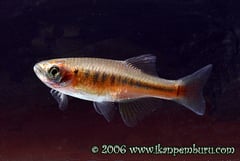
Devario apogon is a small devario from southwestern Yunnan, China, where all known localities lie in the Daying river watershed. Narrow, indistinct vertical bars on the front of the flank, a wide, tapering P stripe behind them, and no barbels or lateral line separate it from similar congeners. It is apparently abundant in rivers, streams and even ditches, in clear or turbid water.
Devario interruptus
Cyprinidae · (Day, 1870)
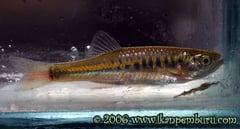
Devario interruptus is a devario from the Hotha valley and nearby areas of southwestern Yunnan, China, close to the border with Myanmar. Short, wide vertical bars on the flanks and a P stripe made of contiguous dark blotches separate it from the similar D. maetaengensis and D. shanensis. It has mostly been collected from small, clear, moderate to swiftly-flowing streams over sand, gravel and rocks with no aquatic vegetation.

Folifer brevifilis
Cyprinidae · Peters, 1881
Folifer brevifilis is a large cyprinid from the Mekong, Salween and Ayeyarwady systems of southern China, Myanmar, Thailand, Laos and Vietnam. It has also been recorded from Hainan and Hong Kong. Growing to 300 mm SL, it is unsuitable for the majority of home aquaria and extremely rare in the ornamental trade. It inhabits flowing middle and lower sections of major rivers and may migrate seasonally to spawn.

Garra spilota
Cyprinidae · Kullander & Fang, 2004
Garra spilota is a small cyprinid probably endemic to the Rakhine Yoma, or Arakan, mountains in western Myanmar, and occasionally seen in the trade. It has reddish fins, a series of dark blotches on the flanks and an unusual upper lip lined with unculi, and differs from the similar G. flavatra in some meristic counts. It is less territorial with conspecifics than some Garra, and a group of 3-4 is the minimum.

Indostomus paradoxusArmoured Stickleback
Indostomidae · Prashad & Mukerji, 1929
The armoured stickleback, Indostomus paradoxus, is a tiny fish from Myanmar, described from Lake Indawgyi and recorded in the Ayeyarwady basin. It appears to be considerably more widespread than previously thought, having been found as far south as the river's delta. It is rare in the aquarium hobby, and its name is often misapplied to the closely related I. crocodilus, in which adult males have dark bands in the dorsal and anal fins.
Lepidocephalichthys berdmorei
Cobitidae · Blyth, 1860
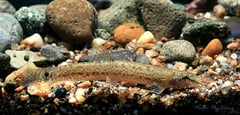
Lepidocephalichthys berdmorei is a cobitid loach found across Myanmar, Thailand, Laos, north-eastern India and Bangladesh. One of the most frequently-traded members of the genus, it is an excellent choice for those new to keeping loaches. Unlike most congeners it shows a preference for headwaters and streams with clear, flowing water, and its larger adult size separates it from the similar L. thermalis.
Lepidocephalichthys goalparensis
Cobitidae · Pillai & Yazdani, 1976
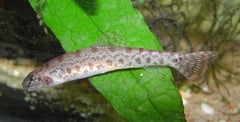
Lepidocephalichthys goalparensis is a cobitid loach from the Brahmaputra, Ganges and upper Irrawaddy basins in India, Nepal, Bangladesh and Myanmar. Rarely seen in the hobby, it was imported into the UK in late 2011 as bycatch among mastacembelid eels from northern India, and the identification was confirmed by Justin Havird. The forked caudal fin normally carries four or five broad, dark V-shaped bars.
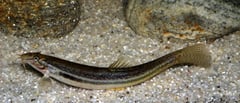
Lepidocephalichthys guntea
Cobitidae · Hamilton, 1822
Lepidocephalichthys guntea is a cobitid loach from the Ganges and Brahmaputra systems of northern India, Nepal and Bangladesh, and much of Myanmar. One of the most frequently-traded members of the group, it is an excellent choice for those new to keeping loaches. Males carry a solid, dark lateral stripe and females spotted flanks, and patterning varies with origin. It is also used as a food fish, eaten fresh and dried.
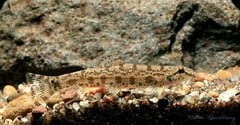
Lepidocephalichthys micropogon
Cobitidae · Blyth, 1860
Lepidocephalichthys micropogon is a cobitid loach from Myanmar, western Thailand, Bangladesh and Assam, India. Known from the Salween, Sittaung, Irrawaddy and Brahmaputra drainages and occasionally exported as bycatch, it grows to 55 mm SL and has a strongly forked caudal fin with broad, dark V-shaped bars. Kottelat (2012) treats L. manipurensis as a synonym, though Havird and Page (2010) list the two separately.

Microdevario gatesi
Cyprinidae · Herre, 1939
Microdevario gatesi is a miniature cyprinid from the lower Irrawaddy basin in Myanmar, growing to around 23 mm SL. Uncommon in the aquarium hobby, it is sometimes traded as 'Burmese golden rasbora' and can be told from its congeners by its hyaline dorsal and anal fins. It is likely to inhabit sluggish and standing waters such as rice paddies, swamps and weedy ditches, and is possibly endemic to the Irrawaddy Delta.

Microdevario nanus
Cyprinidae · Kottelat & Witte, 1999
Microdevario nanus is a miniature cyprinid from the lower Sittaung and Bago drainages of the Irrawaddy system in Myanmar. Sometimes referred to as 'green dwarf rasbora' or 'nana rasbora' in the ornamental trade, it grows to around 16 mm SL. A black blotch at the tip of the dorsal fin and a greyish marking at the tip of the anal fin immediately distinguish it from congeners.

Mystacoleucus argenteus
Cyprinidae · Day, 1888
Mystacoleucus argenteus is a cyprinid from the Salween and middle Irrawaddy basins in Myanmar and western Thailand. It is occasionally marketed as 'Burmese rainbow barb' and differs from the similar M. obtusirostris in lacking black-edged scales on the body. Little has been published since Day's original description of 1888. Vigorous when feeding, it can upset slow-moving or timid tankmates.

Opsarius barna
Cyprinidae · Hamilton, 1822
Traded as 'striped hill trout' or 'banded hill trout', Opsarius barna is a cyprinid from the Ganges and Brahmaputra basins in northern India. It is thought to also occur in the Mahanadi and in river systems in Nepal, Bhutan, Bangladesh and Rakhine State, Myanmar, in well-oxygenated, fast-flowing rivers over gravel, cobbles and boulders. An extremely fast swimmer and vigorous feeder, it is unsuitable for the general community.

Opsarius dogarsinghiManipur Baril
Cyprinidae · Hora, 1921
The Manipur baril, Opsarius dogarsinghi, is a cyprinid from the Chindwin river system in Manipur and Nagaland, northeastern India, and Myanmar. It occasionally appears in the trade as 'Burmese hill trout' or 'striped hill trout'. A large dark blotch at the caudal-fin base and 8-9 dark blue vertical bars help separate it from congeners, and it has been bred in aquaria.

Oreichthys sp. 'Myanmar Redfin'
Cyprinidae · authority not recorded
Oreichthys sp. 'Myanmar Redfin' is a small cyprinid apparently native to parts of the Irrawaddy River basin in northern Myanmar. It appears to be an undescribed species, and is one of several fish sometimes imported and sold as O. cosuatis or O. parvus. Adult males lack a dark marking in the dorsal-fin, and a large, well-defined black blotch on the caudal peduncle is the easiest way to tell it from both.

Oryzias dancenaIndian Ricefish
Adrianichthyidae · Hamilton, 1822
The Indian ricefish, Oryzias dancena, is widely distributed through eastern and southern India, Sri Lanka, Bangladesh and Myanmar. Mostly coastal but adaptable, it has been collected from strongly brackish mangrove swamps to acidic freshwater forest streams. It continues to be misidentified as O. melastigma, a name most recent workers consider invalid, or as O. javanicus, a valid but distinct taxon.
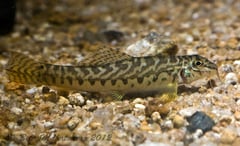
Paracanthocobitis botiaZipper Loach
Nemacheilidae · Hamilton, 1822
The zipper loach, Paracanthocobitis botia, is a nemacheilid loach from the Brahmaputra River in Assam, northeastern India. It was long thought to range from Pakistan to western Thailand, and several populations once included under the name are now treated as separate species. Relatively hardy and peaceful, it is one of the better choices for those new to nemacheilids, and its dark, eye-like ocellus at the top of the caudal peduncle is normally more intense in younger fish.
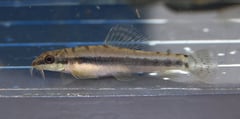
Paracanthocobitis zonalternans
Nemacheilidae · Blyth, 1860
Paracanthocobitis zonalternans is a nemacheilid loach ranging from Manipur in India through Myanmar into western and peninsular Thailand. Several species are thought to be confused under the name, and Singer and Page (2015) consider it likely to be a species complex. Among the more peaceful members of the genus, it does best in a mixed-sex group of at least half a dozen, and it has been bred in aquaria, first by UK aquarist Mick Wright.

Parasphaerichthys lineatus
Osphronemidae · Britz & Kottelat, 2002
Parasphaerichthys lineatus is a tiny gourami from the Irrawaddy delta, Myanmar, and at 15 to 19 mm SL the smallest member of the family Osphronemidae. It is sometimes traded as 'mini chocolate gourami' or 'Burmese chocolate gourami', or misidentified as P. ocellatus, from which it differs in its dark mid-lateral stripe and the lack of an ocellus on each flank.

Parasphaerichthys ocellatusEyespot Gourami
Osphronemidae · Prashad & Mukerji, 1929
The eyespot gourami, Parasphaerichthys ocellatus, is a small anabantoid from the upper Ayeyarwady basin in northern Myanmar, including Lake Indawgyi. It shares the trade names 'mini chocolate gourami' and 'Burmese chocolate gourami' with P. lineatus, but grows larger, to 32 mm SL, and has an ocellus-type marking in the middle of each flank with no dark mid-lateral stripe. In nature it is subject to seasonal temperature fluctuations and is comfortable between 15 and 25 °C.

Pethia didi
Cyprinidae · Kullander & Fang, 2005
Pethia didi is a small cyprinid from the Ayeyarwady drainage around Lake Indawgyi and Myitkyina, Kachin State, where it appears to be endemic. Rare in the aquarium trade though occasionally available, it has two black, vertically-orientated flank blotches, one behind the operculum and one on the caudal peduncle, a pattern shared with several congeners. The type locality is a swift, shaded stream through bamboo forest, and the species is subject to seasonal temperature fluctuations in nature.

Pethia erythromycterLipstick Barb
Cyprinidae · Kullander, 2008
The lipstick barb, Pethia erythromycter, is a small cyprinid from the upper Ayeyarwady River basin in northern Myanmar, including Lake Indawgyi. Sometimes traded as 'Tulip barb', it first appeared in the hobby in 2006 and was described by Kullander (2008). Males have red pigmentation around the mouth and tubercules on the snout when nuptial. It may nip slow-moving or long-finned tankmates but does very well with other small, active cyprinids or nemacheilid loaches.

Pethia geliusGolden Dwarf Barb
Cyprinidae · Hamilton, 1822
The golden dwarf barb, Pethia gelius, is a small cyprinid native to the Ganges and Brahmaputra river drainages of northern India and Bangladesh. Records suggest a wider range, including Tamil Nadu and the Ayeyarwady delta in Myanmar, though the latter may warrant investigation. Knight (2013) settled its identity, revalidating P. canius and describing P. aurea, both previously treated as phenotypes of P. gelius. Very peaceful but timid, it does best alone or with other diminutive species.

Pethia padamyaOdessa Barb
Cyprinidae · Kullander & Britz, 2008
The Odessa barb, Pethia padamya, is a small cyprinid from central Myanmar, also recorded from the lower Chindwin, a tributary of the Ayeyarwady. In the trade since the early 1970s, it first appeared in Ukraine and was widely considered a hybrid until natural populations were found, with the formal description following in October 2008. Males carry a thick band of bright red-orange on the flanks, and farm-produced fish seem to hold their colour better when stressed.

Pethia stoliczkana
Cyprinidae · Day, 1871
Pethia stoliczkana is a small cyprinid that appears to range from Manipur state in northeastern India through Myanmar and Thailand to western Laos. Much of the literature confuses it with P. ticto, but the two do not occur in the same waters and the lateral line is complete in this species and incomplete in P. ticto. The form from Mandalay division in Myanmar is sometimes sold as Puntius sp. 'pearlscale'. It mostly inhabits shady, flowing streams and tributaries.

Pethia tiantian
Cyprinidae · Kullander & Fang, 2005
Pethia tiantian is a small cyprinid known only from the remote, mountainous area of Putao in Kachin state, northern Myanmar. Both known localities, the Nan Hto Chaung and the Mali Hka River, are part of the upper Ayeyarwady system. The species is only exported occasionally, and an undescribed fish often traded as 'Burmese bumblebee barb' is sometimes mislabelled with its name. It is subject to seasonal temperature fluctuations in nature.

Pethia tictoTicto Barb
Cyprinidae · Hamilton, 1822
The ticto barb, Pethia ticto, is a small cyprinid widely distributed through most of the Indian subcontinent, from Pakistan and Nepal to Bangladesh. Its name is frequently misapplied to P. padamya in aquarium literature, though P. ticto is much the less colourful fish and males lack reddish-orange pigmentation on the body. Morphology and colour pattern vary by population, and some populations have already been described as distinct species.

Puntius cholaSwamp Barb
Cyprinidae · (Hamilton, 1822)
The swamp barb, Puntius chola, is a cyprinid from much of Pakistan, India, Nepal, Bhutan, Bangladesh, Sri Lanka, Myanmar and western Thailand. Sometimes called the 'chola' or 'green' barb, it has a single pair of barbels and dark blotches behind the operculum and near the caudal-fin base. It apparently prefers stiller waters over mud or silt, and makes an ideal addition to a peaceful community of riverine fishes.
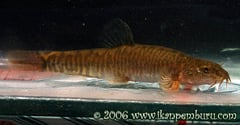
Schistura polytaenia
Nemacheilidae · Zhu, 1982
Schistura polytaenia is a nemacheilid loach known only from its type locality, an Irrawaddy tributary in Tengchong County, Yunnan, China. It appears never to have been exported for the aquarium hobby. Normally listed in Nemacheilus, it appears under Schistura in Kottelat (2012), and the specimens shown on the profile were identified on the basis of collection locality.
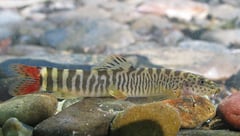
Schistura vinciguerrae
Nemacheilidae · Hora, 1935
Schistura vinciguerrae is a nemacheilid loach from the Irrawaddy, Salween and Chindwin river basins in Myanmar and northeastern India. Traded fairly regularly, it belongs to the Schistura multifasciata group, in which the anterior flank bars are divided and thinner than those behind. Males lack a suborbital flap, and this separates it from S. bella, S. mahnerti, S. reticulata and S. udomritthiruji. It inhabits clear, well-oxygenated forest streams over coarse sand, gravel, rocks and boulders.
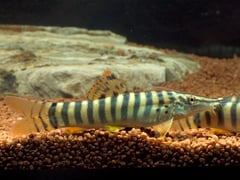
Syncrossus berdmoreiRedfin Tiger Loach
Botiidae · Blyth, 1860
The redfin tiger loach, Syncrossus berdmorei, is a botiid loach from the Irrawaddy, Sittaung and Salween systems in Myanmar and Manipur, India. It looks very similar to S. beauforti but has 11-14 branched dorsal-fin rays, and in young fish its larger dark markings appear first behind the opercle. Colour and pattern vary with locality and age, and some of these forms may turn out to be separate species.

Xenentodon cancilaFreshwater Needlefish
Belonidae · Hamilton, 1822
The freshwater needlefish, Xenentodon cancila, is a belonid from Pakistan east through India, Bangladesh, Nepal, Sri Lanka, Myanmar and Thailand. Often called 'freshwater garfish', it only superficially resembles the true gars, and most of its relatives in the Belonidae are marine or estuarine. A near-exclusive inhabitant of the upper water column, it is surprisingly peaceful with anything too large to swallow and is best kept in numbers of four or more, in a tank of 180 ∗ 60 cm or more.

Bagarius yarrelliGoonch
Sisoridae · Sykes, 1839
The goonch, Bagarius yarrelli, is a very large sisorid catfish recorded from the Indus in Pakistan east through Indochina to Sumatra and Borneo. Also known as the 'giant devil catfish' and 'sand shark', it reaches 1300 to 2000 mm and is fished for food across much of its range. That wide distribution appears doubtful, and Indian and Southeast Asian populations may prove not to be conspecific. It lives among boulders in the fast, turbulent rapids of large rivers.

Channa maruliusBullseye Snakehead
Channidae · Hamilton, 1822
The bullseye snakehead, Channa marulius, is a large snakehead recorded from Pakistan across southern Asia to southern China, Laos and Vietnam. Also called the 'giant', 'cobra' or 'Indian' snakehead, it is widely accepted to represent a complex of related species in need of further research. Reports of 120-180 cm remain to be proven, with 500-600 mm a more common adult size, and it is suitable only for public installations or the very largest private aquaria.

Crossocheilus burmanicus
Cyprinidae · Hora, 1936
Crossocheilus burmanicus is a cyprinid from Myanmar plus northeastern India and western Thailand, in rivers draining to the Irrawaddy and Salween. It lives in clear, flowing streams over boulders, pebbles, gravel and sand, browsing the biofilm on submerged surfaces. Its dark lateral stripe does not extend into the caudal fin, which separates it from the fish traded as 'Siamese algae eater' or 'SAE'.

Notopterus notopterusBronze Featherback
Notopteridae · Pallas, 1769
The bronze featherback, Notopterus notopterus, is an air-breathing notopterid from the Indian subcontinent and Southeast Asia. Also called 'Asian knifefish' or 'ghost knifefish' in the trade, it grows to 600 mm and arguably has no place in the ornamental hobby given its adult size and specialised requirements. The single species in Notopterus is likely to represent a complex of closely-related species.
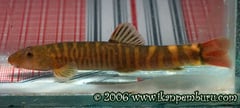
Schistura yingjiangensis
Nemacheilidae · Zhu, 1982
Schistura yingjiangensis is a nemacheilid loach known only from the Daying River, an Irrawaddy tributary in Yingjiang County, Yunnan, China. It appears never to have been exported for the aquarium hobby. Normally listed in Nemacheilus, it appears under Schistura in Kottelat (2012), as it does in Chen & Neely (2012) and Endruweit (2014).

Bangana devdevi
Cyprinidae · Hora, 1936
Bangana devdevi is a cyprinid known with certainty from the Irrawaddy system in Manipur, India, and Myanmar, and the Salween in Myanmar and Thailand. Records from the Red River basin in Vietnam appear questionable. It presumably inhabits flowing river channels and larger tributaries and migrates seasonally, as related species do.

Garra bispinosa
Cyprinidae · Zhang, 2005
Garra bispinosa is a cyprinid known only from its type locality, the Daying Jiang in the Irrawaddy basin, Yunnan Province, China. It is distinguished from other Garra in Southeast Asia and China by a quadrate proboscis on the snout, each lobe tipped with a single large tubercle. Nothing specific is recorded of its habitat.

Garra nambulica
Cyprinidae · Vishwanath & Joyshree, 2005
Garra nambulica is a small cyprinid known only from tributary streams of the Nambul River, in the Chindwin basin of Manipur state, northeastern India. It has a squarish head, no proboscis or transverse groove on the snout, and a W-shaped blue-black band on the caudal fin. It grows to around 65 mm SL.

Garra poecilura
Cyprinidae · Kullander & Fang, 2004
Garra poecilura is a small cyprinid known only from a minor Irrawaddy tributary draining the eastern Rakhine Yoma, western Myanmar. The largest specimen in the type series measured 44.5 mm. The type locality is a clear stream 1-2 metres wide in bamboo forest, flowing over rocks and gravel. It has a weakly-defined dark band or series of blotches on the flank and two vertical rows of black spots on the caudal fin.
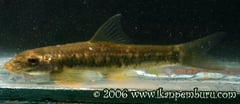
Garra qiaojiensis
Cyprinidae · Wu & Yao, 1977
Garra qiaojiensis is a cyprinid known only from a handful of localities in the upper Irrawaddy (Yiluowadi Jiang) basin in Yunnan province, China. It may also occur in northern Myanmar, and was collected from clear, flowing mountain streams over rock and gravel. It is similar to G. rotundinasus but has a quadrate, heavily tuberculated proboscis, a longer head and a deeper body. It grows to around 175 mm SL.
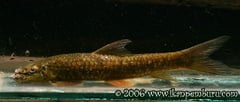
Garra rotundinasus
Cyprinidae · Zhang, 2006
Garra rotundinasus is a cyprinid native to the Yiluowadi Jiang, the upper Irrawaddy river system, in Yunnan province, southern China. Before its description it was confused with a congener now accepted to occur only in the Salween and Manipur basins. Both have a weakly-developed proboscis, but G. rotundinasus has a broadly rounded snout and more lateral line scales. It grows to around 185 mm SL.

Hemibagrus microphthalmus
Bagridae · Day, 1877
Hemibagrus microphthalmus is a very large bagrid catfish from the Salween, Irrawaddy and Sittaung systems of Myanmar and western Thailand. It also occurs in the Manipur River drainage in northeastern India. Known to reach 1500 mm SL and to live for several decades, it cannot be considered a suitable home aquarium subject, and it is likely to prove aggressively territorial.

Hemibagrus peguensis
Bagridae · Boulenger, 1894
Hemibagrus peguensis is a bagrid catfish from the Irrawaddy, Bago and Sittaung drainages of Myanmar and the Chindwin basin in northeastern India. Sometimes referred to as 'Sittang mystus', it has been widely confused with H. menoda in the past and seems virtually unknown in the aquarium hobby. It grows to 286 mm SL and can be told from H. menoda by its almost truncate snout.

Labeo calbasuOrangefin Labeo
Cyprinidae · Hamilton, 1822
The orangefin labeo, Labeo calbasu, is a large cyprinid from Pakistan, Nepal, India, Bangladesh, Myanmar and southern China. Growing to 800 mm, it is an important food and game fish across its native range and is not a suitable subject for the home aquarium. It is known as 'black rohu' in parts of India and Bangladesh, and inhabits the lower reaches of major rivers, lakes and reservoirs.

Bagarius bagarius
Sisoridae · Hamilton, 1822
Bagarius bagarius is a sisorid catfish with a wide but disjointed recorded range, from the Indus in Pakistan east to the Mekong and Malay Peninsula. Its identity is confused: the name has been widely applied to a small fish said to reach only 200 mm SL, but it may be the only Bagarius in the Indian subcontinent, in which case it can reach 2 metres. It is mostly collected from fast, turbulent rapids in larger rivers, where it shelters among boulders, and is best kept alone.