Basin
Zhu basin
Only species with a profile on Seriously Fish are counted.
- Species
- 21
- Rivers
- 6
- Photographed
- 21 of 21
- Difficulty rated
- 20 of 21
Rivers in this basinspecies recorded from each
Runs through
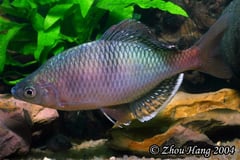
Acheilognathus macropterusGiant Chinese Bitterling
Cyprinidae · Bleeker, 1871
The giant Chinese bitterling, Acheilognathus macropterus, is a bitterling from China, the Korean peninsula, northern Vietnam and southeastern Russia. It has been introduced to Japan and is considered invasive there. Typical adults are 100 to 150 mm, and it appears in the trade only irregularly. Like all bitterlings it spawns in living unionid mussels, and its wide range suggests it may be a group of closely-related species.
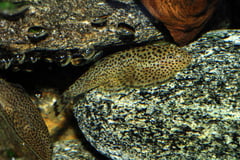
Beaufortia kweichowensisButterfly Loach
Gastromyzontidae · Fang, 1931
The butterfly loach, Beaufortia kweichowensis, is a hillstream loach from the Xi Jiang (West River) system in southern China. In many countries it is the most common gastromyzontid in the shops, one of several loaches traded as 'butterfly loach', 'Hong Kong plec' or 'Chinese hillstream loach' regardless of species. The name B. leveretti is often applied to it. It needs clean, well-oxygenated, fast-flowing water, and 16 to 24 °C is recommended.
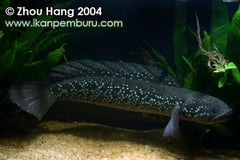
Channa asiaticaChinese Snakehead
Channidae · Linnaeus, 1758
The Chinese snakehead, Channa asiatica, is a snakehead native to central and southern China and northern Vietnam. One of several Channa lacking pelvic fins, it is told apart from them by vertical black bars on a brownish body and numerous white spots on the body and fins. It is best kept in a species tank. Pairs build no bubble nest, and both parents defend several thousand floating eggs and the fry.
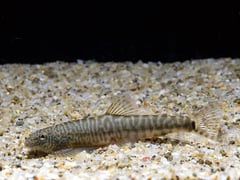
Erromyzon sinensis
Gastromyzontidae · Chen, 1980
Erromyzon sinensis is a gastromyzontid loach from the Xi Jiang (West River) system in southern China, mostly in Guangxi. It is extremely rare to nonexistent in the aquarium trade, although its name has been widely misapplied to congeners such as the unidentified E. sp. 'ER02'. An obligate bottom-dweller, it lives in shallow, fast-flowing, highly-oxygenated headwaters and minor tributaries, clinging to rocks with its flattened body and horizontally-orientated paired fins.
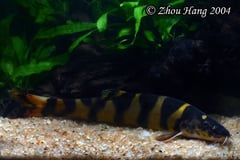
Leptobotia pellegrini
Botiidae · Fang, 1936
Leptobotia pellegrini is a botiid loach from southern China, described from Sichuan province and also known from the Pearl River (Zhu Jiang) basin. Often traded as 'royal clown loach', a name also applied to L. elongata, it differs from that species chiefly in adult size, reaching around 200 mm SL against 500 mm. It is also more slender with a darker head, and its relatively wide distribution probably explains why it is commoner in the hobby.
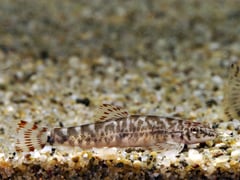
Liniparhomaloptera disparisBroken-band Hillstream Loach
Gastromyzontidae · Lin, 1934
The broken-band hillstream loach, Liniparhomaloptera disparis, is a gastromyzontid from the Pearl River system of southern China and from Hong Kong. It is restricted to shallow, fast-flowing, highly oxygenated headwaters with riffles and runs. Sometimes available as bycatch among shipments of Rhinogobius duospilus, it also appears on trade lists under the fictitious name 'Homaloptera hoffmani'. It has been bred in aquaria and buries its eggs within the substrate.

Macropodus ocellatusRoundtail Paradise Fish
Osphronemidae · Cantor, 1842
The roundtail paradise fish, Macropodus ocellatus, is a labyrinth fish with an enormous range in China, Korea and Japan, north to the Amur River. It lives in ditches, rice paddies, marshes and river backwaters, where winter can freeze the surface and drop the water to 3 °C. It is sometimes referred to as M. chinensis in older literature, a name now considered a synonym of M. opercularis. Males are territorial when breeding and build bubble nests.

Macropodus opercularisParadise Fish
Osphronemidae · Linnaeus, 1758
The paradise fish, Macropodus opercularis, is a labyrinth fish from China south of the Yangtze, including Taiwan and Hainan, plus Vietnam and Laos. Imported to France in 1869, it was among the very first ornamental fish brought to Europe. Wild examples are uncommon in the hobby since it is farmed extensively, and xanthic, albino, red, blue and stripeless strains exist. Males are territorially aggressive, especially when breeding, and should not be housed together unless the aquarium is very large.
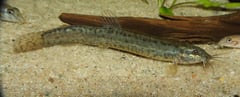
Misgurnus dabryanusLarge-scaled Loach
Cobitidae · (Guichenot, 1872)
The large-scaled loach, Misgurnus dabryanus, is a 'true' loach from the Yangtze and Pearl rivers in China, plus Taiwan and the Amur in Russia. It is sold regularly in the hobby but almost always labelled as or mixed in with M. anguillicaudatus, from which it differs in its high adipose crests on the caudal peduncle and the lack of a dark spot at the caudal-fin base. It spends some of its time completely buried, so it needs a soft, sandy substrate.
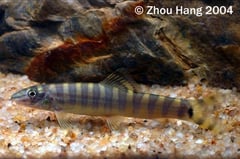
Parabotia lijiangensis
Botiidae · Chen, 1980
Parabotia lijiangensis is a botiid loach described from the Li River drainage near Guilin, in the Pearl River system of southern China. It has 10-13 dark vertical bars on the body and a dark, ocellated spot in the centre of the caudal-fin base. It probably inhabits clear, well-oxygenated running water, and the occasional specimen may turn up among shipments of similar-looking Sinibotia.
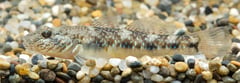
Rhinogobius giurinus
Gobiidae · Rutter, 1897
Rhinogobius giurinus is a goby found through much of China, plus Taiwan, the Korean Peninsula, Japan and the Red and Pha river basins in Vietnam. It appears to exist in a number of forms that differ in colour pattern, morphology or both, and it is unclear whether all of them are conspecific. Newly-imported wild fish tend to be aggressive towards conspecifics, so unlike most Rhinogobius it is best kept in sexed pairs.
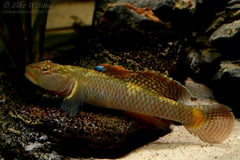
Rhinogobius leavelli
Gobiidae · (Herre, 1935)
Rhinogobius leavelli is a goby ranging from northeastern Laos through northern Vietnam to the Pearl drainage in Guangxi, southern China. It appears to exist in a number of forms that differ in colour pattern, morphology or both, although those in the aquarium trade all look similar. Fish identified as this species tend to have an orange blotch at the base of the caudal fin and a dark vertical bar at the base of the pectoral fin.
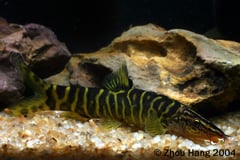
Sinibotia pulchraGolden Zebra Loach
Botiidae · Wu, 1939
The golden zebra loach, Sinibotia pulchra, is a botiid loach from the Zhu Jiang (Pearl River) system in southern China. It is also sold as the 'golden Chinese loach' or '12-banded Chinese loach' and, with S. robusta, is the most commonly traded Sinibotia, the two often imported in mixed batches. It is reclusive but very peaceful, and the gregarious nature of the genus means 3-4 should be the minimum purchase.
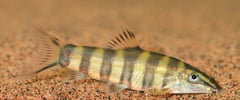
Sinibotia robustaKansu Loach
Botiidae · Wu, 1939
The Kansu loach, Sinibotia robusta, is a botiid loach from the Zhu Jiang (Pearl River) system in Guangxi, southern China. Its deeper, stockier body separates it from other Sinibotia. With S. pulchra it is the most commonly traded member of the genus, and the two are often imported in mixed batches. Young fish have around 6 dark bars that usually bifurcate as they mature.
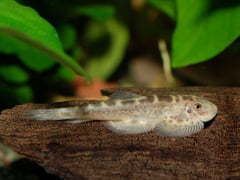
Sinogastromyzon wui
Balitoridae · Fang, 1930
Sinogastromyzon wui is a hillstream loach known only from parts of the Xi Jiang (West River) watershed in Guangxi and Guangdong, southern China. Probably the most common member of the genus in the aquarium trade, it is still not often exported in numbers and more often arrives in mixed shipments with Beaufortia or Pseudogastromyzon. It lives in shallow riffles and rapids with swift currents.
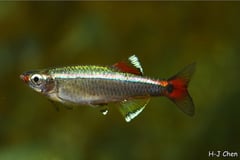
Tanichthys albonubesWhite Cloud Mountain Minnow
Cyprinidae · Lin, 1932
The White Cloud Mountain minnow, Tanichthys albonubes, is a small cyprinid from Guangdong and Hainan in southern China and from northeastern Vietnam. It appears to have been extirpated from White Cloud Mountain itself and is considered endangered in China, but all the fish on sale are commercially bred. Inbreeding among farm-bred stock has left many genetically weak and prone to disease or deformity, and permanent exposure to warmer conditions is likely to shorten its life.
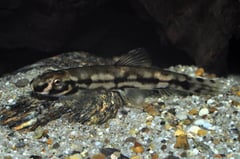
Yaoshania pachychilusPanda Loach
Balitoridae · Chen, 1980
The panda loach, Yaoshania pachychilus, is a balitorid loach from headwater streams draining the Dayao Mountain in Guangxi, southern China. The name comes from the black-and-white-striped juvenile pattern, which fades in older fish, so only young fish tend to be traded, sometimes labelled 'panda goby'. It needs clean, well-oxygenated, fast-flowing water, and though often marketed for them it is not suitable for tiny 'nano' aquaria.
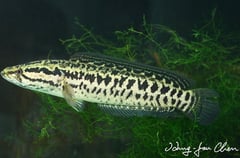
Channa maculataBlotched Snakehead
Channidae · Lacepède, 1801
The blotched snakehead, Channa maculata, is a snakehead from coastal drainages of southeastern China, including Hong Kong, and northern Vietnam. It is frequently confused with C. argus but has fewer fin rays and lateral line scales and carries 2-3 rounded blotches on the caudal peduncle. An important food fish, it has become established in Japan, Taiwan, the Philippines, Madagascar and Hawaii, and hybrids with C. argus appear to be quite common in aquaculture.
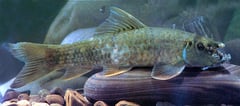
Garra orientalis
Cyprinidae · Nichols, 1925
Garra orientalis is a cyprinid widely distributed in southern China, with records from the Pearl River (Zhu Jiang) and Min Jiang watersheds. Earlier records from the Salween and upper Irrawaddy are now known to represent other species. It shares a forward-projecting, trilobed proboscis with G. salweenica and G. fuliginosa but lacks their dark blotch on the caudal peduncle. It tends to inhabit rocky, swiftly-flowing headwaters.
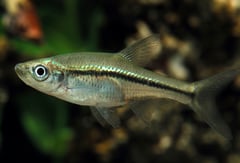
Metzia formosae
Cyprinidae · Oshima, 1920
Metzia formosae is a small cyprinid from northern Taiwan, Hainan, Hong Kong, southern China and northern Vietnam. It is identified by its upturned mouth and a black stripe along the flank from the gill opening to the caudal-fin base. It inhabits slow-moving to still, well-vegetated waters, including streams, rice paddies, ditches and canals. The genus remains unresolved in taxonomic terms.
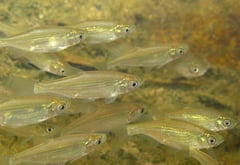
Metzia lineata
Cyprinidae · Pellegrin, 1907
Metzia lineata is a cyprinid from southern China, Hainan, Hong Kong and the Red River basin of northern Vietnam. Populations from the upper Pearl River and from Vietnam differ from those elsewhere, which suggests several species may be included under the name. It lives in slow-moving to still, well-vegetated waters. It has been introduced to other river systems in China and to northern Laos.