Country · Africa
Burkina Faso
Only species with a profile on Seriously Fish are counted, whether native or introduced.
- Species
- 21
- Families
- 14
- Genera
- 15
- Found only here
- 0
- Photographed
- 19 of 21
The country
These figures are from Wikidata, checked on 24 October 2026.
Shares its fishes withspecies recorded in both
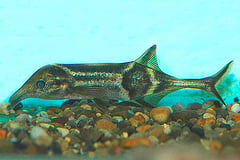
Campylomormyrus tamanduaWorm-Jawed Mormyrid
Mormyridae · authority not recorded
The worm-jawed mormyrid, Campylomormyrus tamandua, is a benthic mormyrid recorded from nine countries in West and Central Africa. It sometimes arrives among imports of the elephant fish, Gnathonemus petersii, but has both jaws extended into a beak-like shape. It needs pristine soft, acidic water, generally refuses standard foods and grows to 400 mm SL. Like other mormyrids it produces a weak electric field, used to navigate and to communicate.

Chromidotilapia guntheri
Cichlidae · (Sauvage, 1882)
Chromidotilapia guntheri is a mouthbrooding cichlid from coastal drainages of western Africa between Liberia and Cameroon, plus the Niger and Benue. It occurs in a number of geographic forms, with fish from Cameroon tending to show dark blotches on the dorsal fin. A benthophagous omnivore, it sifts mouthfuls of substrate for food, and the male broods the eggs while the female defends the surrounding territory.
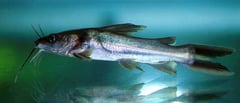
Clarotes laticepsWidehead Catfish
Bagridae · authority not recorded
The widehead catfish, Clarotes laticeps, is a large predatory catfish recorded across much of Africa, from Senegal and Guinea east to Egypt and Kenya. It inhabits large lakes and rivers and grows to 80 cm, though it is unlikely to reach this in captivity. Uncommon in the trade, it is capable of swallowing surprisingly large prey and is unsuitable for all but the biggest aquaria.
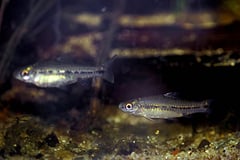
Enteromius sublineatus
Cyprinidae · (Daget, 1954)
Enteromius sublineatus is a widespread West African barb found in river basins from Senegal east to Cameroon, including the Niger and Volta. It is very variable in patterning and can be difficult to identify: Upper Niger fish show three elongate midlateral markings, Middle Niger fish a continuous band and Volta fish four spots. It may prove to be a complex of closely-related species. Little is known of its captive care.
Gymnarchus niloticusAba Aba
Gymnarchidae · authority not recorded
The aba aba, Gymnarchus niloticus, is a large predatory fish from much of the northern half of Africa, and the only species in its genus. An extended dorsal fin gives it the alternative name upside-down knifefish, although it is more closely related to the mormyrids, and it uses a weak electrical discharge to navigate and communicate. Growing to 165 cm and extremely aggressive, it is simply not suited to the home aquarium in any respect.
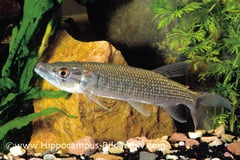
Hepsetus odoeAfrican Pike Characin
Hepsetidae · authority not recorded
The African pike characin, Hepsetus odoe, is a predatory characin of West and Central Africa, found from the Sassandra in Ivory Coast to Kribi in Cameroon and in the Niger, Volta and Chad basins. It is an ambush predator with a fearsome set of teeth that superficially resembles the European pike. Juveniles appear in the trade, but it reaches 70 cm in nature and is strictly for the specialist with a very large aquarium.
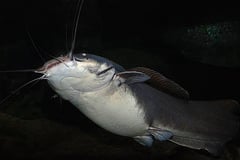
Heterobranchus longifilisVundu
Clariidae · authority not recorded
The vundu, Heterobranchus longifilis, is a clariid catfish widespread throughout Africa and one of the largest freshwater fishes on the continent. Growing to 150 cm, it is highly predatory, must be kept alone, and suits only public aquaria or a hobbyist able to house it properly. Its very long adipose fin separates it from similar members of the genus.

Oreochromis niloticusNile Tilapia
Cichlidae · (Linnaeus, 1758)
The Nile tilapia, Oreochromis niloticus, is a cichlid with a very wide natural range in Africa, from Senegal east to Egypt and Uganda. Bred in huge numbers as a food fish, it has been introduced to over 70 other countries and is one of the most invasive fish species in the world. It reaches 60 cm, though usually around 35 cm, breeds readily, is very messy and does not make a good aquarium subject.
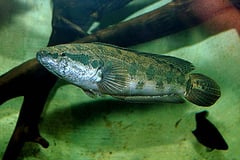
Parachanna obscuraAfrican snakehead
Channidae · authority not recorded
The African snakehead, Parachanna obscura, is widespread in West Africa from Senegal to Cameroon and ranges inland across the continent to Sudan. The most commonly seen African Parachanna, it is hard to tell apart from the rarely imported P. insignis. It will eat any fish less than two thirds its size and is best kept alone. Both parents guard the eggs among surface vegetation, and the female is said to feed the fry with infertile eggs.
Polypterus bichirNile Bichir
Polypteridae · Lacepède, 1803
The Nile bichir, Polypterus bichir, is a large bichir recorded from Egypt, Kenya, Ethiopia and Chad west to Nigeria, Ghana and Guinea-Bissau. It grows to 72 cm, though rarely that large in aquaria, and belongs to the 'lower-jawed' group of Polypterus. It will eat any tankmate it can fit in its mouth, and needs a tight-fitting cover as an excellent escape artist.
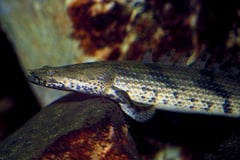
Polypterus endlicheriiSaddled Bichir
Polypteridae · Heckel, 1847
The saddled bichir, Polypterus endlicherii, is a nocturnal bichir recorded from ten African countries including Cameroon, Nigeria and Sudan. It lives in rivers and marshy areas and is occasionally found in brackish water around mangroves. One of the 'lower-jawed' tribe of Polypterus, it can reach 75 cm, though rarely in captivity, and a fully grown fish needs a very large aquarium. Like other bichirs it breathes atmospheric air and can drown if denied access to it. It is still often sold as Polypterus endlicheri.
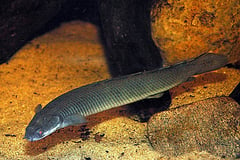
Polypterus senegalusSenegal Bichir
Polypteridae · Cuvier, 1829
The Senegal bichir, Polypterus senegalus, is the most widespread bichir, found in 26 African countries including Egypt and Senegal. It is usually found in shallow, slow-moving swamps, marshes and freshwater lagoons. One of the more peaceful and active Polypterus, it reaches 50 cm, is recommended for beginners with these fish, and has lived for over 30 years in aquaria.
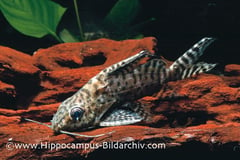
Synodontis eupterusFeatherfin Synodontis
Mochokidae · Boulenger, 1901
The featherfin Synodontis, Synodontis euptera, is a catfish from Nigeria, Cameroon, Mali, Ghana, Sudan, Chad and Niger. Juveniles are often sold as Synodontis 'Network' for their reticulated pattern, with no hint of an adult size of up to 300 mm SL. The pattern breaks up into simple spots with age as the long extensions of the 'feathered' dorsal fin develop. It can live for over 15 years in the aquarium.
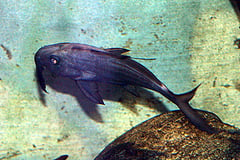
Synodontis membranaceusMoustache Catfish
Mochokidae · (Geoffroy Saint-Hilaire, 1809)
The moustache catfish, Synodontis membranaceus, is a large mochokid widespread in Africa, from Egypt and Sudan to Senegal and Nigeria. Its 'moustache' is a membrane along the maxillary barbels. It feeds mainly on plankton, filtered through its many gill rakers, and often feeds at the surface upside down. Often sold as a spotted juvenile, it can reach 50 cm and becomes territorial with conspecifics as it matures.
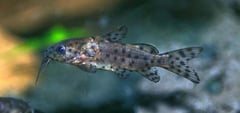
Synodontis nigritaFalse Upside-down Catfish
Mochokidae · authority not recorded
The false upside-down catfish, Synodontis nigrita, is a widespread Synodontis recorded from eleven African countries, among them Nigeria and Mali. Often sold as the upside-down catfish, it inverts far less often than the true one, S. nigriventris, and grows far larger, so adults returned by owners are a common sight in shops. It is also confused with the similar but smaller S. robbianus, from which its greyish base colour separates it.
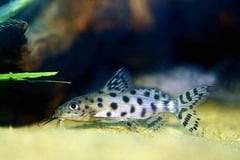
Synodontis ocelliferOcellated Synodontis
Mochokidae · authority not recorded
The ocellated Synodontis, Synodontis ocellifer, is a catfish from Nigeria, Gambia, Chad, Cameroon, Senegal, Mali, Ghana, Niger and Guinea. Often confused with similar Synodontis, it is distinguished by its very long adipose fin. One of the hardiest Synos available, it becomes slightly territorial as it matures, and many hybrids of it have been appearing on the market.
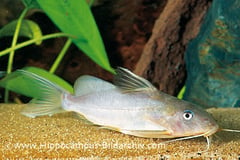
Synodontis schall
Mochokidae · authority not recorded
Synodontis schall is a large, predatory Synodontis catfish recorded from seventeen African countries, among them Nigeria, Egypt and Kenya. Regarded as the 'bad boy' of the genus in aquarium circles, it grows to 375 mm SL, is randomly aggressive and will eat smaller fish, so it should be kept only with tankmates that can stand their own ground. It is an important food fish in some of its native countries.

Ctenopoma kingsleyaeTailspot Ctenopoma
Anabantidae · authority not recorded
The tailspot ctenopoma, Ctenopoma kingsleyae, is an anabantoid with an enormous range, recorded from Mauritania and Senegal to Gabon and the DR Congo. One of the more aggressive members of the genus, it can be particularly nasty towards conspecifics and will eat small fish. It is named after the explorer Mary Kingsley, and there are reports of specimens surviving in aquaria for over 30 years.
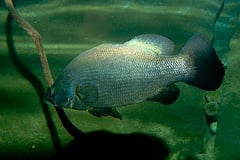
Lates niloticusNile Perch
Latidae · authority not recorded
The Nile perch, Lates niloticus, is a giant predatory fish from Central and Western Africa, reaching 193 cm and up to 200 kg. Introduced into many African countries as a food fish, it is thought to have contributed to the extinction of over 200 endemic species in Lake Victoria, and the IUCN lists it among the world's top 100 invasive species. Juveniles turn up in some aquatic stores, but it is not suited to captive life in any respect.
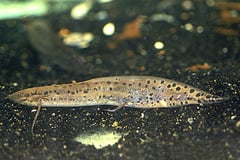
Protopterus annectensAfrican Lungfish
Protopteridae · (Owen, 1839)
The African lungfish, Protopterus annectens, is a lungfish found in 17 African countries, including Senegal, Nigeria, Kenya and Sudan. It inhabits temporary floodplains that dry out completely for part of the year and survives the dry season by aestivating in a mucus cocoon, for several years if need be. The most commonly seen lungfish in the hobby, it reaches 100 cm, bites hard and is best kept singly.
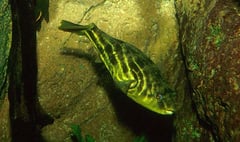
Tetraodon lineatusFahaka Puffer
Tetraodontidae · authority not recorded
The fahaka puffer, Tetraodon lineatus, is a large freshwater puffer from lakes and rivers across northern and West Africa, reaching 43 cm. Also known as the Nile puffer, it was previously named T. fahaka. One of the most aggressive puffers available, it learns to interact with its owner, but should be kept alone and needs no salt in its water.