Corydoras acutus
Blacktop Cory
Last revised 2026Edit this page
On this page9 sections
Quick factsEdit
Difficulty5 of 8 measures
- Space
- medium tank
- Water
- flexible
- Temp
- flexible
- Diet
- unknown
- Temperament
- unknown
- Social
- needs to be in a group
- Compatibility
- fine with others
Other demands
Each of these can raise the rating on its own, whatever the measures above say.
- Hardiness
- unknown
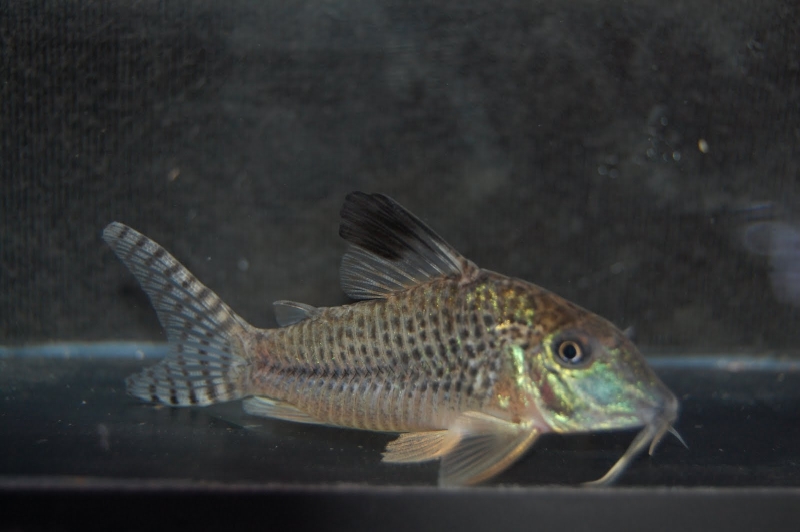
The blacktop cory, Corydoras acutus, is an armoured catfish from the upper Amazon basin in Brazil, Peru, Ecuador and possibly Bolivia. It can be confused with three similar fishes known as C024, C077 and C109. C024 and C109 occur thousands of kilometres outside its range, but C077 lives alongside it in the rio Abunã and is only known to differ in growing smaller. Some specimens lack the dark marking in the dorsal fin.
Etymology
EditCorydoras: from the Ancient Greek κόρυς (korus), meaning ‘helmet’, and δορά (dora), meaning ‘skin, hide of an animal’, in allusion to the rows of bony plates on the flanks of genus members.
acutus: from the Latin acutus, meaning sharpened, in allusion to the shape of the species' snout.
Distribution
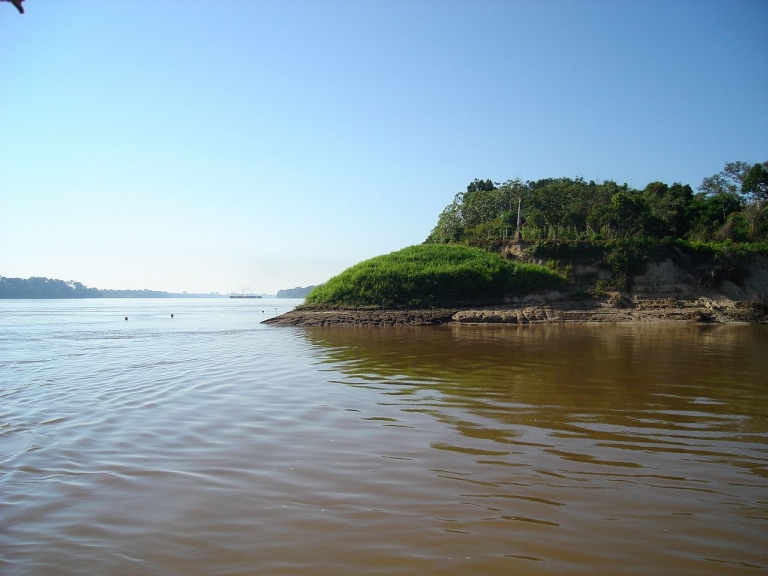
EditType locality is 'Río Ambiyacu, Shansho Caño, Loreto, Peru', with 'Ambiyacu' an apparent misspelling of 'Ampiyacu', a small river running into the Amazon west of the town of Pebas.
It's currently understood to occur throughout parts of the upper Amazon basin in Brazil, Peru, Ecuador, and possibly Bolivia, including the rios Yavarí, Abunã (rio Madeira system), Nueva Rocafuerte (Río Napo system), and Huitoyacu (Río Marañón system).
Unsurprisingly given this relatively large range, it can vary somewhat in appearance depending on collection locality with some specimens lacking a dark marking in the dorsal-fin, for example.
Maintenance
Write a noteEditIdeally use a substrate of fine sand, although rounded gravel is an acceptable alternative provided it's kept scrupulously clean.
Other décor is largely down to personal choice, but some cover should be provided to give the fish security.
Water conditions
EditDiet
Write a noteEditCorydoras spp. are foraging omnivores and will accept most sinking dried foods, as well as small live and frozen varieties such as bloodworm, Tubifex, etc.
Feeding a varied diet will ensure the fish are in optimum condition.
Under no circumstances should they be expected to survive on 'left-overs' from other inhabitants of the aquarium or relied on to 'clean' the aquarium.
These recommendations come from this profile’s own figures. They contain affiliate links, so we may earn a commission.
Sexual dimorphism
Write a noteEditFemales tend to grow larger, and sexually mature individuals are noticeably rounder and broader-bodied than males, especially when gravid.
Notes
EditThis species can be confused with three similar-looking fishes of uncertain taxonomic status which have been assigned the C numbers C024, C077, and C109 in the aquarium hobby.
C024 and C109 are unlikely to be conspecific in that they occur in Pará state, Brazil, several thousand kilometers outside the range of C. acutus, in the rio Guamá (Tocantins drainage), and lower rio Xingu, respectively.
However in the rio Abunã, a tributary of the Madeira in Acre state, Brazil, C077 occurs sympatrically with C. acutus and a similarly-patterned, short-snouted form known to hobbyists as C076.
C. acutus apparently grows larger than C077, but additional diagnostic characters are lacking at this time.
The original description by Cope is very short and reproduced here:
'A stout species, differing from the others, especially in the attenuation of the muzzle, which viewed from above is narrow, and contracted abruptly from the general outline. Mouth inferior, lower lip wanting or not reverted. Head 3.1 times in length without caudal, 1.33 times in depth. Orbit three times in head, 1.33 times in the nearly flat interorbital space. Lateral scuta 22-21; no azygus plates. Radii D. I. 7; A. I. 6; V. 6; P. I. 5, the spines serrate on the inner side. Dorsal spine serrate posteriorly on the distal half. Adipose spine without fin, stouter than anal spine. Caudal fin furcate.
Color olive (faded), a faint pale band on each side; a large black spot on distal part of dorsal rays. Caudal with four vertical bars; clavicle and operculum with blue reflections. Length .051 m., depth .0155 m.'
The genus Corydoras held over 150 valid species until Dias et al. (2024) divided it into five genera.
It is included in the family Callichthyidae, of which members are often referred to collectively as 'armoured' or 'mailed' catfishes group due to the presence of bony plates in place of scales on the body.
Their taxonomy can be confusing, and numerous undescribed species are also thought to exist.
Fish of unconfirmed identification entering the aquarium hobby are therefore typically assigned a 'C' or 'CW' number for purposes of reference and organisation.
They are facultative air breathers and possess a modified, highly vascularised intestine which has evolved to facilitate uptake of atmospheric oxygen and aid survival in oxygen-deprived environments. In the aquarium you'll occasionally see them rising to the surface to take in gulps of air.
The stiffened pectoral-fin spines are capable of piercing human skin and a 'sting' can be very painful indeed, so care should be exercised when handling them.
It is thought that secretions from the axillary glands at the base of each spine may even be mildly toxic or venomous.
References
- Reis, R. E., S. O. Kullander and C. J. Ferraris, Jr. (eds) (2003). Check list of the freshwater fishes of South and Central America. CLOFFSCA. EDIPUCRS, Porto Alegre, i-xi + 1-729
- Fuller, I. A. M., and H-G. Evers (2005). Identifying Corydoradinae Catfish. Verlag A.C.S. GmbH, 1-384
- Cope, E. D. (1872). On the fishes of the Ambyiacu River. Proceedings of the Academy of Natural Sciences of Philadelphia v. 23, 250-294
- Ferraris, C. J., Jr. (2007). Checklist of catfishes, recent and fossil (Osteichthyes: Siluriformes), and catalogue of siluriform primary types. Zootaxa 1418, 1-628
Species images · 2
These photographs are used with each photographer's permission.
Send a photographDistribution
Profile completeness17 of 24
71% complete
Also missing: aquarium size, habitat, aquarium size notes, water condition notes, behaviour and compatibility, reproduction.
Community
Questions about Corydoras acutus?
Ask on Discord