Country · Africa
Gambia
Only species with a profile on Seriously Fish are counted, whether native or introduced.
- Species
- 15
- Families
- 11
- Genera
- 11
- Found only here
- 0
- Photographed
- 13 of 15
The country
These figures are from Wikidata, checked on 24 October 2026.
Shares its fishes withspecies recorded in both

Bryconalestes longipinnisLong-finned Tetra
Alestidae · (Günther, 1864)
The long-finned tetra, Brycinus longipinnis, is an alestid characin from West Africa, found from Gambia to the Democratic Republic of Congo and Gabon. It inhabits large rivers and, unusually for the genus, also moves into smaller streams and lightly brackish estuaries. Not imported often, it ships poorly but usually proves hardy once acclimatised, though it is very sensitive to deteriorating water conditions.
Gymnarchus niloticusAba Aba
Gymnarchidae · authority not recorded
The aba aba, Gymnarchus niloticus, is a large predatory fish from much of the northern half of Africa, and the only species in its genus. An extended dorsal fin gives it the alternative name upside-down knifefish, although it is more closely related to the mormyrids, and it uses a weak electrical discharge to navigate and communicate. Growing to 165 cm and extremely aggressive, it is simply not suited to the home aquarium in any respect.
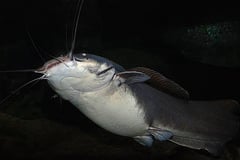
Heterobranchus longifilisVundu
Clariidae · authority not recorded
The vundu, Heterobranchus longifilis, is a clariid catfish widespread throughout Africa and one of the largest freshwater fishes on the continent. Growing to 150 cm, it is highly predatory, must be kept alone, and suits only public aquaria or a hobbyist able to house it properly. Its very long adipose fin separates it from similar members of the genus.

Oreochromis niloticusNile Tilapia
Cichlidae · (Linnaeus, 1758)
The Nile tilapia, Oreochromis niloticus, is a cichlid with a very wide natural range in Africa, from Senegal east to Egypt and Uganda. Bred in huge numbers as a food fish, it has been introduced to over 70 other countries and is one of the most invasive fish species in the world. It reaches 60 cm, though usually around 35 cm, breeds readily, is very messy and does not make a good aquarium subject.
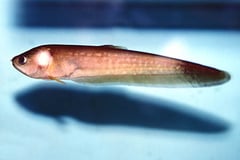
Papyrocranus aferArowana Knifefish
Notopteridae · authority not recorded
The arowana knifefish, Papyrocranus afer, is a notopterid knifefish widespread over much of western and central Africa, from Senegal to Sudan. Its anal and caudal fins are fused into one long, undulating fin. Infrequently imported, it grows to 80 cm and becomes increasingly territorial as it matures, so it is recommended only to the experienced fishkeeper and best kept as a single specimen.
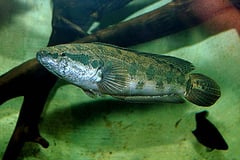
Parachanna obscuraAfrican snakehead
Channidae · authority not recorded
The African snakehead, Parachanna obscura, is widespread in West Africa from Senegal to Cameroon and ranges inland across the continent to Sudan. The most commonly seen African Parachanna, it is hard to tell apart from the rarely imported P. insignis. It will eat any fish less than two thirds its size and is best kept alone. Both parents guard the eggs among surface vegetation, and the female is said to feed the fry with infertile eggs.
Polypterus bichirNile Bichir
Polypteridae · Lacepède, 1803
The Nile bichir, Polypterus bichir, is a large bichir recorded from Egypt, Kenya, Ethiopia and Chad west to Nigeria, Ghana and Guinea-Bissau. It grows to 72 cm, though rarely that large in aquaria, and belongs to the 'lower-jawed' group of Polypterus. It will eat any tankmate it can fit in its mouth, and needs a tight-fitting cover as an excellent escape artist.
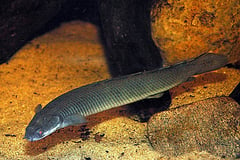
Polypterus senegalusSenegal Bichir
Polypteridae · Cuvier, 1829
The Senegal bichir, Polypterus senegalus, is the most widespread bichir, found in 26 African countries including Egypt and Senegal. It is usually found in shallow, slow-moving swamps, marshes and freshwater lagoons. One of the more peaceful and active Polypterus, it reaches 50 cm, is recommended for beginners with these fish, and has lived for over 30 years in aquaria.
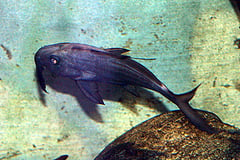
Synodontis membranaceusMoustache Catfish
Mochokidae · (Geoffroy Saint-Hilaire, 1809)
The moustache catfish, Synodontis membranaceus, is a large mochokid widespread in Africa, from Egypt and Sudan to Senegal and Nigeria. Its 'moustache' is a membrane along the maxillary barbels. It feeds mainly on plankton, filtered through its many gill rakers, and often feeds at the surface upside down. Often sold as a spotted juvenile, it can reach 50 cm and becomes territorial with conspecifics as it matures.
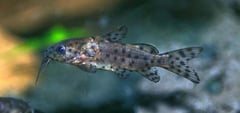
Synodontis nigritaFalse Upside-down Catfish
Mochokidae · authority not recorded
The false upside-down catfish, Synodontis nigrita, is a widespread Synodontis recorded from eleven African countries, among them Nigeria and Mali. Often sold as the upside-down catfish, it inverts far less often than the true one, S. nigriventris, and grows far larger, so adults returned by owners are a common sight in shops. It is also confused with the similar but smaller S. robbianus, from which its greyish base colour separates it.
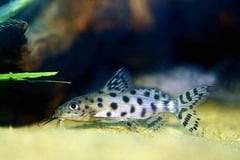
Synodontis ocelliferOcellated Synodontis
Mochokidae · authority not recorded
The ocellated Synodontis, Synodontis ocellifer, is a catfish from Nigeria, Gambia, Chad, Cameroon, Senegal, Mali, Ghana, Niger and Guinea. Often confused with similar Synodontis, it is distinguished by its very long adipose fin. One of the hardiest Synos available, it becomes slightly territorial as it matures, and many hybrids of it have been appearing on the market.
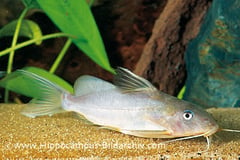
Synodontis schall
Mochokidae · authority not recorded
Synodontis schall is a large, predatory Synodontis catfish recorded from seventeen African countries, among them Nigeria, Egypt and Kenya. Regarded as the 'bad boy' of the genus in aquarium circles, it grows to 375 mm SL, is randomly aggressive and will eat smaller fish, so it should be kept only with tankmates that can stand their own ground. It is an important food fish in some of its native countries.

Ctenopoma kingsleyaeTailspot Ctenopoma
Anabantidae · authority not recorded
The tailspot ctenopoma, Ctenopoma kingsleyae, is an anabantoid with an enormous range, recorded from Mauritania and Senegal to Gabon and the DR Congo. One of the more aggressive members of the genus, it can be particularly nasty towards conspecifics and will eat small fish. It is named after the explorer Mary Kingsley, and there are reports of specimens surviving in aquaria for over 30 years.
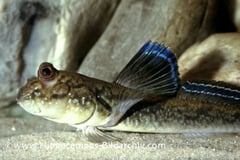
Periophthalmus barbarusAtlantic Mudskipper
Gobiidae · authority not recorded
The Atlantic mudskipper, Periophthalmus barbarus, is a highly amphibious goby from the west African coast, from Mauritania south to Angola. It lives on and around mudflats in estuarine mangrove swamps, so an aquarium needs exposed land and a very humid atmosphere at the same temperature as the water. Males are extremely territorial with one another, and a species tank is preferable in most cases.
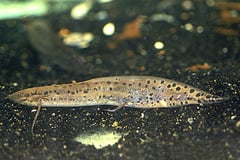
Protopterus annectensAfrican Lungfish
Protopteridae · (Owen, 1839)
The African lungfish, Protopterus annectens, is a lungfish found in 17 African countries, including Senegal, Nigeria, Kenya and Sudan. It inhabits temporary floodplains that dry out completely for part of the year and survives the dry season by aestivating in a mucus cocoon, for several years if need be. The most commonly seen lungfish in the hobby, it reaches 100 cm, bites hard and is best kept singly.