Country · Africa
Mozambique
Only species with a profile on Seriously Fish are counted, whether native or introduced.
- Species
- 11
- Families
- 4
- Genera
- 7
- Found only here
- 2
- Photographed
- 11 of 11
Shares its fishes withspecies recorded in both
Found only here2
2 of the species on this page are recorded in Mozambique and in no other country. This is not the same as being endemic.

Aristochromis christyi
Cichlidae · Trewavas, 1935
Aristochromis christyi is a predatory cichlid endemic to Lake Malawi, found throughout the lake but most commonly in intermediate zones. Growing to 300 mm SL, it is not particularly common in the lake or the hobby. Its beak-like mouthparts are adapted for hunting small fish in crevices between rocks, and it also ambushes prey, sometimes rolling onto its side as it approaches then taking it with a fast sideways motion.

Aulonocara hansbaenschiRed Shoulder Peacock
Cichlidae · Meyer, Riehl & Zetzsche, 1987
The red shoulder peacock, Aulonocara hansbaenschi, is a cichlid endemic to Lake Malawi, known from four localities on its southeastern shore. Some authors regard it as a geographical variant of the highly variable A. stuartgranti. It is also sold as the 'firebird cichlid' and 'red peacock'. At Masinje it shows a distinct preference for rocky caves and crevices in 3 to 6 metres of water, where most of the genus forage over sand.

Aulonocara jacobfreibergiMalawi Butterfly
Cichlidae · Johnson, 1974
The Malawi butterfly, Aulonocara jacobfreibergi, is a cichlid endemic to Lake Malawi, living where rocky shores give way to sand. One of the larger members of the genus, with males reaching 150 to 170 mm, it was among the first Aulonocara species in the hobby and is also sold as 'Freiberg's peacock' and 'fairy cichlid'. Males react aggressively to fish with a similar colour pattern, so tankmates need choosing with care.

Aulonocara sp. 'walteri'Blue-faced Peacock
Cichlidae · authority not recorded
The blue-faced peacock, Aulonocara sp. 'walteri', is a cichlid known only from Chizumulu Island and Likoma Island in Lake Malawi. The confusing trade name has led to it often being referred to incorrectly as 'Aulonocara walteri'. It inhabits the intermediate zones where rocky shores give way to sand, and males hold territories in caves. Males act aggressively towards any fish with a similar colour pattern, and other Aulonocara are best avoided as most can hybridise.

Aulonocara stuartgrantiGrant's Peacock
Cichlidae · Meyer & Riehl, 1985
Grant's peacock, Aulonocara stuartgranti, is a cichlid endemic to Lake Malawi, widely distributed along both the east and west coastlines. Males vary in colour by locality, with blue forms found mostly in the north of the lake and yellow in the south, and many populations are traded under their own names. That variation has caused taxonomic problems: A. baenschi, A. korneliae and A. hueseri were all once considered forms of it. It inhabits the intermediate zones where rocky shores give way to sand.

Butis butisCrazy Fish
Butidae · Hamilton, 1822
The crazy fish, Butis butis, is a flathead gudgeon of coastal and brackish waters across the Indo-Pacific, from eastern Africa to Fiji. The most commonly traded member of the genus, it has many other names, including crocodile fish, duckbill sleeper and upside-down sleeper. A nocturnal ambush predator, it often swims upside-down, and it is territorial and not sociable with conspecifics, so is best kept singly.

Champsochromis caeruleusMalawi Trout
Cichlidae · authority not recorded
The Malawi trout, Champsochromis caeruleus, is a large predatory cichlid endemic to Lake Malawi, where it roams from rocky shores to open water. Also known as the trout cichlid, it is only occasionally offered for sale because its solitary lifestyle makes it difficult to collect. It is told apart from C. spilorhynchus by its more elongate shape, and at up to 32.5 cm this active, pelagic species needs a tank of at least 180 x 60 x 60 cm.

Nimbochromis livingstonii
Cichlidae · (Günther, 1894)
Nimbochromis livingstonii is a predatory cichlid endemic to Lake Malawi, where it is fairly widespread. An ambush predator, it lies motionless on the substrate and its mottled pattern makes it appear dead to the smaller fish that come to investigate. This 'playing dead' behaviour gave it the local name 'Kaligono', loosely 'sleeper'. It is not a fish for the general Malawi cichlid community.

Nimbochromis venustusVenustus
Cichlidae · (Boulenger, 1908)
The venustus, Nimbochromis venustus, is a predatory cichlid endemic to Lake Malawi, where it is fairly widespread. Also sold as 'giraffe hap' or 'giraffe cichlid' after its pattern of irregular dark markings, it is an ambush predator that lies motionless on the substrate to take smaller fish. It is not a fish for the general Malawi cichlid community.
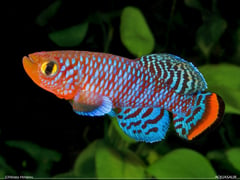
Nothobranchius rachoviiBluefin Nothobranch
Nothobranchiidae · Ahl, 1926
The bluefin nothobranch, Nothobranchius rachovii, is a killifish of seasonal pools and swamps in eastern Mozambique. Its habitats dry out for several months each year and the adults die, while the eggs survive in the substrate and hatch when the rains return. Northern and southern populations once included in it are now described as N. krysanovi and N. pienaari, and N. rachovii sensu stricto is restricted to the lower Pungwe and Zambezi basins.

Ctenopharyngodon idellaGrass Carp
Cyprinidae · Valenciennes, 1844
The grass carp, Ctenopharyngodon idella, is a large cyprinid native to the Amur River system in eastern Russia and northeastern China. Adults typically reach 800 to 1200 mm, making it a wholly unsuitable aquarium subject, though an albino form is traded. Widely introduced for aquaculture and weed control, it has caused serious damage to natural waters, and unwanted fish should never be released.